Author: Karan Singh Bisht

  • Article Writing for Class 9

    Article Writing for Class 9: Do you have creative ideas, strong opinions, or useful suggestions you’d like to express? Writing an article is a powerful way to share your thoughts with a wider audience. Whether your purpose is to inform, persuade, or entertain, learning the skill of article writing is essential. This guide will provide you with the key strategies, tips, and techniques to help you craft engaging and impactful articles that connect with your readers.

    Article Writing Class 9 Format, Topics, Examples

    Writing an article is much like following a recipe you need the right structure, clarity, and understanding to create something meaningful. For Class 9 students, article writing is not only an important academic skill but also a way to express ideas, opinions, and information effectively.

    This guide is designed to help Class 9 learners improve their article writing with simple tips and techniques. By mastering this skill, students will perform better in school assignments, exams, and also develop confidence in personal expression.

    To support your learning, we’ll make use of helpful resources such as NCERT solutions, Class 9 notes, and worksheets, all tailored to improve your grasp of article writing. With consistent practice and the right guidance, you can sharpen your writing skills and become proficient in crafting impactful articles.

    Article writing format class 9

    Title: (Catchy and relevant to the topic)

    Introduction

    • Start with a hook or an attention-grabbing statement to introduce the topic.
    • Provide some background information to set the context.
    • Clearly state the purpose or main idea of the article.

    Body Paragraphs

    • Organize your thoughts into paragraphs with each paragraph focusing on a different aspect related to the topic.
    • Use transition words and phrases to facilitate smooth flow between paragraphs.
    • Support your arguments with relevant examples, statistics, or anecdotes.
    • Maintain coherence and clarity in your writing.

    Additional Tips

    1. Maintain a formal tone throughout the article.
    2. Use appropriate vocabulary and sentence structures.
    3. Pay attention to grammar, punctuation, and spelling.
    4. Make sure your article is well-organized and easy to follow.
    5. Proofread your article before submission to check for any errors or inconsistencies.
    6. Remember to adhere to the word limit specified for the assignment.

    Must Read: Top 10 Science Project Ideas For Class 9

    Topics for Article Writing for Class 9

    Here’s a list of interesting and exam-friendly topics for Article Writing for Class 9:

    1. Importance of Cleanliness in Our Surroundings
    2. Say No to Plastic: A Step Towards a Greener Earth
    3. The Role of Students in Removing Social Evils
    4. Importance of Gender Equality in Today’s World
    5. Cyberbullying and Its Effects on Teenagers
    6. Importance of Reading Habits in Students
    7. Online Learning vs. Classroom Learning
    8. How to Overcome Exam Stress
    9. The Importance of Discipline in Student Life
    10. Value of Time Management for Students
    11. Dangers of Deforestation
    12. Importance of Renewable Energy Sources
    13. Technology: A Boon or a Bane?
    14. Save Water, Save Life
    15. Global Warming and Climate Change
    16. Importance of a Balanced Diet
    17. Yoga and Meditation for a Healthy Life
    18. How to Maintain Physical Fitness as a Student
    19. Impact of Junk Food on Health
    20. Importance of Sports in Student Life
    CBSE Class 9 Subject-wise Important Questions
    CBSE Important Questions for Class 9 Science
    CBSE Important Questions for Class 9 Maths
    CBSE Important Questions for Class 9 Social Science

    Article Writing for Class 9 Examples

    Here are a few examples of article topics suitable for Class 9 students along with sample articles:

    Article on The Importance of Physical Exercise

    Physical exercise plays a vital role in maintaining a healthy body and mind. In today’s world, where lifestyles are becoming increasingly sedentary due to technology and comfort, exercise has become more important than ever. Regular physical activity helps improve blood circulation, strengthens muscles and bones, and keeps diseases such as obesity, diabetes, and heart problems away.

    For students, exercise is equally significant. It not only keeps the body fit but also improves concentration, memory, and overall academic performance. Activities like running, cycling, yoga, or even a simple morning walk help release stress and refresh the mind. Exercise also instills discipline, time management, and the spirit of sportsmanship, which are essential qualities for overall personality development.

    Moreover, physical exercise promotes mental well-being. It reduces anxiety, lifts mood, and gives a sense of confidence. In a world filled with pressure and competition, exercise acts as a natural stress reliever.

    In conclusion, physical exercise is not just about building a strong body it is the foundation of a balanced and happy life. Every individual, especially students, must make it a daily habit to stay healthy, active, and ready to face life’s challenges.

    Do Check: Story Writing for Class 9

    Article on The Importance of Environmental Conservation

    Environmental conservation is one of the most urgent needs of our time. With rapid industrialization, deforestation, pollution, and population growth, the natural balance of our planet is under severe threat. If we do not act now, future generations will struggle for basic necessities like clean air, safe drinking water, and fertile soil.

    Conserving the environment means using natural resources wisely and protecting ecosystems from further damage. Planting trees, reducing plastic use, recycling waste, and adopting renewable energy sources are small but powerful steps towards conservation. Governments, organizations, and individuals must work together to promote sustainable development while protecting biodiversity.

    For students, environmental conservation carries a special responsibility. By spreading awareness, practicing eco-friendly habits, and participating in green initiatives, young people can contribute significantly to a healthier planet.

    Moreover, protecting the environment is not just about nature; it directly affects human survival. A safe and clean environment ensures better health, reduces natural disasters, and maintains ecological balance.

    In conclusion, environmental conservation is not a choice but a necessity. Every step we take towards protecting nature is an investment in the future. Together, we can create a cleaner, greener, and safer planet for all.

    Article on The Impact of Social Media on Teenagers

    In today’s digital age, social media has become an inseparable part of teenagers’ lives. Platforms like Instagram, WhatsApp, and YouTube provide a space for communication, learning, and entertainment. For many teenagers, social media is a tool to express creativity, stay updated with current affairs, and connect with friends and family across the world.

    However, the impact of social media is not entirely positive. Excessive use can lead to addiction, affecting studies, sleep, and overall health. Teenagers are often exposed to cyberbullying, unrealistic beauty standards, and misleading information, which may harm their mental well-being. Constant comparison with others online sometimes creates feelings of anxiety, loneliness, or low self-esteem.

    On the brighter side, if used wisely, social media can be a platform for learning new skills, spreading awareness, and building communities for positive causes. The key lies in maintaining balance and using these platforms responsibly.

    In conclusion, social media has both advantages and disadvantages for teenagers. It is important for young people to use it in moderation, focus on their real-life goals, and remember that virtual life should never replace real-life interactions and experiences.

    Also Read: CBSE Class 10 Blueprint 2026

    Write an article about the use and misuse of cell phones in students life

    In today’s bustling world, cell phones have become an indispensable part of student life. These pocket-sized gadgets serve as lifelines for communication, research tools for assignments, and even as sources of entertainment during breaks. However, amidst their benefits lie pitfalls, as the line between use and misuse blurs.

    Cell phones offer unparalleled convenience, allowing students to stay connected with peers and family, facilitating group study sessions, and providing instant access to educational resources. Whether it’s checking the syllabus, jotting down notes, or collaborating on projects, these devices have revolutionized the learning experience.

    Yet, with great power comes great responsibility. The allure of social media, gaming apps, and endless browsing can easily derail academic focus. The incessant pings of notifications beckon, tempting students to stray from their tasks. Consequently, productivity suffers, and time management becomes a challenge.

    Moreover, the over-reliance on cell phones can impede real-world interactions. Face-to-face communication skills may dwindle as screen time increases, leading to difficulties in social situations and professional settings. It’s crucial for students to strike a balance between virtual and physical connections to foster holistic growth.

    Furthermore, the misuse of cell phones extends beyond personal impact, affecting academic integrity. The temptation to cheat via text messages, photos, or accessing unauthorized resources during exams poses ethical dilemmas. Such actions not only undermine the learning process but also erode the foundation of trust within educational institutions.

    To mitigate these issues, education on responsible cell phone usage is imperative. Schools and universities should incorporate digital literacy programs into their curriculum, teaching students about the ethical use of technology, time management strategies, and the importance of maintaining a healthy balance between screen time and offline activities.

    Additionally, fostering a culture of mindfulness and self-regulation can empower students to make informed choices regarding their cell phone usage. Encouraging designated phone-free zones during classes and study sessions can promote focused learning environments conducive to academic success.

    In conclusion, while cell phones have undoubtedly enriched student life, their misuse can impede academic progress and personal development. By promoting responsible usage and providing necessary support mechanisms, we can harness the full potential of these devices while safeguarding the well-being of our students. Let’s navigate the digital wave together, ensuring that cell phones remain tools for empowerment rather than distractions.

    Article Writing Class 9 Tips for Students

    Article writing is an important part of the Class 9 English curriculum. It not only tests a student’s writing skills but also helps them express ideas in a structured and logical way. To write a good article, students should keep in mind a few simple tips.

    1. Understand the Topic: Read the question carefully and analyze what is being asked. Stay focused on the main theme without drifting away.
    2. Plan Before You Write: Make a rough outline with points for the introduction, body, and conclusion. This helps in organizing thoughts clearly.
    3. Write a Catchy Introduction: Start with a fact, quote, or question to grab the reader’s attention.
    4. Use Clear Language: Avoid complicated words. Write in simple, correct English to ensure your ideas are easily understood.
    5. Maintain Paragraphs: Divide the article into short paragraphs – one for introduction, a few for the body, and one for conclusion.
    6. Stick to Word Limit: Follow the word limit given in the exam (usually 150–200 words).
    7. End Strongly: Conclude with a suggestion, solution, or impactful statement.

    In short, with proper planning, clear language, and practice using Class 9 notes, NCERT solutions, and worksheets, students can easily master article writing.

    CBSE Class 9 Syllabus 2025-26: Subject wise Links
    CBSE Class 9 Syllabus Maths
    CBSE Class 9 Syllabus Science
    CBSE Class 9 Syllabus Hindi
    CBSE Class 9 Syllabus English
    CBSE Class 9 Syllabus Social Science
    CBSE Class 9 Syllabus AI 
    CBSE Class 9 Syllabus IT 
  • Animal Cell Diagram Class 11

    Cells are the basic building blocks of life. Just like bricks form a house, cells form the structure of all living organisms. In this blog, we’ll explore the animal cell diagram in detail, understand its structure, organelles, and functions. By the end, you’ll not only be able to draw and label an animal cell but also explain the importance of each part.

    1. Overview of Animal Cell

    • Definition: An animal cell is the smallest unit of life in animals, responsible for performing essential biological functions.

    • Characteristics: Eukaryotic (has a nucleus), lacks a cell wall and chloroplasts (unlike plant cells), and contains multiple organelles.

    • Difference from plant cell: Animal cells do not have cell walls or plastids, but they have centrioles which are absent in most plant cells.

    Also Check: list of Biology Topics

     2. Structure of Animal Cell

    Animal cells are generally round or irregular in shape. Their main structural components include:

    • Cell Membrane – thin, flexible barrier controlling movement of substances.

    • Cytoplasm – jelly-like fluid where organelles float.

    • Nucleus – control center containing genetic material (DNA).

    Also Check: Human Eye Diagram for Class 11

    3. Cell Organelles and Their Functions

    Each organelle performs a specific task, making the cell function like a miniature factory:

    • Mitochondria – generates energy (ATP); called the powerhouse.

    • Ribosomes – build proteins.

    • Endoplasmic Reticulum (ER)

    • Rough ER: synthesizes proteins.

    • Smooth ER: synthesizes lipids and detoxifies.

    • Golgi Apparatus – modifies, packages, and transports proteins.

    • Lysosomes – digest waste and worn-out cell parts; the “suicidal bags.”

    • Centrioles – help in cell division.

    • Cytoskeleton – provides shape and internal support.

    4. Nucleus in Detail

    The nucleus acts as the brain of the cell, regulating growth and reproduction. It has:

    • Nuclear membrane – protective covering.

    • Nucleoplasm – fluid inside.

    • Chromatin – genetic material (DNA + proteins).

    • Nucleolus – makes ribosomes.

    Do Check: Concave Mirror Ray Diagram

    5. Functions of Animal Cell

    • Supports growth and repair of tissues.

    • Produces energy needed for body processes.

    • Synthesizes proteins and other molecules.

    • Facilitates transport of substances across the cell.

    • Carries out cell division (mitosis and meiosis).

    6. Animal Cell Diagram

    A well-labeled animal cell diagram usually includes:

    • Cell membrane

    • Cytoplasm

    • Mitochondria

    • Ribosomes

    • ER

    • Golgi apparatus

    • Nucleus and nucleolus

    • Lysosomes

    • Centrioles

    📍 Tip for students: Always use clean labels and indicate organelles clearly with arrows in your diagram for exams.

    7. Applications & Importance

    Understanding the animal cell is important for:

    • Biology & Medicine – explains how tissues and organs function.

    • Genetics – helps in studying DNA, genes, and heredity.

    • Medical research – cell study leads to treatments for diseases like cancer.

    • Biotechnology – foundation for innovations like stem cell therapy.

    Conclusion

    The animal cell diagram is more than just a chapter in biology – it’s a window into how life functions at its most basic level. By mastering the structure and functions of animal cells, students gain a deeper understanding of biology and its applications in medicine, genetics, and biotechnology.

  • Aikyashree Scholarship 2026

    The Aikyashree Scholarship 2026, launched by the West Bengal Minority Development and Finance Corporation (WBMDFC), continues to support minority students in West Bengal with financial aid for education. If you’re looking to apply or renew, this guide covers everything you need—from eligibility to application steps, documents, deadlines, and payment tracking.

    What is the Aikyashree Scholarship?

    The Aikyashree Scholarship is a state-funded financial assistance scheme for students from minority communities (Muslim, Christian, Sikh, Buddhist, Jain, and Parsee) in West Bengal. It aims to reduce dropout rates, promote higher education, and ensure equitable opportunities.

    The scheme has three major categories:

    • Pre-Matric (Class 1–10)
    • Post-Matric (Class 11–PhD)
    • Merit-cum-Means (Professional/Technical courses)

    Aikyashree Scholarship Eligibility Criteria for 2026

    Students applying in 2026 must meet the following requirements:

    • Residency: Must be a permanent resident of West Bengal.
    • Community: Belong to a recognized minority community.
    • Academic performance: Minimum 50% marks in the last qualifying exam.
    • Income: Annual family income ≤ ₹2.5 lakh.
    • Institution: Must be enrolled in a recognized school, college, or university in West Bengal.

    Key Dates for Aikyashree 2026

    • Application Start: Expected in July 2026
    • Last Date for Fresh & Renewal: Likely by October 2026
    • Institute Verification Deadline: November 2026
    • Payment Disbursement: From December 2026 onwards

    Do Check: Margadeepam Scholarship 2026 Application Form

    Aikyashree Scholarship Documents Required

    You will need:

    • Aadhaar Card
    • Minority Community Certificate
    • Income Certificate
    • Marksheet of last exam
    • Bank Passbook (with IFSC)
    • Institution verification form
    • Photograph & signature (as per portal size requirements)

    How to Apply Online for Aikyashree Scholarship 2026

    1. Visit Aikyashree Scholarship Portal
    2. Click New Registration → select your scheme (Pre-Matric/Post-Matric/Merit-cum-Means).
    3. Fill in personal, academic, and bank details.
    4. Upload required documents.
    5. Submit and download the acknowledgment.
    6. Submit the form to your institute for verification.

    Aikyashree Scholarship Renewal Process 2026

    If you already received the scholarship in 2024:

    • Login with your previous credentials.
    • Select Renewal Application 2026.
    • Update academic and bank details if needed.
    • Upload latest mark sheet.
    • Submit and verify at your institution.

    Aikyashree Scholarship Amount 2026

    Category Day Scholar (₹/month)Hosteller (₹/month)
    Pre-Matric 150
    Post-Matric (Class 11–12) 230
    Undergraduate 300
    Postgraduate 380
    Merit-cum-Means (Professional/Technical) up to ₹25,000/year

    Checking Application & Payment Status

    • Visit the official portal.
    • Click Track Application/Payment Status.
    • Enter your Application ID/DOB.
    • Check whether it shows Pending, Verified, Sanctioned, or Paid.

    If payment fails:

    • Verify bank account details.
    • Contact your institute’s Nodal Officer.
    • Use PFMS portal (pfms.nic.in) to track DBT status

    Do Check: HDFC Bank Parivartan’s ECSS Programme 2026

    Common Issues & Fixes

    1. Login errors: Clear cache or switch browser.
    2. OTP not received: Re-try after 15 minutes or use alternate mobile.
    3. Application rejected: Cross-check income/academic proof, reapply if window is open.

    Why Choose Aikyashree Scholarship?

    • Covers school to professional courses.
    • Transparent DBT payment system.
    • State-backed, reducing fraud risk.
    • Helps thousands of minority students every year.

    Conclusion

    The Aikyashree Scholarship 2026 is a major opportunity for minority students in West Bengal to continue their studies without financial stress. Apply early, keep documents ready, and track your status regularly.

  • Acknowledgement for Project Class 12 Design

    Acknowledgement for Project Class 12: Acknowledging others in a project report is crucial for high school studentsAn acknowledgement for project class 12 is a small but meaningful way to show gratitude to all the people who helped in making the project successful. It is usually written in a simple and clear way so that teachers and examiners can understand it easily. Many students look for ideas on how to write acknowledgement for project because it gives respect to the guidance of teachers, parents, and sometimes even friends.

    When we talk about specific subjects, for example an acknowledgement for English project class 12, it is written to thank the English teacher and others who guided during the work. In the same way, an acknowledgement for school project can be general and used for any subject or activity. It reflects politeness, honesty and also the human side of learning. For students, making a good acknowledgement for school project class 12 shows not only respect but also responsibility in academic writing.

    What is Acknowledgement for Project

    An acknowledgement for project is a small section in your file or report where the student or writer says thank you to all the people who helped in making the project possible. It is mostly seen in school project class 12, research work, or even college projects. This part gives respect to teachers, mentors, classmates, parents, or sometimes organizations that gave support. It can also include those who gave funding, ideas, or guidance during the study. Writing an acknowledgement for school project is not just formality, it is a way to show honesty and gratitude for the help received.

    Do Check: Chemistry Investigatory Project for Class 12

    How to Write a Unique Acknowledgement for Project

    1. Start with Gratitude: Begin with a warm line like “I am thankful to” or “I wish to express my gratitude to”. This makes the tone polite and positive.
    2. Mention People or Groups: Always add names of your teachers, guide, school, or friends who supported. If you are writing acknowledgement for english project class 12, you can also thank your English teacher directly.
    3. Say How They Helped: Write short lines about their role, like providing notes, ideas, encouragement, or resources. This shows your acknowledgement is real.
    4. Add Personal Touch: Share a small line about what you learn or how their help made the work easier. It feels more natural.
    5. Include School and Teacher Name: A good acknowledgement for school project class 12 must include official names, like subject teacher and school name, to make it formal.
    6. Group Thanks: If many people helped, thank them in groups. For example: “I am grateful to the Science Department for their constant support.”
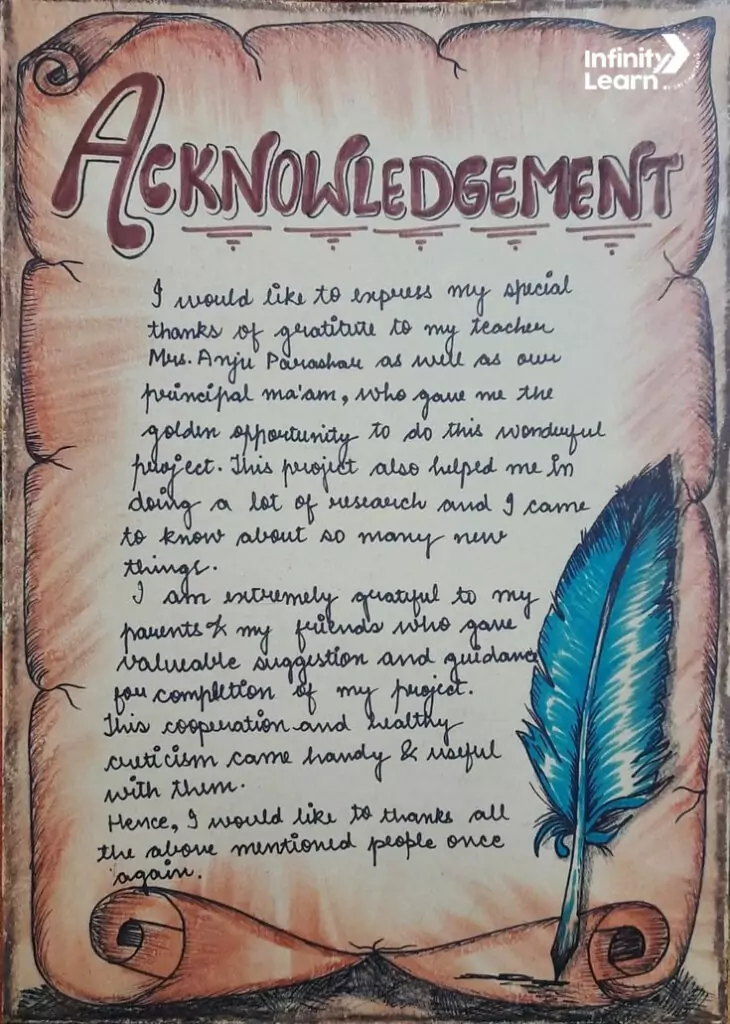
    7. Simple Example: “I am very thankful to my teacher Mrs. Sharma for guiding me in this project. I also thank my friends who shared ideas and supported me during the work. Special thanks to ABC School for giving me this opportunity and resources.”

    Do Check: Physics Investigatory Project for Class 12 Topics

    Acknowledgement for Project Class 12 Design

    Acknowledgement For Project Class 12 Samples

    I am very thankful to my respected teacher [Teacher’s Name] for his/her kind guidance and helpful support during my project work. Their suggestions and advice gave me right direction and made this project possible. Without their help, it would not be complete in good way.

    I also want to thank [School Name] for giving me the resources and chance to complete this project. The school environment and facilities helped me a lot in finishing the work smoothly.

    My special thanks to my classmates and friends for always standing with me, sharing ideas and helping when I needed. Their contribution made this project more better and useful.

    Lastly, I am very grateful to my family members for their patience, love and support. They always motivate me to learn new things and continue the hard work.

    This project is not just a file but also a learning journey for me.

    Acknowledgement For School Project File

    I would like to sincerely thank my teacher [Teacher’s Name] for always guiding me in right path and supporting me during this project. His/her encouragement gave me confidence to finish the work in time.

    I am also thankful to my principal [Principal’s Name] and the school management for giving me the opportunity and facilities which made this project more meaningful.

    My classmates and friends also helped me with their ideas, cooperation and teamwork. Their feedback and small suggestions improve my project quality.

    Finally, my family’s support and motivation is the main reason I could complete this project.

    Acknowledgement For English Project Class 12

    I want to express my heartfelt thanks to my English teacher [Teacher’s Name] and our respected principal [Principal’s Name] for allowing me to work on the topic [Topic Name]. Their encouragement and regular support helped me in completing this English project class 12 successfully.

    I am also very thankful to my friends, seniors and classmates who guided me and gave important advice in the making of this project. Their motivation and help saved me much time and improved my writing and research skills. Last but not least, I am grateful to my family for their continuous love, understanding and moral support in this academic journey.

    Acknowledgement For Physics Project Class 12

    I want to take this chance to say my true thanks to all who helped me in completing this Physics project. Writing an acknowledgement for project class 12 is not only a formality but also a way to show respect for teachers, mentors, and friends who support us.

    First of all, I am very thankful to [Teacher’s Name] and [School Name] for their constant support and helpful guidance. Their teaching made it easy to understand many Physics topics that were hard before.

    I also want to thank [Mentor’s Name] for their kind advice and useful suggestions which make this school project better and more clear.

    Finally, I am grateful to my classmates and friends, who gave small help, encouragement and motivation during this work. Without them this acknowledgement for school project class 12 will be incomplete.

    Acknowledgement For Chemistry Project Class 12

    It is my duty to write this acknowledgement for school project to show my thankfulness to everyone who supported me in preparing my Chemistry file.

    First, my special thanks to [Teacher’s Name] and [School Name] for giving the required resources and motivation during the project. Their support was very important to complete this Chemistry work in proper way.

    I also like to express gratitude to [Mentor’s Name] whose guidance and useful feedback added more value to this Chemistry project acknowledgement.

    Lastly, I appreciate the help of my classmates and friends who co-operated with me in many small but important tasks. This acknowledgement for project class 12 is also for them.

    Acknowledgement For Biology Project Class 12

    With humble words, I want to present my acknowledgement for Biology project class 12. It is really a teamwork of many people who helped me in this school project.

    I thank [Teacher’s Name] and [School Name] for their support and encouragement. Their teaching helped me understand many Biology concepts clearly.

    I am also thankful to [Mentor’s Name] for their valuable time and suggestions which improved the content of this project.

    Finally, I remember my classmates and friends for their encouragement and assistance. This simple acknowledgement is not perfect, but it is written with true feelings.

  • 3-Month JEE Main Study Plan 2026: Week-Wise Schedule, Subject Strategy & Mock-Test

    Students often search for the perfect roadmap to success, whether it’s a comprehensive 1 year study plan for JEE Mains or an intensive 1 month study plan for JEE Mains. While longer preparation is ideal, the reality for many—especially droppers—is a shorter, more focused timeline.

    This guide provides the best study plan for JEE Mains 2026 when time is critical. We will detail a powerful study plan for JEE Mains in 3 months, a 90-day super-sprint designed to help you achieve a 99 percentile. This strategy delivers strong outcomes because it follows a clear order: prioritise high-weightage units, practise with PYQs and mocks, and perfect through analysis-driven revision. The goal isn’t superficial 100% coverage; it’s about achieving reliable mastery of the 70-75% of the JEE Mains syllabus that contributes most to your score.

    Strategy: Prioritise → Practise → Perfect

    • Prioritise: Build the plan around chapters that frequently appear and connect to multiple questions.
    • Practise: Shift quickly from theory to problem blocks, chapter-wise PYQs, and sectional tests.
    • Perfect: Treat mock-analysis as compulsory study time; remove repeated errors with an error-register and cheat-sheet (formulas, standard results, common traps).

    Trend note: Weightage varies by shift. High-weightage units consistently include Calculus, Coordinate Geometry, Algebra, and Vectors & 3D in Mathematics; Modern Physics, Current Electricity, Magnetism/EMI, Optics in Physics; and NCERT-first coverage in Chemistry (Inorganic core, key Physical numericals, high-yield Organic).

    High-Weightage Topics for JEE Mains (PCM)

    • Mathematics: Calculus (Limits, Continuity & Differentiability, AOD, Integrals, Definite Integral), Coordinate Geometry (Straight Line, Circle, Conics), Algebra (Matrices & Determinants, Quadratic & Complex, P&C/Binomial core), Vectors & 3D, Probability.
    • Physics: Current Electricity; Magnetism & EMI; Modern Physics; Optics; Thermodynamics; Kinematics & Dynamics basics.

    Also Check: JEE Mains 2026 Physics Syllabus

    • Chemistry:
      • Inorganic: NCERT-line reading (P-Block highlights, Coordination basics).
      • Organic: GOC fundamentals, reaction mechanisms, named reactions.
      • Physical: Equilibrium, Electrochemistry, Kinetics, Thermodynamics; numerical discipline.

    Month 1: Foundation & Coverage (Weeks 1–4)

    Objective: NCERT Solution-aligned concept build in high-return areas; begin PYQs early.

    Week Physics Chemistry Mathematics
    W1 Units & Measurement; Kinematics Mole Concept; Atomic Structure Sets & Relations; Quadratic Equations
    W2 Laws of Motion; Work, Energy & Power Chemical Bonding; Thermodynamics Matrices & Determinants; Sequences & Series
    W3 Current Electricity; Basic Electrostatics Equilibrium (Physical/Ionic) Straight Lines; Circle
    W4 Ray Optics; Wave Optics (intro) Organic: GOC, Isomerism Limits; Continuity & Differentiability

    Weekly targets

    • Finish NCERT theory → selected exercises (R.D. Sharma Solutions in Maths; standard problem texts in Phy/Chem).
    • Solve chapter-wise PYQs (last 5–7 years).
    • Build one-page formula sheets and summary notes per chapter.
    • End-of-week mini-test (45–60 minutes) per subject.

    Month 2: Intensive Practice & Weak-Area Repair (Weeks 5–8)

    Objective: Aggressive problem-solving; add the next tier of important chapters; start sectional tests twice a week.

    Week Physics Chemistry Mathematics
    W5 Capacitors; EMF & Cells Electrochemistry; Solutions Applications of Derivatives
    W6 Magnetism & EMI Chemical Kinetics; Surface Chemistry Indefinite & Definite Integrals
    W7 Modern Physics (Photoelectric; Atoms/Nuclei) Inorganic: P-Block key groups Parabola; Ellipse; Hyperbola
    W8 Semiconductors; Communication basics Organic: Haloalkanes/Alcohols/Carbonyls Vectors & 3D; Probability

    Practice framework

    • Solve Practice Problems Daily: Every day, have two sessions just for solving practice questions, each lasting about 60 to 90 minutes. Make sure you tackle a mix of easy, medium, and hard problems.
    • Take Subject-Wise Tests Weekly: Twice a week for each subject (Physics, Chemistry, and Maths), take a short test of about 60 to 90 minutes to check your progress in that specific subject.
    • Fix Your Weak Spots: The day after a test, review every question you got wrong. Then, solve another 20 to 30 practice problems from those specific topics to strengthen your weak areas.
    • Review Everything on Sunday: Use Sunday to revise what you learned during the week. Do this by solving a mixed set of problems from all three subjects and taking a short, less intense mock test.

    Also Check: JEE Advanced 2026: Exam Dates, Eligibility, Syllabus & Exam Pattern for IIT Admissions

    Month 3: Final Revision and Mock Tests (Weeks 9 to 12)

    In this month your goal should be all about locking in your knowledge, getting used to the real exam pressure, and fixing any last-minute mistakes. You’ll also start practicing at the exact time of the real exam to get your body and mind ready.

    Weekly Plan

    Weeks What to Focus On Minimum Number of Tests
    Weeks 9–10 Go through your entire syllabus for the first time using the short notes and formula sheets you’ve made. Take 3 to 4 full mock tests per week.
    Weeks 11–12 Go through the full syllabus a second time, this time focusing on improving your speed and accuracy. Also, make sure you have your admit card and ID ready for exam day. Take one full mock test every day.

    How to Analyze Your Mock Tests (Do this after every test)

    This is the most important part of your final month. Don’t just take tests; learn from them.

    • Find the Type of Mistake: For every wrong answer, figure out why you got it wrong. Was it a concept you didn’t know? A silly calculation error? Did you run out of time? Or did you just read the question incorrectly?
    • Keep a Mistake Notebook: Write down each question you got wrong and the simple reason for the mistake. For example: ‘Q.56 – Physics – Forgot the formula for torque.’
    • Fix Your Mistakes Quickly: Try to solve all your incorrect questions again within a day or two. If you notice you’re repeatedly making the same type of mistake, add that tip to a final ‘cheat-sheet’ for revision.
    • Practice Your Weak Spots: If you keep getting stuck on a particular type of problem (like projectile motion), spend 5 minutes solving just that type of question right before you start your next mock test. This helps warm up your brain for your weak areas.

    JEE Mains Daily Timetables for (School-Going & Droppers)

    JEE Mains Daily time table for School-Going Students

    Slot Task
    05:30–07:00 Formula/summary review + 10 quick PYQs (rotating subject)
    16:00–18:30 New concept block (alternate subjects)
    20:00–22:00 Problem block + error-register repair
    Weekly 1 sectional test/subject; Sunday: light mock + analysis

    JEE Mains 2026 Titme Table for Droppers

    Slot Task
    08:00–10:30 Concept block (new chapter)
    11:30–14:00 Problem block (topic drills)
    16:00–18:00 Chapter-wise PYQs
    19:00–21:00 Mixed set/sectional test; 30-minute same-day analysis

    Subject-Wise Strategy for JEE Main Preparation

    A successful JEE Main preparation strategy requires a tailored approach for each subject. You cannot study Physics the same way you study Inorganic Chemistry. This subject-wise playbook provides a clear, actionable plan to master Physics, Chemistry, and Mathematics.

    JEE Physics Strategy: Concepts and Application

    Physics in JEE Main tests your conceptual clarity and problem-solving speed. This JEE Physics strategy is designed to build both.

    • Priority High-Weightage Topics: To maximize your score, your primary focus should be on units that offer the best return on time invested. Prioritize:
      • Current Electricity
      • Magnetism & EMI
      • Modern Physics
      • Optics
      • Thermodynamics
    • Method for Success:
      • Create Compact Notes: Maintain a separate notebook for short notes that include compact derivations of important formulas and lists of standard results (e.g., Moment of Inertia of different objects).
      • Use Dimensional Checks: Make it a habit to verify the dimensional consistency of your answers in numerical problems. It’s a fast and effective way to catch errors.
    • Practice Drills:
      • Focus on solving a variety of numericals, paying strict attention to correct units and significant figures. A key part of an effective JEE Physics strategy is maintaining an error log. Tag every mistake you make by type (e.g., ‘Silly Mistake,’ ‘Calculation Error,’ or ‘Concept Error’) to identify and fix your weak patterns.

    JEE Chemistry Strategy: A Balanced Approach

    The best JEE Chemistry strategy involves giving equal and appropriate attention to its three distinct parts.

    • Inorganic Chemistry:
      • The strategy is simple: master your NCERT textbooks line-by-line. Questions are often asked directly from the text. Focus on memorizing tables, periodic trends, and the basics of coordination compounds. Use frequent, short quizzes on chapters like p-block elements to ensure strong retention.
    • Organic Chemistry:
      • A strong grasp of GOC (General Organic Chemistry) is non-negotiable as it forms the foundation for all other topics. Your focus should be on understanding reaction mechanisms and named reactions. A great technique is to create mind maps for each functional group and use flashcards for quick revision of reagents and reaction patterns.
    • Physical Chemistry:
      • This section is all about numerical practice from key chapters like Equilibrium, Electrochemistry, and Chemical Kinetics. The most effective method is to solve problems in a stepwise manner, maintain a comprehensive formula sheet, and always perform ‘unit sanity checks’ to ensure your final answer’s units are correct.

    JEE Maths Strategy: Practice, Speed, and Accuracy

    A successful JEE Maths strategy is built on consistent practice to master core topics and build incredible speed.

    • Core High-Weightage Topics: Your preparation should be built around these essential units:
      • Calculus: (Limits, Continuity & Differentiability, AOD, Integrals, Differential Equations)
      • Coordinate Geometry: (Straight Lines, Circles, Conics)
      • Algebra: (Matrices & Determinants, Quadratic/Complex Numbers, P&C, Binomial Theorem)
      • Vectors & 3D Geometry and Probability.
    • Practice Approach:
      • Divide your practice time evenly: 50% for concept drills (solving single-chapter problems) and 50% for mixed problem sets to improve speed and simulate exam conditions.
      • Attempt a full-length 90-minute Maths test weekly.
      • Maintain a “standard results” sheet with important formulas, theorems, and identities for your JEE Main revision plan.

    Also Check: JEE Main 2026 Maths Syllabus- Chapter-wise Weightage and Important Topics

    How to Use PYQs & Mock Tests to Score 99 Percentile in JEE Main

    Your knowledge is only potential energy until you convert it into a high score. This framework for using Previous Year Questions (PYQs) and mock tests is the engine that will power your performance.

    • How to Use Previous Year Questions (PYQs):
      • Month 1: Solve chapter-wise PYQs immediately after completing a chapter to solidify your understanding and learn the question patterns.
      • Month 2: Shift to solving full question papers from previous years (e.g., all papers from the 2024 sessions) to build stamina and practice time management.
    • Mock Test and Analysis Strategy:
      • The Target: Aim for a minimum of 15–20 full-length mock tests by the end of your 3-month plan. Supplement these with sectional tests twice a week during the last two months.
      • The Golden Rule of Analysis: The most critical part of your preparation is mock test analysis. Allocate time for analysis equal to the test duration (a 3-hour test deserves a 3-hour analysis).
      • Action Items: For every mock, identify at least three concrete “action items” to work on—for example, “1. Revise lens maker’s formula. 2. Be more careful with signs in integration. 3. Allocate less time to Chemistry to save time for Physics.”
      • Create an Error Log for JEE: This is the most powerful tool for improvement. Maintain a notebook with the following fields for every mistake you make:

    Error-register fields

    • Chapter/Topic → Question ID → Error type → Root cause → Fix planned → Re-attempt date → Status.

    The Final Countdown for JEE Mains: Your Last 30-Day Checklist

    The final month of your JEE Main preparation is not for learning new things. It’s a critical period for consolidation, strategy, and peaking at the right moment. This checklist breaks down your last 30 days into actionable phases.

    Phase 1: 30 Days to 15 Days Before the JEE Mains Exam

    Your goal in this phase is to complete a comprehensive revision and diagnose your final weak areas.

    • Complete Your First Full Revision: Go through the entire syllabus one last time using the short notes and formula sheets you’ve prepared.
    • Take 6-8 Mock Tests: Use these tests to identify recurring errors and build your stamina.
    • Revisit Weak Topics: Go back to your error log. Dedicate specific time slots to revise the chapters and concepts where you have consistently made mistakes.

    Phase 2: Last 14 Days to 8 Days Before the JEE Mains Exam

    The focus now shifts from revision to speed, accuracy, and confidence-building.

    • Start Your Second Revision Pass: Instead of re-reading everything, do “topic sprints”—quick, intensive revisions of chapters you are still not confident about.
    • Take 5-6 More Mock Tests: Keep your analysis sharp and focused. Crucially, stop learning any new topics now. Your goal is to perfect what you already know.

    Phase 3: The Final Week (7 Days to JEE Mains Exam)

    This week is all about staying calm, confident, and exam-ready.

    • Reduce Mock Test Frequency: Take a maximum of 3 to 4 mock tests. Your priority now is to align your sleep cycle with your exam slot to ensure peak performance on the final day.
    • Stay Sharp with Light Practice: Instead of heavy study, solve light sets of mixed problems to keep your mind active.
    • Get Your Logistics Ready: Print your admit card, arrange your photo ID, and finalize your travel plan to the exam center to avoid any last-minute stress.

    The key to success is not to study from every book available, but to master a few high-quality ones. This is the recommended resource stack for your JEE Main preparation.

    • Core Foundation (All Subjects):
      • NCERT Class 11 & 12 Textbooks: This is the absolute, non-negotiable baseline for Physics, Chemistry, and Mathematics.
    • Mathematics:
      • R.D. Sharma: Excellent for bridging the gap from board-level to JEE-level concepts.
      • Infinity Learn or Arihant Series: Choose one of these series for comprehensive practice and problem-solving.
      • Chapter-wise PYQ Bank: Essential for understanding the exam pattern.
    • Physics:
      • H.C. Verma (Concepts of Physics): The gold standard for building a strong conceptual foundation.
      • D.C. Pandey (Modules): A great resource for extensive numerical practice.
      • PYQ Collections: To master a wide variety of problem types.
    • Chemistry:
      • NCERT: The absolute core for Inorganic Chemistry.
      • O.P. Tandon or RC Mukherjee: For practicing numericals in Physical Chemistry.
      • A Standard Organic Practice Series: To master reaction mechanisms and conversions in Organic Chemistry.

    Common Mistakes in JEE Main Preparation

    Even the best students can falter by making these common mistakes. Here’s how to control them.

    • Mistake 1: Using Too Many Books
      • The Problem: Studying from too many sources reduces the depth of your preparation and leads to confusion.
      • The Control: Follow a “one-series rule” per subject for your main practice. Master that one resource completely.
    • Mistake 2: Taking Mock Tests Without Analysis
      • The Problem: Your scores will stagnate if you don’t learn from your mistakes.
      • The Control: Make the error-register habit non-negotiable. Spend as much time analyzing a mock as you did taking it.
    • Mistake 3: Ignoring Your Body Clock
      • The Problem: Your performance will drop significantly if your brain isn’t used to being at its peak during the exam hours.
      • The Control: From Month 3 onwards, practice taking your mock tests in your official exam slot.
    • Pitfall 4: Unplanned Revision of Weak Topics
      • The Problem: Randomly trying to fix weak areas and backlogs in the last month is inefficient.
      • The Control:Tag weak chapters early in your preparation. The day after you identify a mistake, solve 20-30 targeted problems from that specific topic and track its closure in your error log.

    A realistic 3-month JEE Main preparation plan focus on high-wirghtage units, enforcing a practice-first routine, and converting mock test feedback into measurable improvements. Consistent execution of the week-wise schedule, daily timetables, and mock-analysis framework creates steady score lift across the 90-days time.

  • 10 Most Difficult College Degrees in India 2026

    Choosing the right degree after Class 12 is one of the most important decisions for Indian students. Some courses are considered the most difficult college degrees in India 2026, not only because of their vast syllabus but also due to their competitive nature and demanding career paths. In this article, we will explore the toughest courses in India after 12th, covering science, commerce, and humanities streams.

    Why Are Some Degrees Considered Difficult?

    Degrees become tough when they require:

    • Intense academic study across multiple years
    • Competitive entrance exams with low acceptance rates
    • Practical training and internships
    • High expectations of skill, accuracy, and commitment

    With that in mind, let’s explore the hardest degrees in India 2026.

    10 Most Toughest degree in the India 2026

    Below are the top 10 Toughest degree in the India 2026-

    1. MBBS (Bachelor of Medicine and Bachelor of Surgery)

    • Duration: 5.5 years (including 1-year internship)
    • Why difficult: MBBS is the toughest medical degree in India. The syllabus covers anatomy, physiology, pathology, pharmacology, surgery, and medicine. The NEET exam has millions of aspirants competing for limited seats. Along with theory, students undergo clinical training, emergency handling, and patient care. The responsibility of human lives makes this degree the hardest.

    Do Check – HDFC Scholarship

    2. BTech in Engineering

    • Duration: 4 years
    • Why difficult: Engineering is among the hardest engineering courses in India due to its depth in mathematics, coding, mechanics, and technology. Competitive entrance exams like JEE Main and JEE Advanced are themselves tough filters. Students often juggle long semesters, lab work, and final-year projects while preparing for placements.

    3. Chartered Accountancy (CA)

    • Duration: Varies (4–5 years or more depending on attempts)
    • Why difficult: CA is one of the toughest commerce courses in India. It has three levels – Foundation, Intermediate, and Final – with a low pass percentage (less than 10%). The subjects include auditing, taxation, corporate law, and financial reporting. Continuous practice and practical training (articleship) make this a demanding career path.

    4. Law (LLB and Integrated Law Programs)

    • Duration: 5 years (Integrated LLB), 3 years (LLB after graduation)
    • Why difficult: Law requires extensive reading, case study analysis, and strong debating skills. Students must learn the Indian Constitution, civil/criminal laws, corporate laws, and global legal systems. The entrance exams like CLAT, AILET, LSAT are very competitive. Balancing theory with internships in courts and law firms adds to the challenge.

    5. Architecture (B.Arch)

    • Duration: 5 years
    • Why difficult: Architecture blends creativity and technical skills. Students must master design, drafting, structural engineering, and environmental sciences. They work on multiple projects, models, and fieldwork. Long hours, strict deadlines, and practical studio work make it a difficult bachelor degree in India.

    6. Design (NID/NIFT Programs)

    • Duration: 4 years (undergraduate), 2 years (postgraduate)
    • Why difficult: Fashion and industrial design demand not just creativity but also logical reasoning and market understanding. Entrance tests at NIFT, NID, and other design schools are highly competitive. Students face continuous evaluation through projects, presentations, and portfolios.

    7. Pharmacy (B.Pharm and M.Pharm)

    • Duration: 4 years (B.Pharm), 2 years (M.Pharm)
    • Why difficult: Pharmacy requires a strong base in chemistry, biology, and pharmacology. Students study drug formulation, toxicology, and pharmaceutical technology. At the master’s level, M.Pharm is considered one of the toughest postgraduate courses in India due to its research and lab work demands.

    8. Management (BBA + MBA)

    • Duration: 3 years (BBA), 2 years (MBA)
    • Why difficult: MBA aspirants face one of the most competitive exams in India – CAT, which has very low acceptance rates in top IIMs. Management courses include case studies, group discussions, internships, and live projects. Students are trained in marketing, finance, HR, and analytics, making it a demanding degree.

    9. Fine Arts and Performing Arts

    • Duration: 3–5 years (depending on specialization)
    • Why difficult: Courses like painting, theatre, dance, and music require years of discipline, practice, and creativity. Unlike academic degrees, progress is measured by skill and originality. Careers in fine arts are also competitive, making this a mentally and emotionally challenging field.

    10. Bachelor of Science (Pure Sciences)

    • Duration: 3 years (B.Sc), 5 years (integrated MSc)
    • Why difficult: Pure sciences like Physics, Chemistry, and Mathematics demand strong conceptual clarity, research skills, and analytical thinking. Students often pursue research careers, which require dedication and higher studies. This makes it one of the hardest degrees to study in India 2026.

    Which Is the Toughest Course in India After 12th?

    It is based on workload, competitiveness, and career impact, MBBS, CA, and Engineering are often considered the toughest courses in India with highest salary prospects. However, difficulty also depends on personal interest and aptitude.

    How to Prepare for These Tough Degrees?

    • Build strong basics from NCERT and reference books
    • Practice past question papers and mock tests
    • Develop time-management and stress-handling skills
    • Stay consistent with revision and self-assessment
  • NIRF Rankings 2026: Top 4 Engineering Colleges in Bengaluru to Consider

    Bengaluru, often called the technology capital of India, is known for its strong bond between academia and industry. Its universities and engineering colleges fuel innovation, producing skilled graduates who contribute to start-ups, multinational companies, and research hubs. With the release of the National Institutional Ranking Framework (NIRF) 2026 by the Ministry of Education, Bengaluru’s engineering institutions have once again proven their academic and industry relevance.

    What is NIRF and Why It Matters?

    The NIRF Rankings, launched by the Ministry of Education in 2015, have grown into the most trusted barometer for higher education in India. Institutions are assessed on multiple parameters such as:

    • Teaching, Learning, and Resources
    • Research and Professional Practices
    • Graduation Outcomes
    • Outreach and Inclusivity
    • Perception
    • Sustainability (newly introduced)

    This transparent evaluation ensures students, parents, and stakeholders can make informed choices based on data-driven insights.

    Must Check: JEE Main 2026 Jan 28 Paper Analysis (Shift 1 and Shift 2)

    Bengaluru’s Top Engineering Colleges in NIRF 2026

    Name of College Score Rank
    International Institute of Information Technology Bangalore (IIIT-B) 50.46 69
    M. S. Ramaiah Institute of Technology (MSRIT) 49.26 75
    Christ University 49.03 76
    Jain University, Bangalore 48.01 84

    Bengaluru’s Strong Performance in Engineering Education

    The NIRF 2026 rankings spotlight four engineering institutions from Bengaluru, each shaping the city’s academic ecosystem in unique ways.

    International Institute of Information Technology, Bangalore (IIIT-B) emerged as the leading performer, securing the 69th rank with a score of 50.46. Its focus on computing, data sciences, and digital innovation makes it a pioneer for India’s digital economy.

    The M. S. Ramaiah Institute of Technology (MSRIT) ranked 75th with a score of 49.26. With its strong alumni network, consistent technical excellence, and strong industry links, it remains one of the most sought-after institutions in Bengaluru.

    Must Read: 

    Christ University, known for its multidisciplinary strengths, secured the 76th position with a score of 49.03. Its holistic approach blends ethics, innovation, and technical learning, strengthening its presence in engineering education.

    Completing Bengaluru’s presence in the top 100, Jain University ranked 84th with a score of 48.01. Its growing engineering programs showcase the rising influence of private universities in India’s higher education space.

    Also Read: JEE Main 2026 Answer Key and Question Paper (28th Jan) Shift-Wise

    Bengaluru’s Academic Pulse

    These rankings reaffirm Bengaluru’s reputation as a hub where technology, industry, and academia intersect. With access to a thriving technology ecosystem, students in Bengaluru gain exposure to innovation that goes beyond textbooks preparing them not just as engineers but as problem-solvers for a dynamic economy.

    The NIRF 2026 results also show how Bengaluru’s colleges are embracing inclusivity, sustainability, and improved graduate outcomes. This forward-thinking approach positions education as a driver of both social and economic growth.

    Why These Rankings Are Important

    For students, the NIRF 2026 rankings are a trusted guide to select institutions that balance academic rigor with real-world relevance. For Bengaluru, the results strengthen its dual identity as an educational hub and a global technology capital.

    At the same time, the rankings emphasize the need for continuous improvement in research infrastructure, interdisciplinary programs, and global collaborations to sustain Bengaluru’s competitive edge.

    The Road Ahead for Bengaluru’s Engineering Colleges

    The journey of Bengaluru’s institutions reflects both experience and adaptability. IIIT-B focuses on technology and digital innovation, MSRIT builds on a legacy of excellence, Christ University blends holistic learning with technical education, and Jain University expands as a modern private university model.

    As India’s knowledge-driven economy grows, these colleges are well-positioned to train graduates not only for local industry needs but also for global challenges. The NIRF 2026 rankings serve as recognition of current success and a reminder of the higher milestones Bengaluru’s institutions can achieve.

    Conclusion

    Bengaluru’s strong showing in the NIRF 2026 Engineering Rankings highlights the city’s role as a bridge between education, technology, and innovation. For students, it offers clarity in decision-making; for institutions, it serves as a benchmark to aim higher. Together, they strengthen Bengaluru’s position as a leader in India’s academic and technological journey.

  • CBSE Roll Number Finder 2026 for Class 10th and 12th

    CBSE Roll Number Finder 2026 is an online tool designed to help students who have lost their admit cards recover their CBSE roll numbers to check exam results. The Central Board of Secondary Education (CBSE) assigns unique roll numbers to every student through their admit cards, which are essential for appearing in exams and viewing results.

    If a student misplaces their admit card or forgets their roll number, they can use the CBSE Roll Number Finder 2026 available on the official CBSE website — cbse.gov.in. To retrieve the roll number, students must provide key details such as their name, parents’ names, and school code.

    The CBSE Class 10 Result 2026 and CBSE Class 12 Result 2026 are expected to be released in May 2026 on the official results portal — cbseresults.nic.in. Students can check their results using their roll numbers either online or via the SMS facility provided by CBSE. This initiative ensures that students have multiple, convenient ways to access their exam results, even if they no longer have their admit cards.

    CBSE Roll Number Finder 2026: Overview

    Feature Details
    Tool Name CBSE Roll Number Finder 2026
    Purpose Helps students retrieve their CBSE roll number if they have misplaced their admit card
    Conducting Board Central Board of Secondary Education (CBSE)
    Applicable Classes Class 10 and Class 12
    Result Declaration Class 10: May 2026 (Tentative)
    Class 12: May 2026 (Tentative)
    Result Availability Online and via SMS
    Required Details to Find Roll Number Candidate Name, School Code, Mother’s Name, Father’s Name
    Official Website for CBSE Roll Number Finder cbse.gov.in/cbsenew/finder.html
    CBSE Results Website cbseresults.nic.in

    Also Read: CBSE Class 10 Syllabus 2025-26

    CBSE Roll Number Finder 2026 Official Website

    The CBSE Roll Number Finder 2026 on the official website- cbse.gov.in allows students to easily recover their CBSE roll numbers if they have misplaced their admit cards. This tool is particularly useful for students appearing for the CBSE Class 10 and Class 12 exams, as roll numbers are required to check results.

    Students can use the CBSE Roll Number Search by Name 2026 feature by entering their name, parents’ names, and school code on the official portal. The roll number retrieval process is simple, ensuring quick access to exam details without any hassle.

    For guidance on how to find the CBSE roll number 2026, the board provides a detailed, step-by-step guide on its website. Students need to visit the CBSE Roll Number Finder 2026 login page, enter the required information, and follow the on-screen instructions.

    A direct link to the CBSE Roll Number Finder 2026 is available on the official website, enabling students to retrieve their roll numbers conveniently before the CBSE Results 2026 are declared in May 2026.

    CBSE Roll Number Finder 2026 Step-by-Step guide​

    The CBSE Roll Number Finder 2026 for Class 10 and Class 12 is a useful online tool designed for students who have misplaced their admit cards and need to recover their CBSE roll numbers to check their results. Accessible on the official CBSE website this feature allows students to find their roll numbers by entering key details such as name, date of birth, and school code.

    With a quick and straightforward retrieval process, the CBSE Roll Number Finder 2026 makes it easy for students to obtain their roll numbers and check their CBSE 10th and 12th results 2026 online without any hassle.

    CBSE Roll Number Finder 2026 for Class 10th

    Students who have lost their CBSE Class 10th admit card can easily retrieve their CBSE 10th roll number using the CBSE Roll Number Finder 2026 available on the official website (cbse.gov.in). Follow these simple steps to find your roll number:

    • Visit the CBSE Roll Number Finder 2026 webpage at www.cbse.gov.in/cbsenew/finder.html.
    • On the homepage, select the server of your choice.
    • Choose your academic level as Class 10th.
    • Enter the required details, including student’s name, father’s name, mother’s name, and date of birth (DOB).
    • Click on “Search Data”, and your CBSE 10th roll number will be displayed on the screen.

    This facility ensures that students can access their CBSE Class 10th result 2026 without any difficulty.

    CBSE Roll Number Finder 2026 for Class 12th

    For CBSE Class 12th students who need their roll number to check their results, the CBSE Roll Number Finder 2026 provides an easy way to retrieve it online. If you have misplaced your CBSE Class 12th admit card, follow these steps to find your roll number:

    • Go to the CBSE Roll Number Finder 2026 webpage at www.cbse.gov.in/cbsenew/finder.html.
    • Click on the preferred server from the homepage.
    • Select your academic level as Class 12th.
    • Enter details like candidate’s name, father’s name, mother’s name, and date of birth (DOB).
    • Click on “Search Data”, and your CBSE 12th roll number will appear on the screen.

    This tool is essential for students awaiting their CBSE Class 12th result 2026, making the result-checking process hassle-free.

    Use of CBSE Roll Number Finder 2026

    The CBSE Roll Number Finder 2026 is a helpful tool for students who have misplaced their admit card and need to retrieve their CBSE roll number to check their results.

    • This facility is available on the official CBSE website (cbse.gov.in) and allows students to find their CBSE Class 10th roll number and CBSE Class 12th roll number easily.
    • By entering basic details such as their name, school code, and parents’ names, students can quickly access their roll number.
    • This tool ensures that students do not face difficulties while checking their CBSE results 2026 online.

    How to Find Your Roll Number by Name?

    Students who have lost their CBSE admit card can use the CBSE roll number search by name 2026 to retrieve their roll number. Follow these steps to find your CBSE roll number using your name:

    • Visit the CBSE Roll Number Finder 2026 webpage at www.cbse.gov.in/cbsenew/finder.html.
    • Choose the class level (Class 10th or Class 12th).
    • Enter your full name, father’s name, mother’s name, and date of birth (DOB).
    • Click on “Search Data”, and your CBSE roll number will be displayed on the screen.

    This method makes CBSE roll number retrieval 2026 simple and convenient for students who have forgotten or lost their roll number.

    CBSE Roll Number Retrieval 2026

    The CBSE roll number retrieval 2026 process allows students to recover their roll number in case they have lost access to their CBSE admit card 2026. Since the CBSE roll number is required to check CBSE Class 10th results and CBSE Class 12th results, this tool is crucial for students.

    To retrieve the CBSE roll number, students need to visit the CBSE Roll Number Finder 2026 official website, select their class, and enter the required details like their name, school code, and date of birth. The roll number will be displayed immediately, ensuring a smooth and stress-free result-checking process.

    For quick access, students can use the CBSE roll number finder 2026 direct link available on the official CBSE website.

  • CBSE Class 9 Registration 2025-26

    CBSE Class 9 Registration 2025-26

    The Central Board of Secondary Education (CBSE) will soon begin the registration process for students of Class 9. It is important to note that only students who complete this registration will be eligible to appear for the Class 10 CBSE Board Examinations 2025–26.

    The Central Board of Secondary Education (CBSE) will soon begin the registration process for Class 9. According to the latest CBSE notice, the registration window will open on September 18 and remain active until October 16. Students can complete their registration through the Pariksha Sangam link available on the official CBSE website – cbse.gov.in.

    The notification also emphasizes that submitting registration data within the given timeline is essential. Schools are therefore advised to ensure timely submission of candidate details. It is important to note that only students who complete this registration will be eligible to appear for the CBSE Class 10 Board Examinations 2025-26.

    CBSE Class 9 Registrations 2025-26: Important Dates

    Event Date
    Registration begins for Classes 9 (without late fees) September 18
    Registration ends for Classes 9 (without late fees) October 16
    Registration begins for Classes 9 (with late fees) October 18
    Registration ends for Classes 9 (with late fees) October 24

    Also Check: CBSE Class 9 Syllabus Maths

    How to do Registration in CBSE Class 9?

    The CBSE registration process for CBSE Classes 9 is managed entirely by the school, not by individual students. While students don’t register on their own, they must cooperate by sharing correct details and documents when asked. Here’s how the process works:

    • Step 1 – School Affiliation: Only CBSE-affiliated schools can register students.
    • Step 2 – Data Collection: Schools gather required information from students, such as personal details, subjects opted for, and supporting documents.
    • Step 3 – Online Registration: The school logs in to the CBSE Pariksha Sangam portal and enters student data.
    • Step 4 – Fee Payment: Schools collect registration fees from students and make a bulk payment to CBSE.
    • Step 5 – Verification & Submission: The school cross-checks the information entered, ensures accuracy, and submits the final registration form.

    For students, the key responsibility is to provide accurate information on time so the school can complete registration without errors.

    Also Check: CBSE Roll Number Finder 2026

    CBSE Registration 2026 Process- Important Instructions

    The CBSE registration process for Class 9 involves sharing students’ personal details with parents so that any errors can be corrected immediately. This proactive step helps avoid problems during future board exams.

    • Accurate Data Entry: Schools must enter the number of sections and students exactly as reported in OASIS. Once submitted, these details cannot be changed.
    • Small Batches: Schools with fewer students in Class 9 can enter details individually on the CBSE website.
    • Bulk Entries: For larger batches, schools can select the “Download Excel File” option to fill in student information in bulk. Care must be taken to ensure accuracy while completing the Excel sheet.
    • Checklist Printing: After submitting the data, schools must print the list using the “Checklist Printing of Registered Students” option. The document will be titled CHECKLIST OF STUDENTS REGISTERED FOR CLASS 9.
    • Verification: The printed checklist should be cross-checked with the Original Admission and Withdrawal Register. Both subject codes and subject names for each student must be carefully verified.
    • Corrections: Any mistakes, such as spelling errors, should be updated online using the “Correction of Registered List of Students” option.

    This process ensures accurate student data, minimizing issues when students move forward to Class 10 board exam registration.

    CBSE Registration Guidelines for Submitting a Photograph for class IX (2025-26)

    Below are the guidelines for Student Photograph Submission-

    1. The photograph must be taken in school uniform.
    2. It should be in full colour and of high quality (no visible pixels).
    3. Use a recent photo taken within the last 6 months.
    4. The student’s name, surname, and date of photograph must be mentioned on the picture.
    5. The head should face the camera directly, be centred, and cover about 80% of the image (from slightly above the hair to the middle of the chest).
    6. Eyes should be open and looking straight at the camera. Glasses are allowed only if worn daily for medical reasons (no tinted lenses).
    7. Expression should be natural; a slight smile is acceptable.
    8. The subject must be in clear focus with a plain, solid-colour background.
    9. The full face must be clearly visible.
    10. Scan the photo and save it in .jpg format.
    11. The file size should be passport-size within 35 KB.

    Also Read: CBSE Class 9 Blueprint 2026

    CBSE Class 9 Registration Fees

    Students who will appear for the CBSE Class 9 Board Examinations 2025–26 must pay the registration fees as per CBSE guidelines.

    • Class 9: Registration fee – ₹300

    If the registration is not completed within the deadline, a late fee of ₹2,300 will be charged. The final date to pay the late fee is October 24.

    Please note that the fee can only be paid through the online payment options provided by CBSE. Payments made offline or directly in bank accounts will not be accepted. For complete details and the latest updates, students and schools should visit the official CBSE website and log in through the Pariksha Sangam portal.

    CBSE Registration Correction Process for Registered List of Students

    The process provides three options: ADD, MODIFY, and DELETE.

    • ADD: Use this option to enter details of newly admitted students or those whose information was missed earlier.
    • MODIFY: This option allows corrections to already submitted details. Enter the student’s Record No., and the existing information will appear on screen for editing.
    • DELETE: Use this option to remove a student’s details completely by entering the corresponding Record No.. The information will be displayed before deletion for confirmation. Once deleted, it cannot be restored; if required again, it must be re-entered through the ADD option.

    Note: The options “Checklist Printing of Registered Students” and “Correction of Registered List of Students” can be used multiple times until all errors are corrected.

  • Which Digital Tools Help Monitor Student Learning Outcomes?

    Student Learning Outcomes (SLOs) are the measurable skills, knowledge, and growth learners can demonstrate after a course or program. Today, Infinity Learn and widely used school tech (LMS, assessment suites, analytics dashboards) surface SLOs through dashboards, AI-driven insights, mock-test analytics, and clear reports—so students, parents, and teachers can see strengths, gaps, and next steps in near real time.

    Learning in the Digital Age

    Once upon a time, progress showed up twice a year on a report card. Now it’s visible almost every day on dashboards, mastery views, and mock-test reports. Infinity Learn supports personalized paths and real-time performance tracking, helping learners (and families) monitor growth meaningfully rather than chasing marks alone.

    With Infinity Learn test series, learners also see accuracy, speed, and time-management insights—ideal for outcome-driven exam prep.

    What Are Student Learning Outcomes (SLOs)?

    SLOs are clear, measurable statements of what students should know or be able to do at the end of a learning experience (course, unit, or program). They’re learner-focused and observable more like apply, analyze, create than a vague understanding.

    Why Monitoring Learning Outcomes Matters

    • Students: identify strengths/weaknesses early; use targeted practice to self-correct.
    • Parents: get transparent views of growth (not just “syllabus done”).
    • Teachers/Schools: plan timely interventions with data, not guesswork.

    On Infinity Learn, mock-test analytics surface accuracy, speed, time-management and provide personalized recommendations—so effort goes where it counts most.

    What It Means for Parents: Clarity Without Pressure

    Parents can track progress and growth areas via reports, PTMs/mentor meetings, and program dashboards—supporting children without micromanaging. Infinity Learn highlights Parent Mentor Support and Regular Progress Reports so families stay aligned.

    Enabling Teachers With Better Planning

    Teachers use dashboards and analytics to craft targeted study plans, track class trends, and explain progress with data. For institutions, Infinity Learn Schools solutions offer 360° Progress Analytics to spot challenges early and act decisively.

    Categories of Digital Tools That Monitor Learning Outcomes

    1) Learning Management Systems (LMS)

    • Manage classes, assign work, and record grades.
    • Provide class and learner-level analytics (assignment completion, performance trends).
    • Exportable data enables deeper analysis when needed.

    2) Adaptive Learning & Practice Platforms

    • Deliver personalized practice that adapts to accuracy and pace.
    • Offer next-best activity suggestions and mastery tracking.
    • Infinity Learn combines adaptive practice with AI-driven analysis and mock-test performance reports (accuracy, speed, benchmarking).

    Also Read: Top 10 Science Project Ideas For Class 9

    3) Assessment & Testing Tools

    • Power quizzes, unit tests, and full-length mocks with auto-scoring.
    • Provide reports for item-level accuracy, time per section, and attempt patterns.
    • Useful for formative checks and exam simulation.

    4) Data-Analytics Dashboards

    • Turn raw activity into progress graphsaccuracy/speed insights, and trend lines to highlight where to focus next—central to SLO monitoring.
    • Infinity Learn’s test series emphasizes these analytics for board and entrance exam prep.

    5) Gamified Practice Apps (Motivation for Early & Ongoing Practice)

    • Use levels, badges, and streaks to build habits in foundational reading, numeracy, and language.
    • Parent views help keep practice purposeful without pressure.

    6) Collaboration & Classroom Tools (with Useful Analytics)

    • Enable live classes, assignments, and discussions.
    • Provide attendance/participation and engagement indicators—helpful for spotting learners who might need support.
    • Not designed for “learning mastery” by themselves, but valuable context alongside LMS/assessment data.

    How These Tools Work

    • Data collection – quiz scores, assignments, activity (sometimes time-on-task)
    • AI & analytics – detect strengths/weaknesses; estimate mastery & pace
    • Reports & dashboards – visual insights for students, parents, teachers
    • Personalization & feedback – next-best activities, instant feedback, targeted recommendations

    Think of it like a fitness tracker for your mind—but with teachers and mentors interpreting the data.

    Best-Fit Tools by Learner

    • Combine an LMS for structure, an adaptive practice tool for mastery, and an analytics dashboard to track progress.
    • Layer Infinity Learn for PYQs and timed mocks.

    Competitive Exams (JEE/NEET/Olympiads/NTSE)

    • Rely on Infinity Learn mock-test dashboards for speed/accuracy and time-management insights.
    • Add topic-wise practice and last-mile revision using performance data.
    • Use Infinity Learn reports/PTMs/mentor touchpoints to stay informed without micromanaging.
    • Many tools provide parent dashboards—look for clarity, not complexity.

    Teachers/Schools

    • Pair classroom/collaboration tools with LMS analytics and Infinity Learn’s 360° institutional analytics for data-informed instruction.

    Real-Life Scenarios

    • Grade 8 Maths: A learner reviews a mastery view, practises adaptively on weak subtopics, and sees steady score gains over four weeks.
    • NEET Aspirant: Infinity Learn mock analytics surface repeated errors; after pacing drills, speed vs accuracy improves before finals.
    • Teacher View: Class analytics flag low assignment turn-ins; targeted feedback and mini-quizzes close gaps the same week.

    Challenges—and How to Handle Them

    • Data overload → Focus on three metrics: accuracy, consistency, progress.
    • Over-monitoring → Use reports as conversation starters; keep student ownership (PTMs/mentor model helps).
    • Access & inclusivity → Prefer tools with low-bandwidth modes or offline options.
    • Distraction risk → Balance gamified apps with offline practice; use parent dashboards to keep it purposeful.

    The Future of Monitoring Learning Outcomes

    • AI tutors/mentors offering guidance and recommendations (Infinity Learn’s AINA is a live example of AI-assisted mentorship on the platform).
    • Richer engagement signals across live classes and self-study, integrated into a single dashboard.
    • Predictive analytics that flag likely gaps earlier—so intervention happens before a concept becomes a roadblock.

    How Students Can Use These Tools Effectively

    1. Set weekly, outcome-tied goals (not just hours).
    2. Review dashboards weekly—don’t wait for exams.
    3. Share insights with parents/teachers to adjust strategies quickly.
    4. Balance online & offline: let analytics guide where to focus, then practise with pen and paper.
    5. Keep an error log: question type → mistake pattern → fix.

    Your progress graph is your growth story—own it.

    Conclusion: Your Progress, Your Power

    Digital tools turn SLOs into daily, visible growth. Infinity Learn plus modern LMS and assessment tools give students control, parents peace of mind, and teachers smarter ways to guide. Focus on outcomes—not just numbers—and let data power your learning journey.

    Try a free mock on Infinity Learn, review your speed/accuracy dashboard, and plan one targeted revision today.