Author: Ankit Gupta

  • Infinity Learn: Best Online NEET Coaching for Class 11–12 Droppers in South India

    Being a NEET dropper can feel tough. You have worked hard, faced challenges, and now want a second chance to achieve your dream of becoming a doctor. But the right guidance and strategy can make all the difference.

    Finding the best NEET coaching for repeaters is not easy, especially if you live in South India. Many online classes do not understand the specific needs of NEET droppers. You need a program that focuses on your strengths, helps fix weak areas, and guides you step by step.

    This is where Infinity Learn NEET comes in. With their specially designed NEET droppers course, students from Class 11 and 12 get personalized lessons, practice tests, and expert support. Infinity Learn helps you plan your preparation smartly so that you can crack NEET with confidence.

    Why an Online Repeater’s Batch is a Game-Changer for South Indian Students

    The Unique Advantages of an Online NEET Coaching Program

    Joining an online coaching for NEET in a NEET repeaters batch can completely change the way you prepare. For students in South India—whether in Chennai, Hyderabad, Bangalore, or Kerala—this model offers many benefits.

    First, it gives you flexibility. You can attend classes from home at your own pace and fit your studies around other commitments. Second, you get access to top faculty from anywhere in South India, so location is no longer a barrier. Third, you save valuable time and energy by avoiding travel to physical coaching centers, giving you more time for practice and revision.

    This online model also creates a focused, distraction-free environment. As a NEET dropper, you need a setting that keeps you motivated and fully concentrated on your preparation. A NEET repeaters batch online allows you to interact with peers who share the same goals, discuss doubts, and stay on track with structured study plans.

    With Infinity Learn’s NEET coaching South India, you get all these advantages in one place—making it the perfect choice for droppers who want to maximize their chances of success.

    A Deep Dive: What Makes Infinity Learn the Best Online NEET Coaching?

    A Structured NEET Droppers Course Designed for Maximum Impact

    Infinity Learn offers a NEET droppers course that is carefully structured to help repeaters achieve their medical dream. Here’s what makes it stand out:

    • Expert Faculty: The teachers at Infinity Learn have a proven track record of helping NEET droppers succeed. They understand the challenges of a drop year and provide guidance to overcome them.
    • Comprehensive Study Material: The curriculum is tailored for repeaters, focusing on high-yield topics and NCERT Solutions fundamentals. Every concept is explained clearly, making it easy to revise and practice.
    • Personalized Mentorship: Students receive one-on-one mentorship to navigate the high-pressure year, set realistic goals, and stay motivated throughout their preparation.

    An Online Test Series for NEET Droppers That Simulates the Real Exam

    Practicing with mock tests is key to cracking NEET. Infinity Learn’s online test series:

    • Simulates the real exam environment for accuracy and time management.
    • Provides detailed performance analysis, helping students identify weak areas and focus on improvement.
    • Offers feedback from mentors, so students can correct mistakes and strengthen their understanding.

    With Infinity Learn online classes, droppers get all the tools, guidance, and support they need. If you are wondering how is Infinity Learn for NEET preparation, the answer lies in its combination of expert faculty, structured content, personalized mentorship, and exam-like practice—making it one of the top NEET institutes for repeaters in South India.

    Your Pathway to a Medical Seat: How to Get Started with Infinity Learn

    A Step-by-Step Guide to Enrolling in the Best Online NEET Coaching in Chennai (and beyond!)

    Getting started with Infinity Learn NEET is simple and designed to make the journey for NEET droppers smooth and stress-free. Follow these steps to join the top NEET institutes in South India:

    1. Visit the Infinity Learn Website: Go to the official portal and explore the NEET droppers course details.
    2. Book a Free Demo Class: Experience the teaching style, course structure, and mentorship approach firsthand. This helps you decide if it’s the right fit.
    3. Choose Your Course Package: Infinity Learn offers tailored options for repeaters, including full-year courses and revision-focused programs.
    4. Complete Enrollment: Fill out the registration form with your details and select your preferred schedule.
    5. Access Online Classes: Once enrolled, you can start attending Infinity Learn online classes from anywhere in South India—be it Chennai, Hyderabad, Bangalore, or Kerala.
    6. Begin Your NEET Preparation: Follow the structured timetable, use practice assignments, and participate in the NEET repeaters batch for focused learning.

    Understanding the Infinity Learn NEET Dropper Course Fees

    Infinity Learn believes in affordable online NEET coaching for every aspirant. Here’s what you need to know about fees:

    • The fee structure is flexible, with options to pay in installments.
    • Scholarships and special offers are available for meritorious students.
    • Compared to traditional offline coaching, the online dropper course provides the same quality of education at a fraction of the cost.

    Ready to take the first step toward your medical dream? Don’t wait—Book Your FREE Demo Class Now!

    By following this pathway, you can join Infinity Learn’s NEET online classes and start your journey with expert guidance, structured content, and a supportive community.
  • Important Chapters of NEET 2026 To Score Above 650+ Marks

    NEET is the gateway to India’s top medical and dental colleges. With NEET 2026 likely in May 2026, plan your study time now. A 600+ score demands focus on high-yield chapters—the “Do or Die” set. These topics appear year after year and carry significant weight, so targeting them lifts performance, especially when time is short.

    Our Infinity Learn expert-designed module condenses the most important chapters across Physics, Chemistry, and Biology. It’s built from NEET UG past-paper trends and gives you a clear, chapter-wise priority list for NEET 2026. So you can revise faster, score higher, and secure your seat

    Importance of Most Important Chapters of NEET 2026

    • Save time and effort: Focus on high-yield chapters. Direct your energy. Cut stress.
    • Score from higher weightage: These chapters appear more often. Master them to lift marks.
    • Prepare smarter: Prioritise impact topics instead of spreading thin.
    • Build confidence: Strength in key areas reduces exam anxiety.
    • Improve selection odds: Covering must-do chapters raises your chance of a top rank.
    • Practice effectively: Targeted questions boost speed and accuracy, which shows up in your score.

    Most Important Chapters of Physics for NEET 2026

    The most important chapters of Physics for NEET 2026 are those that carry the highest weightage and consistently feature multiple questions in recent exams. Prioritizing these chapters can greatly improve exam scores, as they collectively account for the majority of the Physics section in NEET.

    The most important chapters of Physics for NEET 2026 are those that carry the highest weightage and consistently feature multiple questions in recent exams. Prioritizing these chapters can greatly improve exam scores, as they collectively account for the majority of the Physics section in NEET.

    Do Check: Tips and Study Plan to Score 600+ in NEET 2026

    Important Chapters of Physics for NEET 2026

    • Mechanics (Class 11 & 12)
      • Laws of Motion
      • Kinematics
      • Work, Energy & Power
      • System of Particles & Rotational Motion
      • Gravitation
      • Mechanical Properties of Solids & Fluids
    • Thermodynamics & Thermal Physics
      • Thermodynamics
      • Thermal Properties of Matter
      • Kinetic Theory of Gases
    • Electrodynamics
      • Electrostatics (Electric Charges, Fields, Potential, Capacitance)
      • Current Electricity
      • Moving Charges and Magnetism
      • Electromagnetic Induction & Alternating Current
      • Electromagnetic Waves
    • Optics
      • Ray Optics & Optical Instruments
      • Wave Optics
    • Modern Physics
      • Dual Nature of Radiation & Matter
      • Atoms & Nuclei
      • Electronic Devices (Semiconductors)
      • Experimental Skills

    Also Read: How To Study Physics For NEET 2026

    Chapter-wise Estimated NEET 2026 Physics Syllabus Weightage

    Chapter Estimated Weightage
    Laws of Motion 7%
    Rotational Motion 6%
    Thermodynamics 7%
    Current Electricity 6%
    Magnetic Effects of Current & Magnetism 6%
    Ray Optics & Wave Optics 8%
    Atoms & Nuclei 5%
    Semiconductor Electronics 6%
    Electrostatics & Capacitors 10% (combined)
    Work, Energy & Power 4%

    Most Tested Topics

    • Mechanics (especially Laws of Motion, Work & Energy, Rotational Motion)
    • Current Electricity & Electrostatics
    • Magnetic Effects, Electromagnetic Induction
    • Thermodynamics
    • Optics (Ray and Wave)
    • Modern Physics & Semiconductors

    These topics regularly feature in NEET due to their fundamental nature and frequent application-based questions. Building a strong conceptual understanding of these chapters, along with NCERT-based practice, is vital for a high Physics score.

     Most Important Chapters of Chemistry for NEET 2026

    The most important chapters of Chemistry for NEET 2026 are those consistently carrying higher weightage and frequent questions in recent exams, spanning Organic, Inorganic, and Physical Chemistry. Focusing on these key chapters helps maximize scores by covering high-yield topics.

    High-Weightage Chapters in Chemistry

    Physical Chemistry

    • Mole Concept & Stoichiometry
    • Chemical Equilibrium
    • Thermodynamics & Thermochemistry
    • Ionic Equilibrium
    • Solutions & Colligative Properties
    • Chemical Kinetics
    • Electrochemistry
    • Atomic Structure

    Organic Chemistry

    • General Organic Chemistry (GOC)
    • Hydrocarbons (Alkanes, Alkenes, Alkynes)
    • Haloalkanes & Haloarenes
    • Alcohols, Phenols, Ethers
    • Aldehydes, Ketones, Carboxylic Acids
    • Amines
    • Biomolecules
    • Polymers
    • Chemistry in Everyday Life

    Inorganic Chemistry

    • Chemical Bonding & Molecular Structure
    • p-Block Elements (Groups 13–18)
    • d and f-Block Elements
    • Coordination Compounds
    • Periodic Table & Periodicity
    • Hydrogen & its compounds
    • s-Block Elements
    Important Links
    Best NEET Online Course for Class 11
    Best NEET Online Course for Class 12
    Best NEET Online Course for Droppers
    NEET Class 12 Online Test Series
    NEET Dropper Online Test Series

    Chapter-wise Chemistry Weightage (NEET 2026)

    Chapter/Topic Estimated Weightage (%)
    Chemical Bonding & Molecular Structure 8%
    Coordination Compounds 6%
    Equilibrium 6%
    Alcohols, Phenols & Ethers 4%
    Aldehydes, Ketones, Carboxylic Acids 4%
    p-Block Elements (Groups 13–18) 7%
    d and f-Block Elements 4%
    Hydrocarbons 4%
    Organic Chemistry Principles & GOC 5%
    Chemical Kinetics 4%
    Solutions & Colligative Properties 4%
    Biomolecules 4%

    Most Tested Topics

    • Chemical Bonding & Coordination Compounds
    • Equilibrium & Thermodynamics
    • Organic Reaction Mechanisms, Carbonyl Compounds
    • Periodic Table, p-Block & d/f Block Elements
    • Chemical Kinetics, Electrochemistry

    Thorough coverage of these chapters, with rigorous NCERT practice and previous year questions, is essential for a high NEET Chemistry score.

    Must Check
    NEET 2026 Admit Card NEET 2026 Cutoff
    NEET 2026 Application form NEET 2026 Physics Syllabus
    NEET 2026 Exam Pattern NEET 2026 Exam Date

    Most Important Chapters of Biology for NEET 2026

    NEET UG candidates are future doctors, so Biology carries more weight than the other sections. It is the highest-weightage part of NEET and key for scoring 600+. Build strong fundamentals in both Botany and Zoology. To streamline prep, focus on the most important NEET 2026 Biology chapters first.

    Important Chapters of Biology for NEET 2026: Botany

    Chapter Name Average Questions Weightage
    Genetics and Evolution 15 24%
    Ecology and Environment 10 16%
    Plant Physiology 8 13%
    Plant Diversity 7 12%
    Cell Structure & Function 6 10%
    Plant Reproduction 5 9%

    Important Chapters of Biology for NEET 2026: Zoology

    Chapter Name Average Questions Weightage
    Human Physiology 13 45%
    Human Reproduction & Reproductive Health 5 18%
    Animal Kingdom 3 10%
    Origin & Evolution 3 10%
    Human Health & Diseases 3 9%
  • IIT Fee Structure 2025 – Check Annual & Semester-wise

    Getting admission into an Indian Institute of Technology (IIT) is a dream for lakhs of students every year. Along with preparing for JEE Advanced, students and parents are equally concerned about the IIT fees. Knowing the IIT fee structure in advance is very important because it helps in proper financial planning. The IIT college fees include tuition charges, hostel fees, mess expenses, and other one-time deposits.

    The IIT fees for BTech courses vary from campus to campus, but on average, the IIT fees per year for General and OBC students range between ₹2 lakh and ₹3 lakh. Over four years, the IIT fees for 4 years BTech including hostel and mess expenses can be around ₹8–10 lakh. For SC, ST, and PwD students, tuition fees are waived, which reduces the total cost significantly.

    Average IIT BTech Fees (Annual Estimate)

    IIT Campus Tuition Fee (per year) Hostel & Mess Charges (per year) Total Estimated Fee (4 years)
    IIT Bombay ₹2.4 – ₹2.5 lakh ₹50,000 – ₹60,000 ~₹9.5 lakh
    IIT Delhi ₹2.1 – ₹2.2 lakh ₹40,000 – ₹50,000 ~₹8.5 lakh
    Other IITs (avg) ₹2 – ₹3 lakh ₹50,000 – ₹80,000 ₹8 – ₹10 lakh

    The fee structure of IIT is updated from time to time by the IIT Council, so students must always check the latest circulars. However, the broad pattern of IIT fees per year and the IIT total fees for 4 years with hostel remains similar across all IITs.

    Also Check: JEE Main Chapter-wise Weightage 2026 Expected for Physics, Chemistry, Maths

    Why Understanding IIT Fees is Important

    1. Financial Planning – The IIT college fees are not the same across all campuses. Some IITs like Kharagpur and Bhubaneswar charge higher tuition compared to others. Knowing the exact fee structure of IIT helps in planning loans, scholarships, or savings.
    2. Scholarship Eligibility – IITs provide multiple waivers and financial aid options. If your family income falls under certain categories, you may get partial or full tuition waivers.
    3. Return on Investment (ROI) – Even though IIT BTech fees may seem high, the return on investment through job placements is excellent. IIT graduates often secure high-paying jobs in India and abroad.
    4. Avoiding Surprises – Apart from tuition, students also need to pay hostel fees, mess charges, and one-time deposits. Knowing the IIT total fees for 4 years with hostel avoids last-minute shocks.

    Do Check: 3 Ways to Choose the Best Coaching Institute For JEE Advanced

    IIT Fees for 4 Years BTech – An Overview

    The IIT fees for BTech generally fall in the range of ₹8 – ₹10 lakh for General/OBC students. For SC/ST/PwD students, tuition fees are waived, making the cost much lower. Over the years, the IIT fees per year have increased significantly. In 2008, the annual fees were about ₹50,000, but today, they have gone up to around ₹2 – 3 lakh per year.

    Average IIT BTech Fees (General Category)

    • Tuition Fees (per year): ₹2 – ₹3 lakh
    • Hostel & Mess Charges (per year): ₹60,000 – ₹1,00,000
    • Total IIT Fees for 4 Years with Hostel: ₹8 – ₹10 lakh

    Also Check: What to Do If You Don’t Receive Your JEE Main 2026 Admit

    IIT Fees Structure 2025

    The following table shows the IIT BTech fees structure per semester, including tuition and hostel charges:

    IIT Fees Structure (Per Semester)

    IIT Name Tuition Fees Hostel Fees
    IIT Bombay ₹1,19,750 ₹13,000
    IIT Delhi ₹1,07,800 ₹8,000
    IIT Kanpur ₹1,12,142 ₹12,175
    IIT Kharagpur ₹1,48,700 ₹25,100
    IIT Madras ₹1,12,663 ₹23,750
    IIT Guwahati ₹1,11,750 ₹18,120
    IIT Roorkee ₹1,18,480 ₹16,000
    IIT Bhubaneswar ₹1,43,000 ₹19,300
    IIT Hyderabad ₹1,19,000 ₹28,000
    IIT BHU Varanasi ₹1,20,700 ₹12,000
    IIT Dharwad ₹1,22,876 ₹13,000
    IIT Goa ₹1,22,876 ₹13,000

    IIT Fees for 4 Years – General vs SC/ST/PwD

    Here is the IIT fees structure per semester for some top IITs, comparing General/OBC vs SC/ST/PwD categories:

    IIT Name Tuition Fee/Sem Hostel Fee/Sem Total Fees (Gen/OBC) Total Fees (SC/ST/PwD)
    IIT Bombay ₹1,19,750 ₹13,000 ₹9,50,000 ₹1,36,000
    IIT Delhi ₹1,07,800 ₹8,000 ₹8,50,000 ₹2,00,000
    IIT Kanpur ₹1,12,142 ₹12,175 ₹8,50,000 ₹1,84,536
    IIT Madras ₹1,12,663 ₹23,750 ₹8,00,000 ₹3,00,000
    IIT Kharagpur ₹1,48,700 ₹25,100 ₹10,00,000 ₹2,16,165
    IIT Guwahati ₹1,11,750 ₹18,120 ₹8,50,000 ₹2,38,960

    Do Check: Is Infinity Learn Good for Medical or IIT JEE?

    How to Pay IIT College Fees

    Paying the IIT college fees is simple and fully online:

    1. Visit your IIT’s official website.
    2. Open the Academic Fee Payment Portal.
    3. Enter roll number & date of birth.
    4. Verify your details.
    5. Download the IIT fee structure PDF for your category.
    6. Enter the required fee amount.
    7. Pay online through net banking/UPI/card.
    8. Save the receipt.

    IIT Fee Waivers & Scholarships

    To make education affordable, IITs offer fee waivers and scholarships:

    • General/OBC (Income < ₹1 Lakh): Full tuition fee waiver
    • General/OBC (Income ₹1–5 Lakh): 2/3rd tuition fee waiver
    • SC/ST/PwD Students: Full tuition fee waiver

    Scholarships Offered

    • Merit-Cum-Means (MCM) Scholarship – Free mess + pocket allowance
    • Institute-Specific Scholarships – IIT Bombay, IIT Delhi, IIT Madras, etc.
    • Private & Alumni Scholarships – Some IITs offer additional financial aid through endowment funds.

    Value for Money – IIT Fees vs Placements

    Even though the IIT BTech fees are around ₹8–10 lakh, the return on investment is huge.

    • Average IIT BTech salary packages range from ₹15 – ₹25 lakh per year for top branches like Computer Science, Electrical, and Mechanical.
    • Many IIT graduates get international offers with packages above ₹1 crore per annum.
    • Compared to private colleges, the IIT fees for BTech are much lower with far better placement outcomes.

    Do Check: NIRF Ranking 2025 – Top 4 Engineering College in Banglore to Consider

    NIRF Rankings 2025 – Top IITs

    Here is the NIRF ranking of IITs for 2025, which also influences student preferences:

    IIT Name NIRF Score Rank
    IIT Madras 90.04 1
    IIT Delhi 88.12 2
    IIT Bombay 83.96 3
    IIT Kanpur 82.56 4
    IIT Kharagpur 78.89 5
    IIT Roorkee 76.70 6
    IIT Guwahati 72.98 7
    IIT Hyderabad 68.03 9
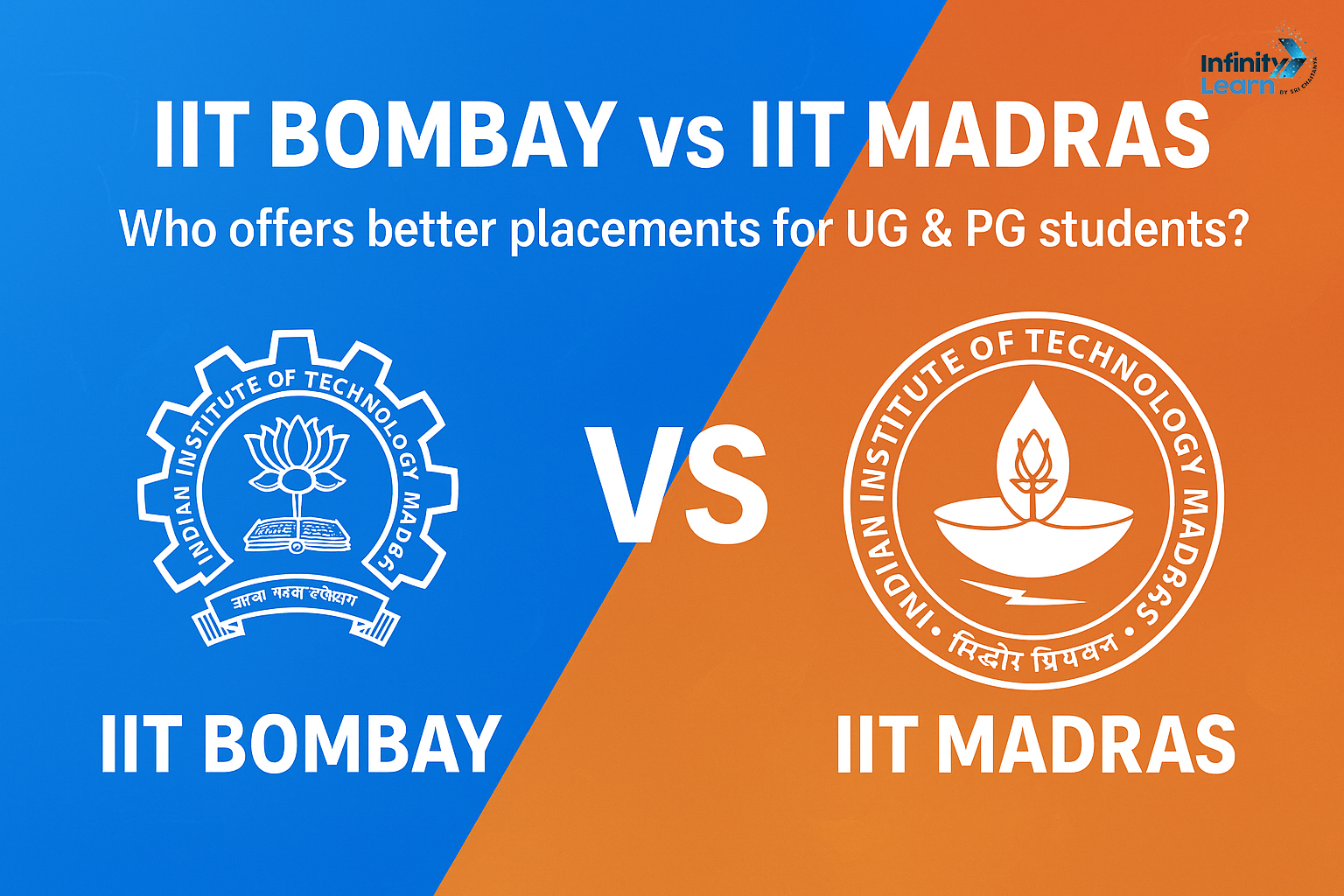
  • IIT Bombay vs IIT Madras 2025: Who offers better placements for UG and PG students?

    The National Institutional Ranking Framework (NIRF) 2025, released by the Ministry of Education, shows how top Indian institutes are performing. Among them, IIT Madras and IIT Bombay continue to lead, both in rankings and in areas like placements and higher education opportunities.

    IIT Madras ranked first with a score of 88.72, while IIT Bombay was in third place with a score of 83.65. The NIRF data highlights differences between the two in intake, graduation rates, placements, salary packages, and higher studies.

    Must Read – JEE Mains 2026 Exam

    Ranking and Performance Parameters

    • IIT Madras scored very high in Teaching, Learning & Resources (95.70), Research & Professional Practice (90.74), and got a perfect 100 in Perception.
    • IIT Bombay performed better in Graduation Outcomes (87.06), ahead of IIT Madras in this area.
    • For Outreach & Inclusivity, both showed moderate results: IIT Madras at 63.25 and IIT Bombay at 59.13.
    Institute Rank Score TLR RPC GO OI Perception
    IIT Madras 1 89 95.70 90.74 82.29 63.25 100
    IIT Bombay 3 84 87.97 84.81 87.06 59.13 85.04

    In the academic year 2025–26, IIT Bombay admitted more students than IIT Madras in both four-year undergraduate and two-year postgraduate courses. IIT Bombay enrolled 1,161 students in UG four-year programs, compared to 961 at IIT Madras. For PG two-year programs, IIT Bombay’s intake was almost three times higher than that of IIT Madras. However, IIT Madras offered three-year PG programs, admitting 245 students, a course category not available at IIT Bombay.

    Also Read: Top 4 NIRF Ranked 2025 Engineering Colleges in Bangalore

    Institute UG [4 Years] UG [5 Years] PG [2 Years] PG [3 Years]
    IIT Madras 961 93 511.00 245.00
    IIT Bombay 1,161 80 1,406.00

    UG 4 year programme placements

    In the four-year undergraduate programs, both IIT Madras and IIT Bombay showed steady growth in graduates over the past three years. In 2023–24, IIT Madras had 714 graduates, of which 549 were placed with a median salary of ₹17.5 lakh. IIT Bombay, with a larger batch of 990 graduates, placed 731 students at a higher median salary of ₹19.61 lakh. Additionally, more students from IIT Bombay chose higher studies (259) compared to IIT Madras (153).

    Academic Year IIT Madras – Graduated Placed Median Salary (Rs.) Higher Studies IIT Bombay – Graduated Placed Median Salary (Rs.) Higher Studies
    2023-24 714 549 17,50,000 153 990 731 19,61,000 259
    2022-23 639 496 16,63,440 96 798 644 19,63,000 154
    2021-22 388 297 17,00,000 78 674 591 18,80,000 83

    The five-year undergraduate programs showed strong placement results at both IITs. In 2023–24, IIT Madras graduated 244 students, with 215 placed at a median salary of ₹19.4 lakh.

    IIT Bombay had 182 graduates, out of which 156 were placed, earning a median salary of ₹19.25 lakh. In earlier years, IIT Madras had larger graduating batches, but IIT Bombay consistently recorded higher or similar median salary packages.

    Must read: IIT Fee Structure 2025

    Academic Year IIT Madras – Graduated Placed Median Salary (Rs.) Higher Studies IIT Bombay – Graduated Placed Median Salary (Rs.) Higher Studies
    2023-24 244 215 19,40,000 24 182 156 19,25,000 26
    2022-23 385 325 17,00,000 41 199 187 18,50,000 12
    2021-22 426 352 18,96,000 65 160 157 20,00,000 3

    PG 2 year programme placements

    In the two-year postgraduate programs, IIT Madras showed a higher placement ratio, while IIT Bombay had larger graduating batches. In 2023–24, IIT Madras placed 448 out of 471 graduates with a median salary of ₹15 lakh. At IIT Bombay, 552 of 851 graduates were placed, earning a slightly higher median salary of ₹15.4 lakh. However, many more students at IIT Bombay chose higher studies (286) compared to only 13 at IIT Madras.

    Academic Year IIT Madras – Graduated Placed Median Salary (Rs.) Higher Studies IIT Bombay – Graduated Placed Median Salary (Rs.) Higher Studies
    2023-24 471 448 15,00,000 13 851 552 15,40,000 286
    2022-23 429 390 15,00,000 12 870 641 15,00,000 223
    2021-22 313 285 13,00,000 21 853 623 14,76,188 230

    Among the two institutes, IIT Madras is the only one that offers three-year postgraduate programs. In 2025–26, a total of 129 students graduated, with 63 placed at a median salary of ₹12.25 lakh, while 33 pursued higher education. In earlier years, placements were stronger — 147 students placed in 2022–23 and 112 in 2021–22, both with a median package of ₹15 lakh.

    Do Check – JEE Main 2026 Documents & Upload Guide

    Academic Year IIT Madras – Graduated Placed Median Salary (Rs.) Higher Studies
    2023-24 129 63 12,25,000 33
    2022-23 191 147 15,00,000 37
    2021-22 136 112 15,00,000 24

    IIT Bombay vs IIT Madras Courses Offered

    The table below lists the B.Tech programs available at IIT Bombay and IIT Madras. Currently, IIT Bombay offers B.Tech courses in 8 branches, while IIT Madras offers them in 9 branches.

    IIT Bombay IIT Madras
    B.Tech. in Aerospace Engineering B.Tech. in Aerospace Engineering
    B.Tech. in Chemical Engineering B.Tech. in Chemical Engineering
    B.Tech. in Civil Engineering B.Tech. in Civil Engineering
    B.Tech. in Computer Science & Engineering B.Tech. in Computer Science & Engineering
    B.Tech. in Electrical Engineering B.Tech. in Electrical Engineering
    B.Tech. in Mechanical Engineering B.Tech. in Mechanical Engineering
    B.Tech. in Metallurgical Engineering & Materials Science B.Tech. in Metallurgical and Materials Engineering
    B.Tech. in Engineering Physics B.Tech. in Ocean Engineering
    B.Tech. in Physics

    Apart from B.Tech, both institutes offer a wide range of programs:

    • IIT Madras provides: Dual Degree programs, M.Tech (regular and online), MBA, Executive MBA, M.Sc., MA, PG Diploma, MS, and PhD courses.
    • IIT Bombay offers: BS, B.Des., M.Sc., M.Sc.–PhD Dual Degree, M.Des., MBA, Executive MBA, MSc–PhD (Dual Degree) in Energy, MPP, MS by Research (CSE/Data Science & AI in CMinds), Master of Arts by Research (MA.Res.), MA–PhD (Dual Degree) in Philosophy, and PhD programs.

    Do Check – JEE Main 2026 State Code of Eligibility

    IIT Bombay vs IIT Madras Placements

    Parameter IIT Bombay IIT Madras
    Number of Companies 364 companies made offers (both domestic & international). Not explicitly stated, but very large participation across sectors.
    Students Placed (UG/PG) 1,475 students placed. IIT Madras BTech and Dual Degree placed >1,090 students in Phase I & II campus placements.
    Median Salary (BTech/UG) ₹ 19.63 lakh per annum. Around ₹ 19.6 lakh per annum.
    Highest Domestic Offer ₹ 1.32 crore in finance sector from Da Vinci Derivatives. Some branches (e.g. Computer Science) saw offers above ₹ 1 crore, but less consistently across departments.
    International Offers ~78 international offers accepted. Around 65 international offers.
  • Human Eye Diagram for Class 11

    The human eye is often described as the most precious gift of nature. For Class 11 Physics students, understanding the human eye diagram is crucial because it combines concepts of optics, physiology, and real-life applications. In this blog, we’ll explore the structure, working principle, key concepts, and common defects of vision with a clear cluster-based approach for easy learning.

    Introduction to the Human Eye

    The human eye functions like a natural optical instrument. Just like a camera, it focuses light to form sharp images. Its primary role is to sense light and send information to the brain, enabling us to see the world around us.

    Also Check: Animal Cell Diagram

    Structure of the Human Eye (with Diagram)

    To study the human eye in Physics, we focus on its optical parts.

    • Cornea – Transparent, curved surface that refracts incoming light.
    • Aqueous Humor – Fluid that maintains pressure and helps in refraction.
    • Pupil – Adjustable opening that controls the entry of light.
    • Iris – Colored diaphragm that regulates pupil size.
    • Lens – Convex lens that changes shape to focus light.
    • Ciliary Muscles – Adjust the focal length of the lens.
    • Retina – Light-sensitive layer containing rods and cones.
    • Optic Nerve – Transmits visual signals to the brain.

    Tip for Exams: Always draw and label a neat human eye diagram—it carries scoring weight in Class 11 board papers.

    Must Read: Who Are the Leading Providers of Online Education for Indian Students?

    Working Principle of the Human Eye

    • Light enters through the cornea.
    • It is further refracted by the eye lens.
    • A sharp image is formed on the retina.
    • Retina converts light into electrical signals.
    • Signals are carried by the optic nerve to the brain.
    • Thus, the eye works as a living optical device with continuous adjustments.

    Also Check: Classified Advertisement Class 11 Format | Poster Making Class 11

    Key Concepts for Class 11 Students

    • Power of Accommodation: The eye can adjust its focal length with the help of ciliary muscles.
    • Near Point: Minimum distance at which a normal eye can see clearly (25 cm).
    • Far Point: Maximum distance seen clearly by a normal eye (infinity).
    • Persistence of Vision: The image stays on the retina for about 1/16th of a second, enabling us to perceive continuous motion in movies.

    Common Defects of Vision

    • Myopia (Short-sightedness) – Distant objects appear blurred. Correction: Concave lens.
    • Hypermetropia (Long-sightedness) – Near objects appear blurred. Correction: Convex lens.
    • Presbyopia – Age-related defect; corrected using bifocal lenses.
    • Astigmatism – Caused by irregular curvature of the cornea/lens.

    Also Read: 10 Most Difficult College Degrees in India 2025

    Applications and Importance

    Foundation for optical instruments like cameras and microscopes.

    Development of corrective lenses and spectacles.

    Essential for understanding real-life optics in medical and technological fields.

    Know more: How Does Personalized Learning Work in Online Education?

    Conclusion

    The human eye diagram is more than just a Class 11 Physics topic—it helps us appreciate the natural design of vision. By learning the structure, working, key concepts, and defects, students can score better in exams and also understand the science behind spectacles, cameras, and vision correction.

  • How Will Your JEE Main 2026 Exam Center Be Allotted? The New Rule Explained

    For 2026, NTA has issued an Aadhaar update advisory ahead of registration and activated a demo registration link—and multiple reports indicate that the city-preference step may be removed, with exam cities auto-allotted using the address on your Aadhaar/present address. Final confirmation will appear in the official JEE Main 2026 Information Bulletin.

    This update has naturally raised doubts—How will my center be decided? What if it’s far from home? What should I do now?

    In the sections below, we explain how exam-city allotment is expected to work if the new rule is adopted, what it means for travel and planning, and the single most important step students should take right now: ensure your Aadhaar/present address (including PIN code) is accurate before registration opens.

    Get the latest JEE Main 2026 notification updates from NTA. Know about registration dates, exam city allotment process, new address-based rule, exam pattern, syllabus, and important updates for JEE aspirants.

    JEE Main 2026 Registration — Current Status

    • Registration window: NTA has said the JEE Main 2026 Session-1 application form will open in October 2025 on the official website jeemain.nta.nic.in. Exact dates will be in the information bulletin
    • Demo registration link: On October 7, 2025, NTA activated a demo registration link at demo.nta.nic.in to let candidates practise the process before the form goes live. Multiple reputable outlets have reported this update. (Note: this is not the actual application form.)
    • Official advisory: NTA has already issued a document-update advisory (Aadhaar/UDID/category certificates) to avoid errors during registration.
    • Sessions & schedule: JEE Main 2026 will be conducted in two sessions — January 2026 and April 2026 (as per NTA notice).
    • Primary portal:jeemain.nta.nic.in (application link and information bulletin)
    • NTA portal:nta.ac.in (news/forwarding updates)
    • Practice only:demo.nta.nic.in (demo flow; not an application submission).

    JEE Main 2026 Notification Release Date — When Will NTA Announce It?

    The National Testing Agency (NTA) is expected to release the JEE 2026 Notification in October 2025 on its official website, jeemain.nta.ac.in. The information bulletin will include:

    • JEE Main 2026 exam dates (Session 1 & 2)
    • Registration start and last date
    • Updated exam pattern and syllabus
    • Exam city allotment details
    • Eligibility criteria and required documents

    Once the official NTA JEE Main 2026 Notification PDF is released, students will be able to download it directly from the website.

    JEE Main 2026 Registration — Date, Fee, Documents, and Process

    When Will JEE Main 2026 Registration Start?

    The JEE Main 2026 registration is likely to begin in October 2025, immediately after the official notification is out. The registration link will be available on the NTA JEE Main official website.

    JEE Main 2026 Registration Last Date

    The last date to apply is expected to be around mid-December 2025. Students are advised not to wait till the final day because the server often experiences heavy traffic close to the deadline.

    JEE Main 2026 Registration Fee

    The fee will be mentioned in the NTA bulletin, but based on the previous year:

    • ₹1,000 for General (Boys)
    • ₹500 for Female candidates
    • ₹500–₹750 for reserved categories

    Documents Required for JEE Main 2026 Registration

    Make sure you keep these ready before filling the form:

    • Scanned photograph and signature
    • Class 10 and 12 mark sheets (if applicable)
    • Valid Aadhaar card / government ID
    • Correct address proof (this is crucial for exam city allotment)
    • Category or PwD certificate (if applicable)

    How Will NTA Allot Exam City for JEE Main 2026?

    The NTA JEE Main 2026 exam city allotment system has changed. Students will not get the option to select preferred cities while filling your form. Now, the exam city will be automatically allotted based on the permanent or present address you enter during registration.

    Key Points About JEE Main 2026 Exam City Allotment

    Criteria Details
    Basis of Allotment Permanent or present address entered in the form
    City Choice Option Removed (no manual selection)
    System Type Fully automated, data-based
    Possible Centers Within your home state or the state where you currently live
    City Slip Release Expected in January 2026, a few weeks before the exam

    Example Scenarios

    • If you study in Kota (Rajasthan) but your permanent home is in Patna (Bihar), NTA may allot your center in either state.
    • If your address is in Delhi NCR, you may get centers in Delhi, Noida, or Ghaziabad — depending on availability

    How to Fill the JEE Main 2026 Application

    1. Visit jeemain.nta.nic.in and open “JEE Main 2026 Application”.
    2. Click “New Candidate Registration” → complete basic registration to generate Application No./Password.
    3. Log in → fill personal, academic, and contact details.
    4. Enter addresses carefully (Permanent & Present) and verify PIN code.
    5. Upload photo, signature, and relevant certificates as per NTA specs.
    6. Pay the fee online and submit.
    7. Download and save the confirmation page. (For practice, you may walk through the same steps on the demo site first.)

    Also Check: JEE Advanced 2026: Exam Dates, Eligibility, Syllabus & Exam Pattern for IIT Admissions

    JEE Main 2026 Exam Date and Session Details

    According to the usual NTA schedule, JEE Main 2026 will be held in two sessions:

    Session Tentative Month Purpose
    Session 1 January 2026 Early attempt, before Board exams
    Session 2 April 2026 Second attempt for score improvement

    The exact JEE Main 2026 exam dates will be confirmed in the official notification.
    The JEE Main 2026 admit card will be released 3–5 days before the exam date.

    JEE Main 2026 Syllabus and Exam Pattern

    Most likely, the JEE Main 2026 syllabus will remain the same as 2025.
    The exam will have two sections (A and B) per subject — Physics, Chemistry, and Mathematics.

    Subject Section A (MCQs) Section B (Numerical)
    Physics 20 10 (any 5 to attempt)
    Chemistry 20 10 (any 5 to attempt)
    Mathematics 20 10 (any 5 to attempt)
    • Total Marks: 300 (100 per subject)
    • Negative Marking: −1 for wrong answers in both sections
    • Mode of Exam: Computer-Based Test (CBT)

    Students can download the JEE Main 2026 syllabus PDF once NTA updates it on the official website.

    What Students Should Do Now

    The JEE Main 2026 notification and registration dates are around the corner. Since NTA will allot exam cities automatically, ensure your address, district, and PIN code are accurate in the registration form. Stay updated with:

    • JEE Main 2026 exam date and city slip release
    • Registration link and fee details
    • Latest NTA announcements and syllabus updates
  • How To Study Physics For NEET 2026: Important Physics Preparation Tips

    Preparing for NEET 2026 is a big challenge, and among all three subjects—Biology, Chemistry, and Physics—most students find Physics the toughest. Unlike Biology, which is more about learning facts, and Chemistry, which is a mix of theory and formulas, Physics demands both strong concepts and problem-solving skills. Many aspirants feel nervous about this subject, but with the right plan and regular practice, Physics can actually become one of the most scoring sections of NEET.

    Physics carries 180 marks out of 720, which is 25% of the total score in NEET. This makes Physics extremely important for securing a high rank. In fact, many students who score well in Physics often find themselves ahead of others in the final merit list. On the other hand, ignoring Physics can reduce your total score, even if you are strong in Biology and Chemistry. This is why a focused NEET Physics Preparation Strategy is necessary from the very beginning of your journey.

    The good news is that Physics is not about memorization alone. If you understand the concepts clearly and know how to apply them to solve numerical problems, you can easily improve your NEET Physics Score. Topics like Mechanics, Electrostatics, Current Electricity, Optics, and Modern Physics form the backbone of the exam. Once you build a strong grip on these, solving questions becomes much easier.

    Another key point is time management. NEET is not only about knowledge but also about solving 180 questions within a strict time limit. Physics questions often take longer because of calculations. This is why practicing with a timer, revising formulas regularly, and working on accuracy are all part of a strong NEET 2026 Physics study schedule.

    Why Physics Matters in NEET 2026

    Physics holds 180 marks out of 720 in the NEET exam. That’s 25% of the total score. This means your NEET Physics Score can make or break your rank.

    • Many students prefer Biology and Chemistry because Physics feels tricky. But skipping Physics can lower your chances of crossing 650+ marks.
    • Good Physics marks set you apart from other aspirants.
    • Since NEET has negative marking, careless mistakes in Physics directly hurt your overall score.

    Mastering Physics is not just about solving problems. It’s about building a foundation of concepts that will also help in your medical career.

    Do Check: Can You Really Crack NEET 2026 in Just 6 Months?

    Chapter-wise Weightage and Important Topics for NEET Physics 2026

    The first step in your NEET 2026 Physics study schedule is to know which chapters matter the most. Previous years’ papers give a clear picture of the NEET Physics weightage 2026.

    Chapter Name 2021 2022 2023 2024 2025 Avg. Weightage %
    Current Electricity 4 4 4 4 3 7.95%
    Moving Charges & Magnetism 3 3 3 2 2 5.44%
    Electromagnetic Waves 2 2 1 2 2 3.77%
    Ray Optics & Optical Instruments 4 4 3 2 1 5.86%
    Gravitation 3 3 3 2 3 5.86%
    Semiconductors 3 3 3 3 2 5.86%
    Electrostatics & Capacitance 3 5 1 4 2 6.28%
    Oscillations 2 3 2 4 2 5.44%
    Units & Measurements 3 3 2 3 1 5.02%
    Electric Charges & Fields 4 3 3 1 1 5.02%

    NEET Physics Preparation Strategy

    A strong NEET Physics Preparation Strategy requires a mix of concept clarity, regular practice, and timed tests. Follow this sequence:

    1. Understand concepts deeply before solving problems.
    2. Start with NCERT, then move to NEET Physics Reference Books for extra practice.
    3. Prepare NEET physics formula sheets for quick revisions.
    4. Solve previous year NEET Physics questions to understand exam trends.
    5. Regularly attempt mock tests to balance speed and accuracy.

    Step-by-Step Guide: NEET 2026 Physics Preparation Tips

    Here is a detailed 5-step method to prepare:

    Step 1: Choose the Right NEET Physics Reference Books

    • NCERT Physics Class 11 & 12 – Foundation must be strong.
    • Concepts of Physics by H.C. Verma – Best for understanding concepts.
    • Objective Physics by D.C. Pandey – Practice-oriented.
    • Problems in General Physics by I.E. Irodov – For tough numerical practice.
    • MTG Chapterwise NEET Physics Questions – For exam pattern-based practice.

    Step 2: Prioritise NEET Physics Important Chapters

    • Use the NEET Physics weightage 2026 table to decide where to spend more time.
    • Focus on chapters like Electrostatics, Current Electricity, Mechanics, Magnetism, Optics, and Modern Physics.

    Step 3: Build Strong Basics

    • Don’t jump directly to solving 100s of questions.
    • First read the theory and examples.
    • A clear concept will help you attempt even tricky questions confidently.

    Step 4: Make NEET Physics Formula Sheets

    • Write all formulas from every chapter in one notebook.
    • Keep notes short with definitions and diagrams.
    • These NEET physics formula sheets are useful for quick revision before the exam.

    Step 5: Practice PYQs and Mock Tests

    • Solve last 10 years of NEET Physics questions.
    • Take at least 2 mock tests per week during final months.
    • Analyze mistakes and work on weak topics.

    Also Check: How Many Days Left for NEET 2026

    NEET Physics Preparation Plan: Daily Timetable

    A simple daily NEET Physics Preparation Plan ensures consistency.

    Time Activity
    6:00 – 7:00 AM Study new Physics concepts
    7:00 – 7:30 AM Break
    7:30 – 9:00 AM Solve numerical problems
    9:00 – 9:30 AM Revise formulas & notes
    9:30 – 10:00 AM Doubt clearing/review
    Rest of the day Other subjects + rest

    6-Month Physics Study Plan for NEET 2026

    If you have only 6 months left, follow this focused 6-Month Physics Study Plan for NEET 2026:

    Month Focus Areas Daily Routine Weekly Tasks
    1–2 Class 11 basics: Mechanics, Laws of Motion, Work-Energy, Gravitation, Oscillations 2 hrs NCERT + 1 hr numericals + 40 MCQs Weekly mini-test
    3–4 Class 12 topics: Electrostatics, Current Electricity, Magnetism, AC, Optics, Modern Physics 1.5 hrs theory + 1 hr Class 11 revision + 50 MCQs Weekly Physics section test
    5 Mixed practice + NEET PYQs 1 hr formula revision + 2 hrs PYQs Sectional test + weak topic focus
    6 Final revision + full mock tests 2 hrs notes + 100 MCQs + 2 mock tests Error analysis

    Best Books and Resources for NEET 2026 Physics Preparation

    Books are the foundation of any preparation. For NEET 2026 Physics, the right set of books and resources will decide how strong your concepts become and how easily you can solve questions. Choosing too many books creates confusion, while using only a few limits your practice. Below is a clear list of the best books and resources for NEET Physics.

    1. NCERT Physics Class 11 & 12 (Base Material)

    • NCERT is the most important book for NEET Physics.
    • All concepts, definitions, and basics come directly from NCERT.
    • Many questions in NEET are either taken directly or inspired from NCERT examples and exercises.
    • Every aspirant must first complete NCERT line by line before moving to reference books.

    How to use it:

    • Read each chapter carefully.
    • Practice the in-text examples and solved numericals.
    • Highlight important formulas and concepts.

    2. Concepts of Physics by H.C. Verma (Vol 1 & 2)

    • This book is a favorite among NEET and JEE aspirants.
    • It explains concepts in simple language and builds strong fundamentals.
    • The solved and unsolved problems improve numerical solving ability.

    How to use it:

    • Read theory for clarity after finishing NCERT.
    • Solve end-of-chapter exercises to strengthen problem-solving.
    • Use it as a bridge between NCERT and advanced problem books.

    3. Objective Physics by D.C. Pandey (Arihant Series)

    • This is a practice-oriented book designed especially for competitive exams like NEET.
    • It contains thousands of MCQs with varying difficulty.
    • Chapters are divided topic-wise, which helps in targeted practice.

    How to use it:

    • After finishing NCERT, attempt chapter-wise MCQs from this book.
    • Focus on solving a fixed number of questions daily.
    • Revisit the questions you get wrong and note the mistakes.

    4. MTG Chapterwise & Topicwise NEET Physics Questions

    • This book compiles previous years’ NEET Physics questions.
    • It is excellent for understanding the exam pattern and frequently asked concepts.
    • Solving these questions gives a real exam-like experience.

    How to use it:

    • Solve chapter-wise questions after studying the same topic in NCERT.
    • Practice under a time limit to improve speed.
    • Keep track of your accuracy.

    5. Errorless Physics (Universal Publication)

    • One of the most exhaustive books for Physics practice.
    • Contains thousands of problems, from basic to advanced.
    • Great for students who want extra practice after finishing other books.

    How to use it:

    • Use it as a supplementary practice book, not the first choice.
    • Attempt selective questions rather than trying to finish the whole book.
    • Focus on weak areas and use Errorless for strengthening them.

    Do Check: Tips and Study Plan to Score 600+ in NEET 2026

    Final NEET 2026 Physics Preparation Tips

    Even with the best books, the right strategy is essential. Here are some final tips:

    1. Stick to NCERT first
      • Do not jump into reference books without finishing NCERT.
      • NCERT builds the foundation for all advanced concepts.
    2. Make your own NEET Physics formula sheets
      • Write all formulas from each chapter in a separate notebook.
      • Use diagrams and short notes to make them easy to revise.
      • Formula sheets save time during quick revisions before the exam.
    3. Use timers while solving mock tests
      • Time management is key in NEET.
      • Practice solving 45 Physics questions within the time limit.
      • This builds speed and accuracy.
    4. Revise formulas daily
      • Spend at least 15–20 minutes every day revising formulas.
      • Frequent revision reduces the chance of forgetting during the exam.
    5. Don’t ignore weaker chapters completely
      • Even if a topic feels tough, learn at least the basic concepts.
      • Cover all important formulas and simple problems from weaker areas.
      • This ensures you don’t lose marks on easy questions.

    Conclusion

    The right combination of NCERT, reference books, formula sheets, and regular practice will make Physics a scoring subject in NEET 2026. Keep your preparation balanced—focus on concepts, practice MCQs daily, and revise regularly. With consistent effort, Physics can become your strength instead of a hurdle.

  • How to Remember Topics for Exams (NEET, JEE, CBSE/ICSE/Boards, UP Board & similar)

    Preparing for NEET, JEE, or Board exams isn’t just about studying more—it’s about remembering better. This mega-guide is your no-nonsense, high-retention blueprint, tuned for Indian students across NEET, JEE, CBSE, ICSE, UP Board, and similar exams. You’ll get fast-acting tactics for “exams-tomorrow” emergencies, plus sustainable systems for year-long mastery (including droppers). We’ll tackle memorization, conceptual clarity, time management, burnout, and demotivation—with concrete schedules, checklists, and example-based routines.

    • T-24 hours rescue plan for students with exams tomorrow (minute-by-minute).
    • 30-, 60-, 90-day study blueprints for NEET/JEE/Boards.
    • Memory engines: Active Recall, Spaced Repetition, Interleaving, Elaboration, Dual Coding, PQ4R, Retrieval-augmented Note Cards, and “Blurting.”
    • Syllabus roadmaps tuned to the actual exam patterns.
    • Mock tests & review loops, including free NTA National Test Abhyas practice.
    • Tables & checklists (common mistakes, session templates, “what to do when stuck,” last-mile revision).
    • Exam pattern updates you must know for 2025 (NEET reverted to 180 compulsory MCQs; JEE Main Paper-1 pattern & negative marking specifics; CBSE competency-based question weights).

    Do Check – JEE Main 2026 Documents & Upload Guide

    First, know your battlefield: the 2025 exam patterns

    Memorization is strategy-dependent. If you know where marks come from, you can engineer memory to match that pattern.

    NEET-UG 2025 snapshot (official)

    • Format: Single paper; 180 compulsory MCQs (no optional Section B).
    • Subject split: Physics 45, Chemistry 45, Biology (Botany + Zoology) 90.
    • Marks: 720 total. +4 / –1. Duration: 3 hours (2:00–5:00 pm IST). Pen-and-paper.
    • Key change: Reverted to pre-COVID pattern (no optional questions; 180 questions in 180 minutes).

    Why it matters for memory: Biology is 50% of NEET marks (360/720). Your active-recall cycles must prioritize high-yield Bio NCERT lines, tables, and figures, while keeping daily retrieval reps for Physics & Chemistry problem frames.

    JEE Main 2025 Paper 1 (B.E./B.Tech) snapshot (official)

    • Structure: Three subjects (Maths, Physics, Chemistry).
    • Questions per subject: Section A: 20 MCQs, Section B: 5 numerical (integer).
    • Total: 75 Qs, 300 marks; +4 / –1, including negative marking in Section B. CBT mode. 3 hours.

    Why it matters for memory: Equal marks per subject encourage balanced retrieval across M/P/C. The negative marking on numericals demands accuracy under retrieval pressure—so your memory practice must include exact steps & rounding rules.

    Do Check – JEE Main 2026 State Code of Eligibility

    CBSE Boards 2024-25 design cues

    • Competency-based questions increased to ~50% (esp. for Class 11–12; with typologies like case-based/source-based). Use practice that forces concept application, not rote alone.

    ICSE (CISCE) 2025 signals

    • CISCE specimen papers highlight more analytical & application-based items; check official specimen QPs while revising.

    Exam Pattern For NEET, JEE and CBSE

    This table gives a quick overview of NEET 2025, JEE Main 2025, CBSE 2024–25, and ICSE 2025 exam patterns.
    Methodology: Numbers of questions, marks, duration, and marking schemes were taken from official NTA information bulletins and CBSE/ICSE circulars. Marks share (%) was computed per subject to help you balance study time.

    Exam Mode Total Questions Subject Split Marks & Scheme Duration Marks Share by Subject Important Notes
    NEET-UG 2025 Pen-and-paper 180 (all compulsory) Physics 45, Chemistry 45, Biology 90 720 marks (+4/–1) 3 hrs Phy 25%, Chem 25%, Bio 50% Reverted to pre-COVID pattern; Section B removed
    JEE Main 2025 (Paper 1) CBT 75 Each subject: Sec A = 20 MCQs, Sec B = 5 numericals 300 marks (+4/–1; Sec B has negative marking) 3 hrs ~33% each (Math, Physics, Chemistry) Section B numericals require rounding; accuracy > guessing
    CBSE 2024–25 (XI–XII) Pen-and-paper Subject-specific Varies by subject 100 marks (typical) ~3 hrs N/A ~50% competency-based questions; rest MCQ + constructed response
    ICSE 2025 (Class X) Pen-and-paper Subject-specific Varies Subject-specific Subject-specific N/A Specimen papers show shift toward analytical and application-based tasks

    NEET, JEE & Board Exams Tomorrow? Here’s Your T-24 Hours Last-Minute Revision Plan

    Goal: Maximize recall & confidence without overload. Keep it simple, active, and verified. The plan below assumes one core exam next day; adapt blocks if multiple papers.

    The plan (minute-by-minute skeleton: 6.5 focused hours + sleep)

    1. 08:00–08:20Calm start + plan
      • Write 3 objectives: X chapters I must recall, Y problem types I must execute, Z formulae/diagrams I must retrieve.
    2. 08:20–09:20Blurting (NCERT/Formulae)
      • On blank paper, blurt everything you know from memory (no peeking): definitions, laws, exceptions, reactions, diagrams.
      • Immediately correct in a different color. This is retrieval + feedback.
    3. 09:20–09:30Micro-break (hydration, walk).
    4. 09:30–10:30Targeted problem frames
      • JEE/Boards: do 6–10 representative problems spanning each chapter (not the hardest—the most common).
      • NEET: 60 mixed MCQs (10 Phy, 10 Chem, 40 Bio) with a 60-minute timer (1 min/Q).
    5. 10:30–11:00Post-test error log
      • Create a “Fix List”: one line per error → cause → the trigger you’ll remember tomorrow (e.g., “Didn’t check units → circle units before marking”).
    6. 11:00–11:40Dual-coding pass
      • Convert tricky text into bitesize visuals: sequence diagrams (biological cycles), reaction maps, formula ladders, mind-maps.
      • Pin key NCERT Bio figures; redraw quickly from memory.
    7. Lunch + 30 minutes nap/quiet time (11:40–12:40)
    8. 12:40–13:40Second blurting pass (weak spots)
      • Re-blurt only from the Fix List topics.
    9. 13:40–14:00Walk + water + glucose.
    10. 14:00–15:00Mock burst
      • NEET: 45 Bio MCQs + 15 Chem + 15 Phy (75Q).
      • JEE: 15 problems (M/P/C 5 each; include 3 numericals total).
      • Boards: 1 section from the subject’s sample/specimen paper.
    11. 15:00–15:30Review & Last-mile cards
      • Make 10 “Night Cards”: the 10 items you still stumble on (one card = one recall).
    12. 17:00–17:30Light walk + music (no screens).
    13. 17:30–18:15Teach-back
      • Explain 3 hardest concepts aloud to a wall/friend in simple Hindi/English without notes. If you can teach it, you own it.
    14. Dinner early; wind-down.
    15. Sleep 7–8 hours. Sleep consolidates memory better than any extra last-minute reading.

    For NEET specifically tomorrow: do one NTA Abhyas timed set or the most recent official pattern mock, then only review errors, not the entire syllabus.

    Do Check – How Will Your JEE Main 2026 Exam Center Be Allotted?

    Year-Long (and Dropper) Study Systems that Make Memory Inevitable

    The 3 memory engines you’ll cycle—every week

    1. Active Recall (ask → answer from memory → check → refine).
    2. Spaced Repetition (same item revisited after 1d, 3d, 7d, 14d, 30d).
    3. Interleaving (mix chapters/subjects so memory becomes discriminative, not context-dependent).

    Layer on Elaboration (connect to “why/how”), Dual Coding (text + visual), and Concrete Examples. This combination is what helps you remember tough “conceptual” topics without rote.

    A week that works (repeatable template)

    • Mon/Wed/Fri = New learning + light mixed retrieval (60:40).
    • Tue/Thu/Sat = Problem-solving + past papers (30:70).
    • Sun = Full-length mock + post-test review + spaced review blocks.

    Within each day:

    • 3 × 50-minute deep work blocks/subject (JEE) or 2 × 50-minute for Phy/Chem + 3 × 50-minute for Bio (NEET), aligned with marks share.
    • Every block ends with 5 minutes of blurting.

    “A balanced weekly rhythm” (NEET vs JEE)

    Day NEET (Phy/Chem/Bio) JEE (M/P/C) Why this helps
    Mon New Bio (2 blocks), new Chem (1), new Phy (1), 30-min mixed MCQ New Maths (2), new Physics (1), new Chem (1), 30-min mixed Load matches marks share (NEET Bio heavy; JEE equal). Retrieval daily cements memory.
    Tue 2-hr chapter test (Bio+Chem); 60-min error review; 40-min formula redraw 2-hr mixed problem-set; 60-min error review; 40-min concept map Tests create desirable difficulties → stronger recall.
    Wed New topics again (same pattern as Mon) New topics again Alternating load keeps interleaving alive.
    Thu 90-min NEET section test; 60-min review; 30-min spaced cards 90-min single-subject test; 60-min review; cards Error logs become Night Cards.
    Fri Finish new topics; 60-min past Qs (NCERT line-based for Bio) Finish new topics; 60-min past Qs Past items shape retrieval cues.
    Sat Mock sections (45+45+90 MCQs); 90-min deep review 3× mini-mocks (M/P/C); 90-min deep review Frequent feedback loops.
    Sun Full mock (NTA Abhyas or credible set) + post-test analysis day Full mock (official pattern) + post-test analysis day Build stamina + identify gaps.

    Bulletproof Memorization for Tough & Conceptual Topics

    1) “Equation-Story-Example” lens (Physics/Maths/Chemistry)

    • Equation: write the core relation (from memory), annotate each symbol with units.
    • Story: one-line intuition (“as distance ↑, intensity ↓ like spreading butter on larger bread”).
    • Example: a quick numbered check with typical magnitudes (keeps you exam-safe).

    2) The 5-Layer Biology Memory Stack (NEET)

    1. NCERT line-by-line (underline verbs/numbers/names).
    2. Diagrams redrawn in <90 seconds (label from memory).
    3. Tables to cards (e.g., plant hormones → “stimulus → hormone → effect”).
    4. One “why” per fact (why that step exists in a cycle).
    5. Image-first recall: close eyes and see the diagram first; then speak it.

    3) Concept maps > long notes

    • Limit page bloat. One concept map per chapter. Use arrows, because links (“A → increases B because …”).
    • On review days, re-draw the map in 3 minutes from memory.

    4) Blurting + Back-filling

    • Write from memory on a blank sheet for 5–10 minutes → then open text and back-fill missing bits in another color.
    • Do this once at learn, once at 1-day, once at 1-week intervals.

    5) Worked-example toggling (JEE)

    • For classic problems, read 1 worked exampleclose, reproduce with steps → compare → annotate the decision points (where you pick a method).
    • Make “decision flashcards” (e.g., “If roots asked & discriminant appears → consider Δ logic first”).

    Your Mock-Test Operating System (so practice actually sticks)

    1. Warm-start: 2–3 starter questions to lock focus (not scored).
    2. First pass: skim and mark sure, maybe, skip.
    3. Time anchors: write T+30, T+60, T+120 on the sheet; glance at them to stay on pace.
    4. Log errors by type: Concept, Formula, Careless, Data/Unit, Endurance, Guess.
    5. The 30:20:10 rule (post-test):
      • 30 minutes: analyze concept errors (open book, re-derive).
      • 20 minutes: rebuild formula recall (cards).
      • 10 minutes: careless fixes (create anti-mistake cues: units boxes, sign checks).
    6. Make 10 Night Cards (the day’s most expensive confusions).
    7. Next morning: re-attempt only the 10 hardest questions (closed-book).

    Use NTA National Test Abhyas for free full-length JEE/NEET mocks to mirror CBT/OMR experience. It’s official and updated.

    Time Management That Doesn’t Burn You Out

    The 3×50 + 1×Recovery block

    • 50-min deep work, 10-min break × 3; then a 30-min recovery (walk, snack, eyes off screens).
    • Cap daily deep blocks at 8–9 (beyond this, retention drops).

    The 10% rule for review

    • For every 5 hours of new study, schedule 30 minutes of spaced review (cards/blurting).
    • Weekly, reserve one full session for nothing but review.

    Power snacks for memory

    • Hydration + fruit or curd + nuts. Avoid heavy fried meals before mocks (slows recall).

    Staying Motivated under Pressure (and how to dodge burnout)

    What to do when demotivation hits

    • Tiny wins: choose one 15-minute micro-task you can finish now (e.g., “draw Krebs cycle from memory”).
    • Flip the script: I’m behind → “I’m in progress; next step is 15 minutes.”
    • Accountability ping: send your Night Cards list to a study buddy.

    Burnout prevention checklist (weekly)

    • Sleep: ≥7 hours (non-negotiable—memory consolidation happens here).
    • One off-day micro-window: 2 hours of no-study guilt-free time.
    • Sunlight + steps: minimum daily walk; movement refreshes focus.
    • Rotate tasks: after 2 heavy derivation blocks, switch to Bio diagrams or Chem reactions (varied cognitive load).

    Syllabus Roadmaps—built from the official patterns

    NEET 2025 Roadmap (marks-weighted)

    • Daily: Bio (2 blocks), Chem (1), Phy (1).
    • Bio priority: NCERT line accuracy, figure labeling, table facts.
    • Chem: Inorganic NCERT facts → cards → rapid retrieval; Physical formula drills + solved patterns; Organic reaction patterns + exceptions cards.
    • Phy: Equation-Story-Example + unit sanity checks.

    Why this split? NEET marks share is Bio 50%, Chem 25%, Phy 25%, per NTA’s 180Q/720-mark layout.

    JEE Main 2025 Roadmap (even balance + accuracy)

    • Daily: Maths (2 blocks), Physics (1–2), Chemistry (1–2) → aim for equal total time weekly.
    • Section B numericals: practice integer answers with rounding rules; penalized if wrong.
    • Build method flashcards: “When I see … I try …” (e.g., symmetry/rotation → coordinate/complex no.).

    Boards (CBSE/ICSE/UP etc.) Roadmap

    • Use official sample/specimen papers to derive typical question structures; lean into competency-based prompts (explain, reason, apply).
    • For ICSE, practice analytical/application questions from the specimen QPs.

    High-Utility Checklists & Tables

    “Common Mistakes & Fix Moves” (pin this above your desk)

    Mistake Why it happens Fast Fix (memory-friendly)
    Forgetting Bio minutiae (terms, taxonomy, cycles) Low-salience facts fade Night Cards with one fact + one image per card; say it aloud; redraw tiny diagrams.
    Dropping units/signs in Physics & Maths Cognitive overload near the end Write Units Box beside every answer; final sign check before marking.
    Confusing similar Chem reactions Weak retrieval cues Reaction families map; color-code conditions (temp/catalyst). Do 5 “look-away → write pathways → check” reps.
    JEE Section B negatives Guessing numericals Estimation pass first; if order-of-magnitude is off, skip; only finalize if steps are clean.
    CBSE long answers too vague Not mirroring typology Use RACE: Restate → Answer → Cite concept → Example/Case. For competency items, apply to real context.

    Example-Based Articles (micro-lessons you can reuse)

    Physics: “Work-Energy Theorem” (JEE/Boards)

    • Equation: ΔK = W_net.
    • Story: If net work is positive, kinetic energy grew; if negative, you lost speed.
    • Example: A 2 kg block pushed with 10 N over 5 m against 2 N friction → W_net = (10–2)×5 = 40 J → ΔK = +40 J → vf=vi2+2ΔK/mv_f = \sqrt{v_i^2 + 2ΔK/m}vf=vi2+2ΔK/m.
    • Recall cue: “Net work writes the kinetic story.”

    Chemistry: “Electrophilic Aromatic Substitution”

    • Memory hook: Attack (E+), Sigma complex, Deprotonate (AED).
    • Why: Donors activate (ortho/para), withdrawers deactivate (meta).
    • Example: Nitration of toluene → ortho/para favored; list reasons in 3 bullets.
    • Card: “If donor on ring → ortho/para (faster). If withdrawer strong (NO2) → meta.”

    Biology: “Renal Regulation” (NEET)

    • Visual: Nephron sketch in 30 seconds.
    • Sequence: Filtration (GC) → PCT reabsorption → Loop (countercurrent) → DCT (hormonal) → Collecting duct (ADH aquaporins).
    • Why: Countercurrent multiplies gradient; ADH inserts aquaporins → water recovery.
    • Recall test: Close eyes; narrate one verb per segment (filter, reclaim, multiply, tweak, conserve).

    Step-by-Step Guides You Can Apply Today

    The Blurting Routine (10 minutes, anywhere)

    1. Pick topic.
    2. Set 10-minute timer.
    3. Write everything you remember.
    4. Open text only to check; add missing in a different color.
    5. Circle 3 weakest bits → turn into Night Cards.

    The NCERT Figure Drill (NEET Bio)

    1. Cover labels.
    2. Draw from memory in <90 seconds.
    3. Label; then open the figure and compare.
    4. Tick what you nailed; star what you missed; redo starred ones tomorrow.

    The Numerical Safety Net (JEE)

    1. Read problem once.
    2. Predict order-of-magnitude result (mental estimate).
    3. Solve cleanly, tracking units each line.
    4. Round only where the paper instructs.
    5. If steps get messy → park it; don’t bleed time (negative marking risk).

    Spaced Repetition Without Fancy Apps

    • Box method on paper: Box-1 (Today), Box-2 (Tomorrow), Box-3 (3 days), Box-4 (1 week), Box-5 (2 weeks).
    • Move a card forward only if 100% recall; else send it back.
    • Keep ≤120 cards active; sunset cards after 3 clean recalls.

    Deep Dives by Exam

    NEET 2025 — What to memorize vs what to understand

    • Memorize: NCERT terminology, exceptions, cycles steps, botanical/zoological classifications, hormones, diseases, phyla characteristics, plant families, human physiology parameters.
    • Understand: genetics problem frames (Punnett logic), physiology mechanisms, ecology interactions, experimental graphs.

    Practice cadence:

    • Daily: 60–90 Bio MCQs (NCERT-aligned), 30–45 Chem, 30–45 Phy.
    • Weekly: 1 full mock + 1 error-only retest.

    Pattern-driven emphasis: With 180 compulsory MCQs and a strict 3-hour window, train to average ~1 min/Q; avoid over-thinking early Bio; bank time for Phy/Chem numericals.

    JEE Main 2025 — Memory for accuracy (not guesswork)

    • Memorize: identities, standard limits, derivatives/integrals, vector & 3D formulas, common series, electrostatics/gravity analogies, standard potentials, organic mechanisms patterns.
    • Understand: method selection (graphs vs algebra), constraints, approximation logic.

    Numericals: Respect rounding and negative marking rules; practice integer-answer entry. Build 10 “method triggers” (e.g., symmetry → reduce integrals; dimension check → sanity).

    CBSE/ICSE — Memorization for competency questions

    • Memorize: definitions, formulas, labeled diagrams, named reactions, theorem statements.
    • Apply: short caselets; reason your steps; RACE structure in long answers.
    • For CBSE Board, expect ~50% competency-based prompts—use everyday examples in explanations.

    Chapter-Wise “Weightage” Reality Check (and a safer alternative)

    Official agencies rarely publish “chapter-wise weightage” for future papers. Instead of chasing unreliable lists, use this safe approach:

    • NEET: Drive by subject marks share (Bio 50%) and past NCERT emphasis.
    • JEE: Equal subject weight; emphasize high-frequency problem archetypes (coaching/samples).
    • Boards: Derive patterns from official sample/specimen papers each year; align practice to those designs.

    A 30-/60-/90-Day Action Plan (droppers + regulars)

    0–30 days: Foundation + Retrieval habit

    • Finish first-pass concepts with blurting after each sub-topic.
    • Build core card deck (≤120 items).
    • 2 mini-mocks/week + 1 full mock (Sunday).
    • Sleep & routine locked.

    31–60 days: Problem patterns + speed

    • Shift to 60% problems / 40% content.
    • Make method flashcards from every tricky question.
    • Weekly sectional speed tests (NEET: 45-minute Bio sprint; JEE: 30-minute numericals).

    61–90 days: Exam simulation + polish

    • Alternate days: full mock & error-focused day.
    • Shrink notes to one-page maps per chapter.
    • Hardest 50 questions re-attempted thrice until clean.

    “Exams Tomorrow” Quick Packs (subject-wise)

    NEET Biology (90 MCQs)

    • NCERT figure blitz: 20 mins.
    • High-yield lists: plant families, hormones, enzymes, diseases.
    • Genetics: do 10 pedigree/Punnett quickies.
    • Eco/Physio: 20 mixed MCQs with time targets.

    NEET Chemistry (45 MCQs)

    • Inorganic: convert P-block highlights to 10 Night Cards.
    • Organic: mechanism triggers; 15 rapid MCQs.
    • Physical: formula ladder; 5 short numericals (estimation first).

    NEET Physics (45 MCQs)

    • Formula recall grid (mechanics→electro→modern).
    • Units/signs checklist.
    • 10 mixed numericals (clean steps only).

    JEE Maths/Physics/Chemistry

    • Maths: identities + 5 mixed problems + one 15-min speed drill.
    • Physics: W–E, E&M, modern; 6 problems with units box.
    • Chem: 6 conceptual MCQs + 2 numericals + 5 organic mechanism IDs.

    When You’re Stuck, Do This”

    Problem Likely Cause 10-Minute Fix
    Can’t recall steps in a derivation Just memorized, not practiced retrieval Try “blurting”: write everything you remember on a blank page, then compare with notes.
    Keep missing similar MCQs Confusion between topics Use interleaving: practice mixed questions from similar chapters, mark differences in your notes.
    Freeze on numericals Fear of making mistakes or losing marks First do rough estimation. If stuck after 60 seconds, park it and return later.
    Bio facts slip Low recall value Use dual coding: combine diagrams with oral recall of at least one fact per diagram.
  • How to download the NEET 2026 admit card from NTA portal

    Every NEET aspirant’s heartbeat rises when the admit card is released. The NEET 2026 admit card is your official entry ticket into the exam hall. Without it, you will be turned away. In this guide, you’ll get the latest timeline, official steps to download from the NTA portal, troubleshooting tips, and exam-day reminders for NEET 2026 Exam.

    When Will the NEET 2026 Admit Card Be Released?

    • According to many exam portals, the admit card is expected in the last week of April 2026 (tentative)
    • The exam is likely scheduled for the first week of May 2026
    • NTA typically issues the card only online; there is no physical mailing of admit cards
    • Earlier years’ precedent: for NEET 2025, admit cards were released a few days before the exam.

    Tip: Keep checking the official NTA / NEET websites in late April for the “Download Admit Card” link to go live.

    Also Read: Tips and Study Plan to Score 600+ in NEET 2026

    Key Details to Check on Your Admit Card

    Once you download your admit card, cross-verify the following details immediately. Errors must be reported early.

    Field What It Represents What to Do if Incorrect
    Candidate name, father’s name, mother’s name Identity match Contact NTA immediately for correction
    Registration / application number & roll number Exam credential Verify consistency with your application
    Date & time of exam, reporting time Schedule info Any mistake can affect your exam day
    Exam centre name, address, centre code Venue details If incorrect, raise it as soon as admit card is released
    Photograph and signature For identification Must be clear and match your official photo
    Medium / language of question paper As opted in form If wrong, inform NTA
    Important instructions, exam guidelines Must read and follow Violation may lead to issues at exam hall

    How to Download NEET 2026 Admit Card on NTA Portal (Official Steps)

    Follow these steps exactly when the admit card is live:

    1. Open your browser and go to official NEET / NTA website (often neet.nta.nic.in or exams.nta.ac.in/NEET)
    2. On the homepage, look for link/text: “Download NEET 2026 Admit Card / Hall Ticket”
    3. Click the link. It will bring you to a login page.
    4. Enter your Application Number, Date of Birth, and Security Pin / Captcha exactly as in your application form
    5. Click Submit / Login.
    6. Your admit card/hall ticket PDF will appear on screen.
    7. Carefully verify all printed information (see section above).
    8. Click Download / Save to get a copy in PDF format.
    9. Print at least 2–3 copies for backup. Keep one for exam day and one as fallback.

    What If You Face Issues (Troubleshooting)

    • Wrong credentials / login failure: Check you typed everything correctly (double-check leading zeros).
    • Forgot application number or password: Use the “Forgot Registration Number / Password” link on the login page; provide required identity proofs. (Many portals list this in their admit card help pages)
    • Captcha / security pin not loading: Try refreshing the page or use a different browser.
    • High server load / site not responding: Try during off-peak hours; avoid last-minute panic.
    • Wrong / missing information on admit card: As soon as the admit card is live, contact NTA via their helpdesk or regional office with details and proof.
    • No access to printer / internet: Use a Common Service Centre (CSC) near you (India has many CSCs) to download and print your admit card. Some portals mention nominal fees for printing.

    Documents You Must Carry on Exam Day

    • Printed NEET 2026 Admit Card (the one you downloaded)
    • A valid government photo ID proof (Aadhaar, PAN, Passport, Driving Licence, Voter ID)
    • A passport-size photograph (same as uploaded)
    • Any extra documents required by NTA or your exam centre (if listed)
    • If applicable: disability certificate / scribe certificate (if you applied under PWD / special category)

    Without the admit card and valid ID, you won’t be allowed to enter the exam hall.

    Must Check- How Many Days Left for NEET 2026

    Exam Day Do’s & Don’ts (to Avoid Last-Minute Chaos)

    • Reach the exam centre well before the reporting time (often 2–3 hours before exam)
    • Do not wear heavy clothing, long sleeves, or any prohibited items. Shoes are often disallowed inside exam halls; prefer sandals/slippers.
    • Do not carry mobile phones, watches, calculators, study materials, or any electronic gadgets.
    • Read all instructions printed on your admit card (they may include desk layout, seating, COVID / hygiene guidelines, etc.)
    • Follow invigilator instructions strictly
    • Keep calm and focus on your test

    What to Do After You Download Admit Card

    • Store the PDF safely (cloud / mobile)
    • Keep extra printed copies
    • Compare it with your application form (ensure no mismatch)
    • Monitor any NTA notifications in case they issue corrections or updates
    • Prepare your travel and logistics to the exam centre in advance
    NEET Online Courses
    Best NEET Online Course for Class 11
    Best NEET Online Course for Class 12
    Best NEET Online Course for Droppers
  • How to Create a 3-month revision plan for NEET 2026: Month-wise schedule, mock tests, and NCERT strategy

    The final three months sharpen recall, speed, and accuracy. A structured plan aligns your daily effort with the NEET exam pattern, recent syllabus updates, and proven practice methods. Use NCERT as the base, drill PYQs, and iterate with mock-test analysis. Facts in this guide reference official NMC/NTA sources so you don’t waste time on guesswork.

    Analyze the NEET syllabus and chapter weightage the smart way

    • Start with the NMC-released NEET UG syllabus. Build your chapter checklist directly from the official PDF. Avoid unofficial topic lists that add or skip chapters.
    • Cross-check the exam structure and timing in the NTA Information Bulletin so your practice mirrors real conditions. NEET exam has 200 questions (you attempt 180) across Physics, Chemistry, Botany, and Zoology, with a 3-hour-20-minute duration and negative marking (+4/–1).
    • For weightage feel, review patterns via PYQs rather than blog lists. Patterns vary year to year, but PYQs show recurring “must-master” areas. Download official past papers from NTA’s archive.

    Set clear goals for each month

    • Month 1: Fast coverage + first recall. Finish one tight pass of the entire CBSE syllabus using NCERT text for Bio and core concepts in Physics/Chemistry. Target 60–70% daily time on content recall and short drills.
    • Month 2: Weak-area repair + sectional tests. Deep-dive into error clusters from Week 4 diagnostics. Add mixed chapter tests and topic-wise PYQs.
    • Month 3: Full mocks + polishing. Shift to exam-like full tests, stamina building, OMR discipline, and last-lap notes.

    Build a weekly and daily schedule that you can actually follow

    • Daily hours split (suggested): Biology 50%, Chemistry 30%, Physics 20%. Adjust if your diagnostics say otherwise.
    • Morning = theory + recall. Read NCERT (Bio), core definitions, formulae, and mechanisms when focus is high.
    • Evening = problem practice. Do numericals, balancing, mechanisms, and application MCQs under a timer.
    • Anchor materials: NCERT for Bio line-by-line, plus standard problem books for Phy/Chem. NCERT alignment with NEET is repeatedly emphasized by top educators and aligns with the official syllabus.

    Also Check: NEET 2026 Admit Card

    Practice with mock tests and PYQs the right way

    • Full-length mocks: Start with one per week in Month 2. Move to 2–3 per week in Month 3. Always simulate official conditions: 200 minutes, OMR bubbling, and the official section format.PYQs: Do chapter-wise PYQs during revision and full-paper PYQs on weekends. Use official NEET PYQs from NTA’s archive for accuracy.
    • Marking discipline: Score with the official scheme (+4 for correct, –1 for wrong, 0 for unattempted) so your projected ranks aren’t inflated.

    Active revision techniques that boost retention

    • Spaced repetition: Revisit each chapter at 24h, 7d, and 21d intervals. Keep decks for formulae, taxonomic ranks, plant/animal systems, and exceptions.
    • Mind maps and formula sheets: One A4 per chapter. For Bio, add labeled NCERT diagrams and tables; for Chemistry, include periodic trends and organic name reactions; for Physics, list laws and derived forms.
    • Error logs: Maintain a running list of misconceptions with “why” notes. Re-test those items within 72 hours.

    Must Read: List of Major Changes between NEET UG 2025 and NEET UG 2026 Syllabus

    Balance between subjects without burning out

    • Start with Bio-heavy allocation to secure accuracy. Shift 5–10% time toward Physics if mock accuracy lags.
    • Pair tough topics with easy wins. Example: Electrostatics + Capacitors with Biomolecules recap, or p-block with Morphology quick-drills.
    • Keep one interleaving block daily: mixed MCQs from all three subjects to train switching speed.

    Track progress like a data scientist

    • Weekly scorecard: Attempted, correct, wrong, unattempted; subject-wise accuracy; top 3 error types; time-overruns by section.
    • Adjust inputs: If Physics accuracy <50% for two weeks, swap in a daily 45-minute numericals block and cut low-yield content tinkering.
    • OMR hygiene: Practice bubbling after each question cluster to reduce end-rush errors. The exam is OMR-based; mastering this saves marks.

    Health and time management for sustained performance

    • Sleep 7–8 hours. Cognitive recall and error-rate correlate strongly with sleep quality.
    • Breaks: 50–10 or 90–15 focus blocks. No scrolling in breaks; hydrate and stretch.
    • Stress control: One low-intensity activity daily (walks, breathing drills). Keep a pre-mock routine to steady heart rate.

    Also Read: How to download the NEET 2026 admit card from NTA portal

    Sample 3-month NEET 2026 revision calendar (adapt to your syllabus)

    Month 1 (Weeks 1–4): Coverage + first recall

    • Mon–Sat:
      • Morning: NCERT Biology (two chapters) + short notes
      • Midday: Physical/Inorganic Chemistry concepts + 30–40 MCQs
      • Evening: Physics concepts + 25–35 numericals
    • Sun: Chapter-wise PYQs across PCB + light analysis
    • Targets: Finish complete Biography once; 70% Chemistry core; 60% Physics core; build first set of one-page chapter sheets.

    Month 2 (Weeks 5–8): Repair + sectional rigor

    • Mon/Wed/Fri: Two tough topics + mixed MCQs; evening sectional tests (90–120 Q)
    • Tue/Thu/Sat: Moderate topics + PYQs; evening analysis and re-tests of errors
    • Sun: One full-length mock under exam conditions + deep analysis (2–3 hours)

    Must Check- How Many Days Left for NEET 2026

    Month 3 (Weeks 9–12): Full mocks + polish

    • Mon, Wed, Sat: Full-length mock + same-day analysis
    • Tue/Thu: High-yield revisions, formulae, diagrams, and weak-spot drills
    • Fri: OMR speed sets (three 45-minute blocks)
    • Sun: Light review + summary tests of top 10 volatile chapters

    Get your papers from official sources to avoid flawed keys or formatting. Use NTA’s archive for authentic PYQs and mirror the current pattern.

    Also Read: Tips and Study Plan to Score 600+ in NEET 2026

    Common mistakes to avoid in a 3-month NEET plan

    • Skipping NCERT lines and diagrams in Biology. Many direct questions originate there, and the official syllabus aligns with NCERT.
    • Practicing with the wrong pattern or casual timing. Always stick to the official duration, sectioning, and negative marking.
    • Ignoring analysis. A mock without post-test diagnosis is just fatigue.
    • Over-expanding notes. Keep one-page chapter sheets only.
    • Not training OMR bubbling. Practice like the real day.
    NEET Online Courses
    Best NEET Online Course for Class 11
    Best NEET Online Course for Class 12
    Best NEET Online Course for Droppers

    Conclusion

    Your NEET 2026 revision should be simple and test-aligned: official syllabus → NCERT-first study → PYQs → timed mocks → analysis → targeted fixes. Keep the plan adaptive using weekly data. When in doubt, verify against NMC/NTA documents and practice under the exact marking scheme and duration.