Author: Swati Singh

  • Water Cycle Diagram for Class 7​

    The Water Cycle, also called the Hydrologic Cycle, is one of the most exciting topics in science because it shows how water keeps moving around the Earth. Water never stays in one place for long it changes from liquid to vapor and back to liquid again. This journey of water includes steps like evaporation (water changing into vapor), condensation (vapor forming clouds), precipitation (rain, snow, or hail), and collection (water gathering in rivers, lakes, and oceans).

    Understanding the water cycle diagram is very important because it is a favorite exam question in CBSE and also a real-life lesson. It helps us see how nature recycles water and keeps it clean for plants, animals, and humans. Without this cycle, life on Earth would not survive.

    For students, learning about the Water Cycle means knowing how rain is formed, how rivers are filled, and why saving water is necessary. It is not just a science chapter, but also a way to understand how our planet works and how everything in nature is connected.

    What is Water Cycle?

    Water Cycle is like nature’s magic trick that keeps repeating again and again. The water cycle, also called the Hydrologic Cycle, is the continuous movement of water on Earth. Water from oceans, rivers, lakes, and ponds gets heated by the sun and turns into vapor this step is called evaporation. Then, the vapor rises up, cools down, and forms clouds this is condensation. When the clouds become heavy, water falls back to the Earth as precipitation in the form of rain, snow, or hail. Finally, this water collects again in rivers, lakes, seas, and underground this step is called collection.

    The water cycle is very important because it recycles the same water again and again, making sure we never run out of it. Without it, there would be no rain, no rivers, and no life on Earth. That is why studying the water cycle diagram is one of the most favorite and important questions in CBSE exams it helps us understand how water travels, how rain forms, and why water conservation is necessary.

    The water cycle is nature’s way of cleaning and reusing water, making it one of the most important processes for life on our planet.

    Also Check: Top 10 Must Know Diagrams for Class 7 Science

    Water Cycle Diagram for Class 7 with Labelled Parts
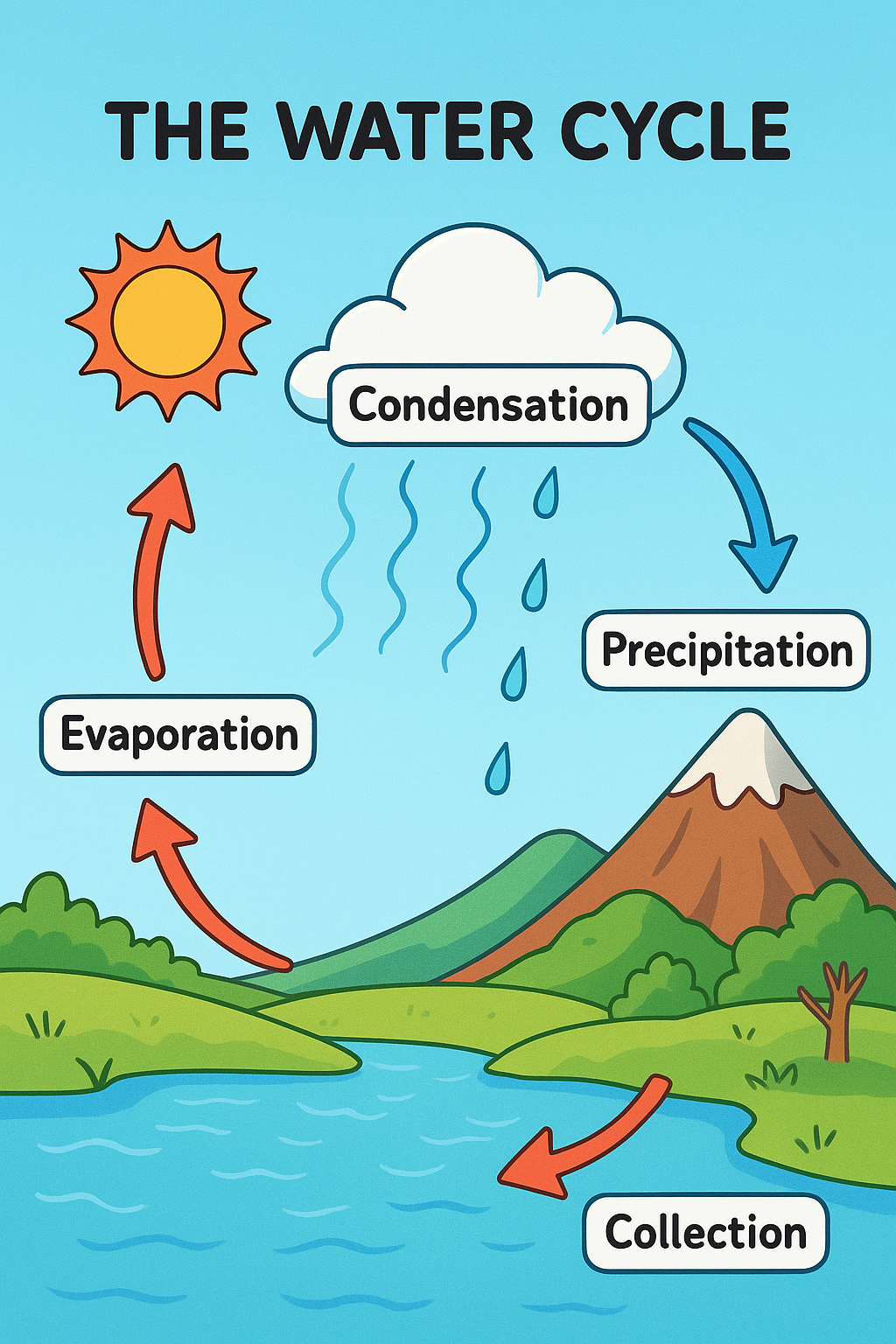
    Stages of Water Cycle for Class 7 Students

    Water Cycle is like a story where water keeps traveling in a circle. It has four main stages, and each one is connected to the next:

    1. Evaporation 

    When the sun heats up water from rivers, lakes, oceans, and even puddles, it slowly changes into water vapor. This invisible vapor rises up into the air. I like to imagine it as water “flying” into the sky.

    1. Condensation 

    As the water vapor goes high up, the air becomes cooler. The vapor changes back into tiny drops of water and forms clouds. This stage is called condensation. It feels like nature is painting the sky with white and gray cotton.

    1. Precipitation 

    When clouds get too heavy with water droplets, they cannot hold them anymore. The water then falls back to the Earth as rain, snow, or hail. This is called precipitation. It’s the stage we enjoy most when it rains outside!

    1. Collection or Deposition

    The water that comes down through rain or snow collects in rivers, lakes, seas, and underground. Some of it goes back to oceans, and some soaks into the soil to help plants grow. After this, the cycle starts all over again.

    Also Check: Science Project Ides for Class 7

    Water Cycle Diagram for Class 7 Explanation

    The Water Cycle Diagram resembles a picture story that shows the way water continues to move on the earth. The first stage in the diagram is evaporation in which the heat produced by the sun causes the water in the oceans, rivers, and lakes to vaporize into the air. Then there is condensation, whereby the vapour cools down and clouds are formed in the sky. This is followed by precipitation during which clouds are filled and water is released back to the earth as rain, snow or hail.

    Lastly, the figure depicts collection whereby the water that falls is collected once again in seas, rivers, ponds or underground. This cycle will continue indefinitely that is, the water is re-used. By looking the water cycle diagram, students can easily learn the process of rain formation, filling the rivers and recycling water in nature in order to sustain life on earth.

    Also Check: What is the Best Study Routine for Class 7 Students

    Importance of the Water Cycle in Class 7 Science

    1. The Water Cycle Class 7 NCERT explanation shows how water is reused again and again on Earth.
    2. It assists in ensuring stability of nature through recycling of the same water.
    3. The cycle creates clouds and precipitation, which is the primary source of fresh water to the human, animal, and vegetative life.
    4. It fills rivers, lakes, and ponds to ensure that we have water to drink, farm and even use on a day to day basis.
    5. The air is kept cool and fresh as well through the cycle, as evaporation and condensation is used to help in keeping the air cool and fresh.
    6. There would not be any rain, rivers, or life on the Earth without the water cycle.
    7. Through it, we learn the need to conserve water since, although water is recycled, fresh water is scarce.

    Also Check: Foundation Course for Class 7

    Daily Life Examples and Applications of the Water Cycle for Class 7

    Water Cycle is working in our daily life in many ways:

    • Rainfall for Crops: The water cycle brings rain, which is used by farmers to cultivate rice, wheat and vegetables that we consume on a daily basis.
    • Drinking Water: The water we drink today may have once been part of the ocean, it has evaporated, it has become clouds, and it has fallen down again as fresh rain.
    • Water in Wells and Handpumps: Some of the rainwater is soaked in the ground and it fills wells and pumps which we use in villages and cities.
    • Weather and Seasons: It depends on the water cycle to create clouds, rain and snow that determine whether it will be sunny, rainy or winters.
    • Water in Rivers and Lakes: Water is collected in rivers and Lakes after rain that provide us with water to bath, to wash and to have electricity through dams.
    • Fresh Air Around Us: Charcoal and rain are fresh air coolers where the weather turns pleasant after a hot sunny day.
    • Plants and Trees: Rain water is used by the plants to grow, and in the absence of water cycle, there will be no fruits, flowers and shade.

    Water cycle is like Earth’s natural recycling machine it makes sure that water is cleaned, reused, and always available for all living beings.

    Also Check: Top 10 Best Science Project Ideas for Class 7 Students 2025

    Water Cycle Project Ideas for Class 7 Students

    • 3D Water Cycle Model: Students can make a colorful 3D model with clay and cardboard to show how water moves in the cycle.
    • Water Cycle in a Jar: Use a jar and sunlight to watch tiny drops form like real rain.
    • Water Cycle Wheel: Want to make a rotating wheel that explains each step of the water cycle.
    • Poster or Chart with Labels: Draw and label a neat water cycle diagram on chart paper for class.
    • Role Play Activity: Act as the Sun or a Cloud to show how the water cycle works.
    • Interactive Quiz Board: Create a quiz game with puzzles to test my friends on water cycle stages.
    • Water Cycle Song or Poem: Write a fun rhyme about rain and clouds to remember the steps easily.
    • Digital Presentation: Make a PowerPoint with moving arrows and images of the water cycle.

    Practice Questions on the Water Cycle Diagram for Class 7

    Multiple Choice Questions (MCQs)

    Which process of the water cycle is directly caused by the heat of the Sun?
    a) Condensation
    b) Evaporation
    c) Precipitation
    d) Collection

    What happens when water vapor cools down in the atmosphere?
    a) Rainfall
    b) Condensation
    c) Melting
    d) Collection

    Which stage of the water cycle forms clouds?
    a) Evaporation
    b) Condensation
    c) Precipitation
    d) Collection

    Rain, snow, and hail are examples of:
    a) Evaporation
    b) Condensation
    c) Precipitation
    d) Absorption

    Short Answer Questions

    1. Explain the water cycle using your own words.
    2. Why is the evaporation considered as the first step of the water cycle?
    3. Give two examples of precipitation from daily life.
    4. What role can the water cycle play in the growth of plants?
    5. What does the Sun contribute to the water cycle?

    Long Answer Questions

    1. Discuss the 4 key processes of water cycle using examples.
    2. What role does the water cycle play in ensuring the water balance on the planet?
    3. Write about three daily life applications of the water cycle that you see around you.
    4. Why is the water cycle also called the Hydrologic Cycle? Explain with a diagram.
    5. Imagine if the water cycle stopped for a year. What changes would happen on Earth?
  • Traditional Education vs. Modern Education

    ⁠⁠⁠⁠⁠⁠⁠Education has always been the backbone of human growth and progress. From ancient times to the present day, people have looked at education as the key to knowledge, wisdom, and success. However, the way education is delivered has changed a lot over the years. This change has given rise to an important debate—traditional education vs modern education. While both systems aim to teach and prepare individuals for life, their methods, tools, and approaches are very different.

    Traditional education refers to the age-old teaching methods where the teacher is the central figure of authority, and students are passive listeners. It focuses heavily on discipline, memorization, and exams. Many of us are familiar with this setup—chalk and blackboard, rows of benches, and the teacher delivering lectures to an entire class. This system builds a strong foundation in reading, writing, and discipline, but often leaves little room for creativity, innovation, or personalized learning.

    On the other hand, modern education has brought in new ways of learning, with students at the center of the process. Instead of being passive listeners, students are encouraged to think, ask questions, and participate actively. Technology plays a big role here—computers, projectors, online classes, and digital resources make learning more interactive and engaging. Modern education focuses on creativity, problem-solving, communication, and preparing students for a rapidly changing world.

    When we compare traditional vs modern education, it is clear that each system has its own advantages and disadvantages. Traditional education provides discipline and strong basics, while modern education encourages flexibility and critical thinking. The question is not about which one is better, but about how both can complement each other to create a balanced system.

    Introduction to Education Systems

    Education is not just about gaining knowledge; it is also about shaping character, skills, and values. Over centuries, teaching styles, resources, and goals of education have shifted. When we compare ancient education vs modern education, we see a big gap in methods, content, and tools. While traditional systems relied on memorization, discipline, and teacher authority, modern systems focus more on creativity, technology, and learner-centered approaches.

    Do Check: Australian Drop Bears – Separating Myth from Reality

    What is Traditional Education?

    Traditional education refers to the old teaching methods that focused mainly on teachers delivering information and students listening, memorizing, and repeating. It is what many of us know as the “chalk and board” method.

    Key Features of the Traditional Education System

    • Teacher-centered approach (the teacher is the main source of knowledge).
    • Students are passive listeners.
    • Focus on memorization and exams.
    • One-size-fits-all teaching, with little personalization.
    • Emphasis on discipline and structure.

    This system created strong foundations in reading, writing, and discipline but often lacked room for creativity or critical thinking.

    Also Check: How can Parents track their Child progress in Online Learning

    What is Modern Education?

    Modern education focuses on a student-centered approach. It emphasizes active learning, problem-solving, and the use of technology in classrooms.

    Key Features of Modern Education

    • Student-centered approach (students take an active role in learning).
    • Use of technology like projectors, computers, and the internet.
    • Focus on creativity, communication, and critical thinking.
    • Personalized learning opportunities.
    • Collaboration through group discussions and projects.

    This approach has made learning more engaging and relevant for today’s world.

    Traditional Teaching vs Modern Teaching

    The traditional teaching vs modern teaching debate is really about control versus flexibility. In the past, teaching was rigid, and the teacher had complete authority. Today, teaching is more about guiding and mentoring.

    Aspect

    Traditional Teaching

    Modern Teaching

    Role of Teacher

    Authority, main source of knowledge

    Facilitator, mentor, guide

    Learning Style

    Memorization, repetition

    Exploration, problem-solving

    Classroom Tools

    Chalk, blackboard, textbooks

    Digital tools, smart boards, online resources

    Student Role

    Passive listeners

    Active participants

    Focus

    Discipline, exams, fixed curriculum

    Skills, creativity, flexibility

    This shift in traditional and modern teaching methods has changed the way students connect with education.

    Do Check: How to Remember Topics for Exams

    Traditional Classroom vs Modern Classroom

    The traditional classroom vs modern classroom comparison shows how the environment of learning has changed.

    Traditional Classroom

    • Rows of benches facing the teacher.
    • Fixed syllabus, no flexibility.
    • One-way communication (teacher to student).

    Modern Classroom

    • Flexible seating arrangements.
    • Digital boards, projectors, and internet access.
    • Group discussions, debates, and collaboration.

    The modern classroom promotes a healthier interaction between teachers and students.

    Ancient Education vs Modern Education

    When we look deeper into ancient education vs modern education, we realize how different their goals were. Ancient education, such as the gurukul system in India or the Greek academies, focused on philosophy, discipline, and spirituality. Modern education, on the other hand, focuses on employability, science, and innovation.

    Feature

    Ancient Education

    Modern Education

    Aim

    Character building, moral values, spirituality

    Career development, innovation, technology

    Methods

    Oral teaching, memorization, living with teacher

    Interactive learning, online classes, research-based

    Resources

    Scriptures, oral traditions

    Books, internet, digital platforms

    This comparison shows the difference between ancient education and modern education, highlighting how society’s needs have shaped education.

    Also Check: How Can Students Access Past Year Question Papers Online

    Traditional Learning vs Modern Learning

    The way students engage with knowledge has also changed.

    Traditional Learning

    • Based on rote learning.
    • Focused on textbooks.
    • Limited to classroom interaction.

    Modern Learning

    • Encourages critical thinking.
    • Uses digital resources and online platforms.
    • Promotes lifelong learning beyond classrooms.

    The shift from traditional learning vs modern learning has made education more dynamic and flexible.

    Also Check: What are the most trusted platforms for Grade 6 and 12 in India 

    Pros and Cons of Traditional Education

    Pros

    • Builds discipline and respect for authority.
    • Provides strong foundations in literacy and numeracy.
    • Structured and predictable.

    Cons

    • Less room for creativity.
    • Too rigid for diverse learning needs.
    • Limited use of technology.

    Pros and Cons of Modern Education

    Pros

    • Encourages creativity and innovation.
    • Makes use of technology and digital tools.
    • Personalized learning opportunities.

    Cons

    • Can create dependency on gadgets.
    • May lead to distractions.
    • Sometimes lacks deep discipline and structure.

    Do Check: Why do so many students study in Infinity Learn?

    Conclusion: Which is Better?

    The debate of modern education vs traditional education does not have one clear answer. Both systems have strengths that can complement each other.

    • Traditional education gave us discipline, structure, and strong basics.
    • Modern education gives us creativity, flexibility, and digital skills.

    By blending both, we can create an education system that is both strong and adaptive. The difference between traditional and modern education is not about good or bad—it is about understanding the value of both and using them wisely.

    Also Check: How does Personalized Learning work in Online Education

  • Top Online Courses for Class 11 JEE Preparation in Chennai

    Preparing for the Joint Entrance Examination (JEE) is one of the most important steps for students aiming to get admission into India’s prestigious engineering institutes. Class 11 is a crucial year for JEE aspirants as it lays the foundation for Class 12 and the highly competitive JEE Main and JEE Advanced exams. Chennai has a reputation for excellent coaching centers, but with the rise of digital education, many students are opting for online JEE courses. In this article, students will find an easy-to-understand guide on the top online courses for Class 11 JEE preparation in Chennai along with important tips to make the journey smoother.

    Why Online JEE Coaching for Class 11?

    Online coaching for JEE preparation offers many advantages especially for students in Chennai who might prefer flexible learning schedules or want access to expert faculty without the hassle of travel. Some key benefits are:

    • Study from anywhere, anytime with recorded and live classes
    • Interaction with experienced teachers through live doubt-clearing sessions
    • Access to comprehensive study materials designed to cover all JEE topics
    • Personalized learning plans and regular assessments
    • Affordable fee structure compared to physical classroom coaching

    These features help students strengthen their concepts in PhysicsChemistry, and Mathematics from the beginning of Class 11, building a strong base for higher studies and success in JEE.

    Top Online JEE Courses for Class 11 Students in Chennai

    1. Infinity Learn (Powered by Sri Chaitanya): Infinity Learn is one of the trusted online platforms for JEE coaching prepared by the experts of Sri Chaitanya, which has over 39 years of coaching excellence. The Class 11 JEE course focuses on:
    • Strengthening core concepts with NCERT Solutions based lectures and advanced JEE topics
    • Live interactive classes with experienced faculty
    • Daily Practice Problems (DPPs) and regular mock tests for practice
    • Small batch sizes allowing personalized attention
    • 24×7 doubt-solving support
    • Study materials including printed books and revision videos

    This course is designed not only for JEE aspirants but also helps students balance school exams and competitive exam preparation smoothly. Infinity Learn’s online course helps develop problem-solving speed and accuracy, both essential for cracking JEE.

    1. Other Notable Online Platforms (General Overview): While Infinity Learn stands out for Class 11 JEE preparation in Chennai, there are other popular online coaching options available that focus on flexible, interactive learning with quality content:
    • Live online classes by expert teachers focusing on understanding and solving JEE level questions
    • Availability of recorded lessons to revise difficult topics anytime
    • Regular assessments and adaptive tests tailored to identify weaknesses
    • Interactive doubt sessions providing instant solutions to student queries

    Key features across such platforms usually include complete syllabus coverage, live quizzes, performance analytics, and personalized study plans to guide students year-round.

    Important to Know for JEE Preparation

    When searching or preparing for JEE courses online, students should keep in mind the following important keywords and phrases related to their studies. These will help in identifying the right coaching material and resources:

    • JEE Main and Advanced preparation
    • NCERT-based concepts and problem-solving
    • IIT JEE online coaching Class 11
    • Live interactive classes and doubt clearing
    • Mock tests and Previous Year Questions (PYQs)
    • Study materials and revision tools
    • Performance tracking and test series
    • Speed and accuracy in problem solving
    • Personalized learning plans

    Tips for Choosing the Best Online JEE Course in Chennai

    1. Check Course Content and Syllabus Coverage: The online course should cover the complete Class 11 syllabus according to the CBSE Board or respective state board and also include topics important for JEE Mains and Advanced exams.
    2. Quality of Teachers and Teaching Methodology: Good courses have experienced faculty who teach concepts simply and clearly, focusing on building fundamentals. Classes should encourage doubt solving with regular and interactive sessions.
    3. Flexibility and Accessibility: Look for courses that provide live classes with recordings so students can access them anytime, especially if schedule conflicts arise.
    4. Practice and Assessment: Regular tests, quizzes, and mock exams are essential for strong preparation. Adaptive tests and previous year papers help students analyse their progress and improve.
    5. Doubt Support and Interaction: A reliable doubt-solving system, preferably 24×7 access, can greatly help students clear their concepts quickly and stay motivated.

    Conclusion

    For Class 11 JEE aspirants in Chennai, online courses provide an excellent way to prepare thoroughly and at convenience. Infinity Learn’s Class 11 JEE online course offers robust support with expert faculty, interactive learning, and extensive practice tools, making it a top choice and trusted platform for engineering entrance coaching.

    Starting JEE preparation early with a structured online program can help students gain confidence, master concepts, and perform well both in their board exams and competitive JEE exams. The key is to stay consistent, follow a realistic study plan, and make use of all the resources provided by the online courses to achieve success in JEE.

    Remember, preparation for JEE is a journey of patience and dedication. By choosing the right online coaching platform, students in Chennai can maximize their potential and pave their way to one of India’s top engineering institutes.

  • Top 5 Reasons Why Online Coaching is Better for JEE Main and JEE Advanced

    Preparing for JEE Main and JEE Advanced is one of the biggest challenges for engineering aspirants in India. Every year, lakhs of students compete for a limited number of IIT and NIT seats, which makes the right guidance essential. While traditional classroom coaching has been popular for years, today more and more students are moving towards online coaching for JEE.

    In this article, we’ll discuss the top 5 reasons why online coaching is better for JEE Main and JEE Advanced, and why it could be the smarter choice for serious aspirants.

    The increasing availability of the internet, interactive platforms, and digital study tools have made JEE Main online preparation easier than ever. Students can now attend classes from home, access the best online coaching for JEE Main and Advanced, and prepare at their own pace. Let’s explore why this mode of learning is gaining so much trust.

    1. Flexibility and Convenience in Online Coaching for JEE

    One of the biggest benefits of online coaching for JEE is the flexibility it offers. Unlike offline coaching, where students must travel long distances, online classes can be attended from anywhere.

    • Students can learn at their own pace and time.
    • Recorded lectures allow revision whenever needed.
    • Easy to balance school studies, self-study, and JEE preparation.

    This convenience is especially useful for students in small towns and rural areas where access to reputed offline institutes may be limited.

    Also Read: JEE Main Chapter-wise Weightage 2026

    2. Access to the Best Faculty and JEE Online Study Material

    With JEE Advanced online classes, geographical barriers are removed. Students no longer have to relocate to metro cities to study under top faculty.

    • Get access to India’s best teachers through online platforms.
    • Comprehensive JEE online study material including PDFs, notes, and digital resources.
    • Quality teaching remains the same across all batches, unlike offline coaching where faculty differs by location.

    This ensures that every student, no matter where they live, gets equal access to quality education.

    3. Personalized Learning and Doubt Solving in JEE Online Preparation

    Every student has unique learning needs. Online coaching for JEE uses adaptive learning technology to customize study plans.

    • Personalized progress tracking with regular feedback.
    • Doubts solved instantly through chat, live sessions, or one-on-one mentoring.
    • Analytics to highlight strengths and weaknesses in subjects.

    This level of individual attention is difficult to achieve in large offline classrooms, making online JEE coaching far more effective.

    4. Affordable and Cost-Effective JEE Online Coaching

    Preparing for JEE in big cities can be expensive. Apart from tuition fees, students spend heavily on travel, hostel, and food. Online vs offline JEE coaching shows a huge difference in cost.

    • Lower fees compared to traditional coaching.
    • Save money on accommodation and travel.
    • Access to free resources like recorded classes, online notes, and doubt sessions.

    This makes affordable JEE online coaching a practical choice for families without compromising quality.

    Also Read: IIT Fee Structure 2025

    5. Mock Tests, Analysis, and Exam Readiness with JEE Online Coaching

    Practicing with JEE online mock tests is one of the biggest advantages of online coaching.

    • Regular mock tests based on the latest JEE exam pattern.
    • Instant performance reports and detailed analysis.
    • Helps students build speed, accuracy, and confidence.

    By attempting online test series, students become familiar with the actual exam environment, reducing stress on the final day.

    Best Online course for IIT JEE

    JEE Online Course for Class 11

    JEE Online Course for Class 12

    JEE Online Course for Droppers

    Benefits of Online Coaching for JEE Main and JEE Advanced

    Here are some additional advantages of JEE preparation at home online:

    • Recorded sessions available for unlimited revision.
    • Study in the comfort of home without distractions of shifting cities.
    • Access to peer groups and discussion forums for motivation.
    • Helps in better time management since travel time is saved.

    Clearly, online coaching advantages for JEE aspirants make it a smart choice for today’s students.

    Online vs Offline JEE Coaching: Which is Better?

    While both modes have their benefits, the comparison is clear:

    Feature

    Offline Coaching

    Online Coaching

    Flexibility

    Fixed schedule

    Learn anytime, anywhere

    Faculty Access

    Limited to city/institute

    Top educators accessible

    Cost

    High (fees + living expenses)

    More affordable

    Doubt Solving

    Limited time with teacher

    Live chat, 1-on-1 sessions

    Resources

    Physical notes

    Digital notes, recorded lectures

    Mock Tests

    Paper-based, limited

    AI-based detailed analysis

    Conclusion

    Scoring high in JEE Main and JEE Advanced requires hard work, smart strategy, and the right guidance. With benefits like flexibility, access to the best faculty, cost savings, and regular online test series, online coaching for JEE clearly outshines offline methods.

    For today’s aspirants, who value time, personalized learning, and technology-driven resources, choosing JEE online preparation could be the difference between just competing and truly succeeding.

  • Tips and Study Plan to Score 600+ in NEET 2026

    The National Eligibility cum Entrance Test (NEET) is one of the toughest exams in India, and with lakhs of students competing for limited medical seats, a well-planned approach is the only way to succeed. Scoring 600+ marks in NEET 2026 is not just about studying harder, but about studying smarter with the right focus, discipline, and strategy.

    Aspirants need to prioritize NCERT-based NEET preparation, especially for Biology, while strengthening their hold on Physics and Chemistry with practice and problem-solving. Regular mock tests for NEET 2026, a well-organized NEET 2026 timetable for 600 marks, and a proper revision strategy can make the difference between an average score and a top rank.

    In this guide, we will cover detailed NEET 2026 preparation tips, subject-wise strategies, important chapters, best books, and a daily routine designed to help you cross the 600+ mark confidently. Whether you are a first-time aspirant or a dropper, this NEET 600+ marks study plan will help you achieve your medical dream step by step.

    Why Aim for 600+ Marks in NEET 2026?

    • The cut-off for government medical colleges often lies above 600.
    • With increasing competition, 600 marks in NEET 2026 ensures a good rank.
    • A clear target keeps you disciplined and motivated.

    NEET 2026 Subject-Wise Marks Distribution

    Subject

    Number of Questions

    Marks

    Physics

    50

    180

    Chemistry

    50

    180

    Biology

    100

    360

    Total

    200 (to attempt 180)

    720

    To score 600+ marks, you should aim for at least:

    • Biology: 300–320
    • Chemistry: 150–160
    • Physics: 120–130

    This breakdown should guide your NEET 2026 strategy for 600 marks.

    Do Check: How Many Days Left for NEET 2026

    NEET 2026 Subject-Wise Study Plan

    1. Biology Preparation Tips NEET 2026

    • Follow NCERT-based NEET preparation strictly. Every line of NCERT is important.
    • Prepare important chapters for NEET 2026 like Human Physiology, Genetics, Ecology, Cell Biology, and Plant Physiology.
    • Revise diagrams and flowcharts daily.
    • Solve NEET 2026 practice questions and mock tests after finishing each chapter.

    2. Chemistry Preparation Tips NEET 2026

    • Inorganic: Stick to NCERT. Revise tables, reactions, and periodic properties.
    • Organic: Focus on reaction mechanisms and named reactions.
    • Physical: Practice numericals regularly.
    • Prioritize high-scoring chapters in NEET 2026 like Chemical Bonding, Thermodynamics, Hydrocarbons, Coordination Compounds.

    3. Physics Preparation Tips NEET 2026

    • This is the most challenging subject. Build concepts first, then move to problem-solving.
    • Chapters like Mechanics, Modern Physics, Current Electricity, and Optics are crucial.
    • Make a formula sheet for regular revision.
    • Give more time to weak topics while maintaining consistency with strong ones.

    NEET 2026 Timetable for 600 Marks

    Here’s a sample daily routine for NEET 2026 aspirants:

    Time

    Activity

    6:00 – 7:00

    Quick revision of formulas and NCERT Biology diagrams

    7:00 – 9:00

    Physics problem-solving

    9:00 – 10:00

    Chemistry (Inorganic/Organic theory)

    10:00 – 10:30

    Break

    10:30 – 12:30

    Biology theory + MCQs

    12:30 – 1:30

    Lunch + rest

    1:30 – 3:30

    Chemistry numericals or Organic practice

    3:30 – 5:00

    Physics numerical practice

    5:00 – 6:00

    Short break / exercise

    6:00 – 8:00

    Mock test practice (alternate days)

    8:00 – 9:00

    Dinner

    9:00 – 10:30

    Revision (Biology/Formulae/Important points)

    10:30 – 11:00

    Mistake notebook review for NEET 2026

    11:00

    Sleep

    This timetable balances all three subjects and supports a NEET 2026 strategy for 600 marks.

    NEET Exam Best Books and Notes

    Along with NCERT, follow these:

    Subject

    Best Books

    Biology

    NCERT (Class 11 & 12), MTG NCERT at Your Fingertips

    Chemistry

    NCERT, OP Tandon (Physical), MS Chauhan (Organic), NCERT at Your Fingertips

    Physics

    NCERT, HC Verma (basics), DC Pandey, Previous Year NEET Papers

    Always make short notes and a mistake notebook for NEET 2026 for quick revision.

    NEET Revision Strategy 2026

    Revision is the backbone of a strong NEET 2026 study plan. Many aspirants study well but fail to revise consistently, which reduces their retention. A smart NEET 2026 revision strategy can help you push your score closer to the 600+ mark.

    1. Revise Biology NCERT 3–4 Times

    • Biology carries the maximum weightage in NEET (360 marks).
    • Read NCERT Biology Class 11 and 12 line by line. Almost every year, 85–90% of Biology questions come directly from NCERT.
    • Revise each chapter multiple times—ideally 3 to 4 rounds before the exam.
    • Pay special attention to important chapters for NEET 2026 like Genetics, Human Physiology, Plant Physiology, Ecology, and Morphology.

    2. Use Flashcards for Formulas and Reactions

    • For Chemistry, create flashcards of important Organic Chemistry reactions and Inorganic Chemistry tables.
    • For Physics, write formulas on cards for quick revision.
    • This helps with quick recall during the NEET 2026 last-minute revision.

    3. Practice Mock Tests Weekly

    • Attempt at least one full-length mock test for NEET 2026 every week.
    • Analyze your mistakes and note them in your mistake notebook for NEET 2026.
    • Mock tests train you in time management and exam temperament.

    4. Last Month Revision Plan for NEET 2026

    • In the final 30 days, avoid new topics.
    • Revise only weak areas, repeated mistakes, and high-scoring chapters.
    • Practice NEET 2026 practice questions and mock tests daily under exam-like conditions.
    • Follow a revision plan for NEET 2026 last month that includes 60% Biology, 20% Chemistry, and 20% Physics.

    Mistake Notebook for NEET 2026

    One powerful tool in the NEET 600+ marks study plan is a mistake notebook.

    • Write Down Errors: After every test or practice session, note down all wrong answers with explanations.
    • Daily Review: Spend 15–20 minutes daily revising these mistakes. This prevents repeating the same errors.
    • Categorize Mistakes: Separate silly mistakes, conceptual errors, and calculation errors.
    • Boosts Confidence: Reviewing your mistake notebook for NEET 2026 regularly improves accuracy and reduces exam fear.

    How to Increase NEET Score from 400 to 600

    Many aspirants score around 400 but struggle to cross the 600 mark. A focused NEET 2026 strategy for 600 marks can help bridge the gap.

    1. Identify Weak Topics and Master NCERT

    • Go through your test reports and find chapters where you lose the most marks.
    • Focus on NCERT-based NEET preparation before referring to other books.
    • Biology NCERT should be your strongest area.

    2. Solve Previous Year Papers

    • Past papers show the exact exam pattern and frequently asked topics.
    • Solve the last 10 years’ NEET and AIPMT papers.
    • This gives you exposure to high-scoring chapters in NEET 2026.

    3. Improve Time Management

    • Divide your day into blocks for Physics, Chemistry, and Biology.
    • Set NEET weekly and monthly targets for syllabus completion and mock test scores.
    • Practice OMR sheet filling to avoid silly errors.

    4. Take Chapter-Wise Mock Tests

    • Attempt small tests after finishing each chapter.
    • This strengthens your basics and gives you confidence.
    • Gradually shift to full-length mock tests for NEET 2026 as the exam approaches.

    Tips to Crack NEET in First Attempt 2026

    Cracking NEET in the first attempt requires smart planning and dedication. Here are NEET 2026 preparation tips for first-timers:

    1. Stay NCERT-Focused

    • Avoid too many reference books. Stick mainly to NCERT and one additional reference for Physics and Chemistry.
    • Make your NEET exam best books and notes concise and simple.

    2. Follow a Realistic Timetable

    • Create a NEET 2026 timetable for 600 marks that suits your routine.
    • Divide equal time for all subjects but give extra priority to Biology.

    3. Revise Daily

    • Instead of last-minute cramming, revise daily in short sessions.
    • Use your mistake notebook for NEET 2026 during revisions.

    4. Keep Subject Balance

    • Do not ignore Physics because it is difficult.
    • A balanced Biology, Chemistry, Physics preparation strategy ensures steady improvement.

    Plan for NEET Dropper 2026

    If you are repeating NEET, you have an entire year to improve. A disciplined plan for NEET dropper 2026 can make the difference.

    1. Treat Drop Year as an Opportunity

    • See this year as a chance to strengthen your concepts, not as a failure.
    • Stay motivated with your target of scoring 600+ in NEET 2026.

    2. Stick to a Fixed Daily Routine

    • Follow a strict daily routine for NEET 2026 aspirants.
    • Dedicate more time to weaker subjects like Physics.

    3. Analyze Past Mistakes

    • Review what went wrong in your previous attempt—poor revision, time mismanagement, or weak chapters.
    • Correct those with a solid NEET 2026 subject-wise study plan.

    4. Focus on Weak Topics but Maintain Strengths

    • Strengthen Biology as it carries the maximum marks.
    • Revise Chemistry and Physics formulas regularly.
    • Solve NEET 2026 practice questions and mock tests daily.

    Conclusion

    Scoring 600+ marks in NEET 2026 is possible with discipline and the right approach. Stick to NCERT-based NEET preparation, follow your NEET 2026 study plan, revise regularly, and practice mock tests sincerely. Use your mistake notebook for NEET 2026 to track progress, and follow the NEET 2026 revision strategy in the last month. Whether you are a first-timer or a dropper, consistency is the ultimate key to success.

  • The Ultimate Study Tips Guide for NEET, JEE, Board, ICSE, CBSE, UP & Competitive Exam Students

    Preparing for exams like NEETJEE, Board, ICSE, CBSE, and UP can feel overwhelming especially for dropper students and repeat aspirants facing a year-long grind, competing societal pressure, time management issues, and burnout risk. The right study strategy isn’t just about working harder, it’s about studying smarter, building consistency, and sidestepping common traps. This guide draws from hundreds of real student queries and expert-tested tactics to deliver actionable, inspiring, and high-utility solutions for competitive exam success, fully grounded in what actual students ask about most often.

    Motivation and Consistency

    Why Motivation Fluctuates

    Competitive exam prep can drain motivation over months, especially with peer pressure and fear of failure.

    Expert Strategies for Sustained Motivation

    • Micro-goals: Break the syllabus into daily targets (e.g., Finish one topic overview).
    • Self-rewards: Celebrate each completed goal small treats keep progress visible.
    • Accountability: Study with peers or mentors for regular check-ins.
    • Resilience exercises: Reflect on progress weekly, learn from off days without harsh judgment.
    • Positive mindset: Visualize exam-day success and build self-belief remember, consistency, intensity.

    Addressing Demotivation and Societal Pressure

    • Discuss feelings with a trusted adult or counselor.
    • Limit social media during study windows.
    • Remind yourself: exams measure performance, not personal worth.

    Do Check: How Can Parents Track Their Child’s Progress in Online Learning?

    Time Management & Scheduling

    Why Time Management is a Challenge

    From students struggling with “How can people study for 10+ hours?” to “What’s the most optimal process for studying?” Time management is one of the top-edged concerns.

    Proven Scheduling Methods

    Below is an analytical comparison of four study schedule types, based on deep survey and expert feedback:

    Schedule Plan

    Description

    Best Use Case

    Potential Pitfalls

    Strict Timetable

    Fixed slots (e.g. 8-9 am Physics, 9-10 am Chemistry, etc.)

    For disciplined, dropper students

    Burnout risk, not easily adaptable

    Flexible Blocks

    Blocks (morning/evening), change subject as needed

    If personal rhythm fluctuates

    Risk of procrastination if blocks aren’t defined

    Revision-Focused Plan

    More hours on revision than new learning (esp. final 2 months)

    For intensive practice/test crashes

    New topics may be ignored

    Topic Weightage Driven

    Time matches chapter weightage (e.g., more on high-yield chapters)

    When you know topic importance

    Needs accurate syllabus breakdown

    Analytical Approach

    This table synthesizes forum questions about scheduling with expert advice, mapping each core plan’s merits, weaknesses, and ideal stage of use.

    Time Management Tips

    • Use online calendars, Pomodoro timers, or printed planners.
    • Review schedule weekly, adjust for difficult topics.
    • Prioritize according to upcoming tests and personal weaknesses.

    Revision & Exam Strategies

    Revision That Works

    Frequent revision using self-testing and problem sets translates cramming into real retention. Focus especially on:

    • Chapter summaries (mind maps, one-page notes).
    • Switching between subjects to avoid fatigue.
    • High-frequency flashcards and formula sheets.

    Effective Syllabus Coverage

    • Break syllabus into monthly, weekly, and daily segments.
    • Use topic weightage: core chapters (often 50% of marks) get double the time.
    • Keep Must Know and Advanced concepts lists updated.

    Do Check: How Does Personalized Learning Work in Online Education?

    Common Mistakes Checklist

    Mistake

    Impact

    Solution

    Ignoring revision

    Leads to forgetfulness

    Allocate specific revision slots weekly

    Focusing only on easy subjects

    Poor marks in tough subjects

    Rotate subjects, tackle hardest first

    Over-cramming last few weeks

    Stress, poor retention

    Start revision early, use spaced repetition

    Neglecting mock tests

    Poor time management in real exam Schedule regular, timed mock tests
    Avoiding difficult chapters

    Missed critical marks, unbalanced knowledge

    At least attempt core points of hard topics

    Study Techniques for Concept Mastery

    High-Impact Techniques

    • Active Recall: Regularly test yourself by writing answers or quizzing with friends.
    • Spaced Repetition: Revisit concepts at growing intervals (e.g., same day, next week, next month) for lasting memory.
    • Pomodoro Technique: 25 min study + 5 min break (cycle via an app or watch).
    • Mind Mapping: Build visual diagrams linking facts, especially for biology, social science.
    • Batch Revision: Group similar topics (e.g., cell biology, genetics) for repeated review in one session.
    • Use of Tech Tools: Apps for flashcards, planners, study reminders.

    Apps & Resources

    • Use apps with flashcard features, chapter-wise analytics, and mock tests.
    • Avoid distraction-heavy tools; stick to essential functions.

    Year-Long Study Plans & Burnout Prevention

    Planning for the Long Haul

    For exams like NEET/JEE, a year of strategic prep is vital.

    • Monthly Blocks: Aug-Sep for foundational subjects, Oct-Dec for advanced problem-solving, Jan-Feb for mock test drills, Mar-May for intensive revision.
    • Weekly Focus: Schedule concept review on weekdays, keep Sundays for practice tests.
    • Flexibility: If illness or crisis hits, adjust not abandon your routine.

    Burnout Prevention

    • Listen to your body; rest actively with exercise or creative hobbies.
    • Limit study hours to maximum 10/day the myth of marathon studying often leads to fatigue and poorer performance.
    • Regular walks, meditation, and socializing strengthen the mind.

    Mock Tests & Last-Minute Tactics

    Approach to Mock Tests

    • Take one mock test per week from three months before your exam.
    • After each mock, identify weak areas and review don’t simply move on.
    • Simulate real exam conditions: time yourself, use only allowed resources.

    Last-Minute Revision Tactics

    • Recap only previously covered material.
    • Use formula sheets, Summary Pages, and mind maps.
    • Don’t stress about new topics strengthen what you already know.

    Infographics, YouTube Tutorials, Tools & Resources

    Infographic Ideas

    • Syllabus Roadmap Visuals: Time allocation per chapter, topic weightage pie chart.
    • Flowchart for Revision Cycles: Visualizing active recall, spaced review, and mock test intervals.
    • “Top Mistakes” Checklist Info-graphic: Pitfalls and quick remedies.

    YouTube & Digital Resources

    • Search for reputable channels focusing on NEET/JEE/Board strategies with proven tips for active recall, time management, and test-taking.
    • Prefer tutorial series covering yearly, monthly, and weekly routines.
    • Use playlist features to o rganize topics and practice sessions.


    Comparative Study Schedules Table

    Here’s an example showing how to select the right schedule for your situation:

    Schedule Type

    Suits Best

    Sample Routine (Weekdays)

    Risks

    Strict Timetable

    Dropper, disciplined

    8 am Physics, 10 am Math, etc.

    Burnout

    Flexible Blocks

    Energetic, busy

    2 hrs morning: Math/Science; 2 hrs evening: Bio/Chem

    Procrastination

    Revision-Focused

    Near exam, consistent

    AM: revise formulas; PM: mock test

    May ignore new topics

    Weightage Driven

    NEET/JEE/UP

    Core topics 2x, minor once/week

    Needs adjustment

    This table was compiled by manual review of candidate feedback and top asked student questions focused on effective schedule patterns for competitive exams.

    Common Mistakes Checklist

    Compiled from recurring queries and real prep stories:

    1. Only reading, never practicing
    2. Skipping revision for “later”
    3. Procrastinating hard topics
    4. Neglecting mock tests
    5. Not reviewing errors and learning from them

    Proactively address these habits to maximize memory, score, and resilience.

    Chapter-wise Topic Weightage

    For NEET/JEE/Board/ICSE/CBSE:

    • Grab official exam blueprints, and split time according to published weightages (often 50% of marks from top 8 chapters).
    • Use school/counselor-provided topic lists and highlight most-tested areas.

    Success in NEET, JEE, Board, ICSE, CBSE, UP, and similar exams is a function of smart strategy, self-kindness, and relentless but balanced pursuit. Use these actionable study plans, expert techniques, and modern resources.

    Remember: Consistency and resilience are just as vital as hard work.

    Whether you’re a dropper student, repeat aspirant, or nervous first-timer, these pragmatic, student-centered study tips offer clarity and motivation for your exam journey based on the most helpful data, guides, and expert insights from real students and educators.

  • What to Do if Aadhaar Details Differ from School Records for JEE Main 2026 Registration

    Facing an Aadhaar–school record mismatch while filling the JEE Main 2026 application form is a common issue — and it’s completely fixable. Consistency between the Aadhaar card and Class 10 marksheet is essential because the National Testing Agency (NTA) verifies candidate details online using the UIDAI database. Even a small difference in spelling, date of birth, or parent’s name can trigger an “Authentication Failed” error during registration.

    This guide explains exactly how to resolve Aadhaar–school record mismatches, update details quickly through UIDAI, and ensure smooth verification before the JEE Main 2026 registration deadline.

    Why Do Mismatches Between Aadhaar and School Records Happen?

    A mismatch between Aadhaar details and school records is one of the most common problems students face during JEE Main 2026 registration. The National Testing Agency (NTA) cross-verifies the candidate’s identity with the UIDAI database, and even a small difference in details can lead to an “Aadhaar Authentication Failed” message.

    These errors usually occur due to minor inconsistencies made while filling out school admission forms, Aadhaar enrolment forms, or both. Understanding the exact reason helps fix the problem quickly and ensures smooth verification.

    Here are the most common causes of Aadhaar–school record mismatches:

    • Spelling Variations in Name: Differences like Ankit Sharma vs Ankit K. Sharma often trigger verification errors. Always ensure the spelling on your Aadhaar card matches your Class 10 marksheet exactly.
    • Inclusion or Exclusion of Middle Names or Initials: Some students use a middle name or initial in school documents but not in Aadhaar (e.g., Ankit Kumar Sharma vs Ankit Sharma). The NTA verification system reads them as separate names, causing a mismatch.
    • Slight Differences in Date of Birth (DoB): A one-day or one-month error (e.g., 15 June 2008 vs 14 June 2008) can block form submission. Verify that the DoB on Aadhaar, Class 10 certificate, and school records are identical.
    • Use of Initials in Parent’s Name: Short forms such as R. Kumar instead of Rajesh Kumar or S. Devi instead of Sunita Devi may result in partial name recognition errors. Always use the full name as printed on the Aadhaar card or the school certificate to avoid issues.

    This small verification step can prevent form rejection, save time during correction windows, and ensure hassle-free Aadhaar validation by NTA.

    What Are NTA’s Official Rules for ID Verification?

    During JEE Main 2026 registration, the National Testing Agency (NTA) verifies each candidate’s identity using the details provided in the application form. According to the official JEE Main 2026 Information Bulletin, Aadhaar is the primary document for identity authentication, as it allows automatic verification through the UIDAI (Unique Identification Authority of India) database.

    However, NTA has also clarified that Aadhaar is not mandatory. If there’s an Aadhaar–school record mismatch or the authentication fails, candidates can use other valid government-issued photo IDs to complete registration successfully.

    The name, date of birth, and gender entered in the JEE Main application form must exactly match the details on the selected ID proof. Any mismatch can delay verification or lead to application rejection during scrutiny.

    Accepted ID Proofs for JEE Main 2026 Registration

    Candidates can use any one of the following government-issued IDs if Aadhaar authentication fails:

    • Passport
    • PAN Card
    • Voter ID Card (EPIC)
    • Bank Passbook with Photograph
    • Ration Card with Photograph

    NTA clearly states that all uploaded ID documents must be valid, clear, and legible. The photograph, name, and date of birth should match the details provided in the JEE Main 2026 application form.

    How Can I Solve the Mismatch Before the Deadline?

    A mismatch between your Aadhaar card and school records can delay or even block your JEE Main 2026 registration, so it’s crucial to act fast. There are two primary ways to fix this issue — updating Aadhaar details or correcting your school records.
    The right choice depends on how much time is left before the JEE Main 2026 registration last date.

    If the deadline is approaching, updating Aadhaar details is the faster and more reliable option.
    If you have a few weeks or months before registration opens, you can also initiate school record correction for long-term consistency.

    Should I Update My Aadhaar Details?

    When the registration deadline is near, updating your Aadhaar details is the quickest and most effective fix. NTA directly verifies candidate information with UIDAI, so once your Aadhaar is updated, the correction automatically reflects during authentication.

    Here’s how to update Aadhaar quickly:

    Step-by-Step Process (Online – myAadhaar Portal)

    1. Visithttps://myaadhaar.uidai.gov.in/
    2. Log in using your Aadhaar number and OTP.
    3. Select ‘Update Aadhaar Online’.
    4. Choose the field to correct (Name, DoB, etc.).
    5. Upload a scanned copy of your proof.
    6. Submit the request and note the URN.

    Offline Method (Aadhaar Seva Kendra – ASK)

    • Visit the nearest Aadhaar Seva Kendra with original supporting documents.
    • Fill out the Aadhaar Update/Correction Form and pay a ₹50 service fee.
    • You’ll receive an acknowledgement slip with an Update Request Number for tracking your request.

    Average Processing Time for Aadhaar Update

    Update Method

    Average Processing Time

    Online (myAadhaar Portal)

    3–5 Days

    Offline (Aadhaar Seva Kendra)

    7–10 Days

    Should I Correct My School Records?

    If there’s a permanent error in your school records—such as your name, father’s name, or date of birth—correcting those details through your school board is the most reliable long-term solution. While updating Aadhaar is faster for meeting the JEE Main 2026 registration deadline, correcting your school records ensures consistency across all future documents like college admissions, government exams, and certificates.

    However, this process takes longer and is only recommended if you have several months before registration opens.

    How to Correct School Record Details

    1. Contact your school or board office (CBSE, ICSE, or State Board) and request a correction form for name, date of birth, or parent details.
    2. Attach required documents — Class 10 marksheet, Aadhaar card, and an affidavit confirming the correct details.
    3. Submit the application through your school principal or directly to the board’s regional office.
    4. Pay the applicable correction fee (varies by board) and keep the acknowledgement slip for tracking.

    What If I Can’t Fix the Mismatch in Time for Registration?

    If there isn’t enough time to correct your Aadhaar or school record mismatch before the JEE Main 2026 registration deadline, don’t panic — you can still complete your application successfully. The National Testing Agency (NTA) allows students to register using an alternate government-approved ID proof. This ensures that no candidate misses out on registration due to verification issues.

    Can I Use a Different ID Proof If My Aadhaar Doesn’t Match?

    Yes. If your Aadhaar details do not match your school records, or if Aadhaar authentication fails during the registration process, you can select a non-Aadhaar ID proof while filling out the JEE Main form. NTA accepts several alternative identity documents to verify a candidate’s name, photograph, and date of birth.

    Here’s the official list of accepted alternate ID proofs for JEE Main 2026 registration:

    • Passport
    • PAN Card
    • Voter ID Card (EPIC)
    • Bank Passbook with Photograph
    • Ration Card with Photograph

    During registration, select the “Other ID Proof” option in the form and enter the corresponding document number. Upload a clear scanned copy (PDF or JPG format) of the chosen ID to avoid verification delays.

    Which Document Does NTA Consider More Important: Aadhaar or Marksheet?

    Many students get confused about whether the Aadhaar card or the Class 10 marksheet holds more weight during JEE Main 2026 registration. Both documents are important, but they serve different purposes in the NTA verification process.

    • Aadhaar is for Authentication:
      NTA uses your Aadhaar details to confirm your identity in real time through the UIDAI database. It verifies that the candidate is genuine and prevents duplicate registrations. Any spelling or date-of-birth mismatch in Aadhaar can cause an “Authentication Failed” error during the registration step.
    • Class 10 Certificate is for Verification:
      Your Class 10 marksheet (or certificate) is the final authority for verifying your Name, Date of Birth, and Father’s Name. The information entered in the JEE Main 2026 form must exactly match this certificate, as NTA uses it to generate your Admit Card and later confirm your eligibility during counselling or document verification.
    Feature

    Update Aadhaar Details

    Correct School Records

    Speed

    Fast (3-10 days)

    Slow (Weeks to Months)

    Best For

    Meeting the immediate JEE Main deadline

    Long-term official consistency

    Process

    Online (UIDAI) or Offline (ASK)

    Offline via School Board

    What Should I Do if Aadhaar Authentication Fails During Registration?

    If your Aadhaar authentication fails while filling out the JEE Main 2026 application form, don’t worry — it’s a common issue and can be fixed easily. Follow this quick troubleshooting checklist to resolve the problem:

    1. Check for Typos:
      Make sure the name, date of birth, and gender entered in the form match exactly with your Aadhaar card. Even a single extra space, dot, or initial can cause the UIDAI verification to fail.
    2. Wait and Retry:
      Sometimes, the issue may be temporary due to heavy traffic on the UIDAI servers. Wait for a few minutes, refresh the page, and try again.
    3. Switch to an Alternate ID:
      If the error persists, select the “Other ID Proof” option and upload a different valid document such as a Passport, PAN Card, or Voter ID. NTA allows alternate identity verification to ensure your registration isn’t delayed.
    4. Contact NTA Helpdesk:
      If all else fails, email the NTA helpdesk at jeemain@nta.ac.in or call 011-40759000. Attach a screenshot of the error message along with your application number (if generated) and Aadhaar details for faster resolution.

    Can I Fix Mismatched Details During the Form Correction Window?

    Yes. The JEE Main 2026 form correction window is your final opportunity to fix certain details after registration. NTA usually opens this window for a few days (typically in December for Session 1) to allow candidates to make corrections in limited fields.

    During this period, you can:

    • Update or change your ID proof details (Aadhaar or alternate ID).
    • Re-upload corrected documents if there were errors or mismatches.
    • Edit category, sub-category, city of examination, or paper selection depending on what NTA allows for that session.

    Once the correction window closes, no further changes are permitted, and the details you submit become final for both your Admit Card and result.

    What Common Mistakes Should I Avoid?

    When fixing an Aadhaar–school record mismatch for JEE Main 2026 registration, even a small error can delay verification or lead to form rejection. To ensure a smooth registration process, avoid these common mistakes that students often make while updating or uploading their documents.

    Here’s a quick “Do Not Do” checklist every JEE Main aspirant should follow:

    • Don’t wait until the last day to start the correction process. Aadhaar updates and school record corrections take time to reflect. Begin the process at least 10–15 days before the JEE Main 2026 registration deadline to avoid server delays and last-minute errors.
    • Don’t upload blurry or unreadable copies of documents. NTA requires clear, colour-scanned copies of your Aadhaar, marksheet, or ID proofs. Blurred or low-resolution uploads often lead to verification failures. Ensure the file size and format (JPG or PDF) match the official guidelines.
    • Don’t enter initials or short names if your documents have the full name. Use the exact spelling and full name printed on your Class 10 certificate and Aadhaar card. Even a minor variation like R. Kumar instead of Rajesh Kumar can cause an “Authentication Failed” error.
    • Don’t forget to save the URN (Update Request Number) after submitting an Aadhaar correction. The URN helps you track the status of your Aadhaar update on the UIDAI portal. Without it, you won’t know when the correction is processed or if it’s approved before the JEE Main registration deadline.
  • What to Do If You Don’t Receive Your JEE Main 2026 Admit Card (Can’t Download/Not Showing)

    The JEE Main 2026 exam is approaching, but your admit card isn’t showing on the NTA website. It’s frustrating, but you’re not alone. The JEE Mains 2026 admit card will mention the candidate’s name, roll number, date of birth, exam date, shift timing, exam centre address, and key exam-day instructions. Every year, students face JEE Main admit card download issues due to technical errors, incomplete forms, or payment delays.

    This guide helps identify why your JEE Main 2026 admit card is not available and provides a step-by-step plan to resolve the issue quickly through the official NTA helpline and email.

    Common Reasons Your JEE Main 2026 Admit Card Is Not Showing

    Before contacting NTA, quickly check if one of these common issues is the cause.

    Reason 1: The Admit Card Isn’t Released for You Yet

    NTA sometimes releases admit cards in phases. If your friends have received theirs but you haven’t, it doesn’t necessarily mean there’s a problem. Check the official website jeemain.nta.ac.in for a public notice confirming the full release.

    Reason 2: Issues with Your Application Form

    This is the most common cause. NTA will withhold your admit card if there is a problem with your application.

    • Incomplete Application Form: You may have filled in the details but forgotten to click the “Final Submit” button.
    • Fee Payment Failure: If your payment transaction failed or is still pending, your registration is considered incomplete.
    • Multiple Applications: Submitting more than one application form is against NTA rules and can lead to your candidature being blocked.

    Reason 3: Technical or Login Errors

    Sometimes, the issue is on your end.

    • Incorrect Credentials: Double-check that you are entering the correct Application Number and Date of Birth/Password.
    • Browser Issues: High traffic can cause the server to slow down. Try clearing your browser’s cache, using a different browser (like Chrome or Firefox), or simply trying again after a few hours.

    Also Check: 3-Month JEE Main Study Plan 2026: Week-Wise Schedule, Subject Strategy & Mock-Test

    How to Fix JEE Main 2026 Admit Card Download Issue

    If you’ve verified everything and still can’t download your JEE Main 2026 admit card, follow this official escalation process:

    Step 1 – Gather Proof: Application Number, Confirmation Page & Fee Payment Receipt

    Before contacting NTA, keep these documents ready:

    • JEE Main 2026 Application Number
    • Confirmation Page Printout
    • Proof of Fee Payment (bank receipt or transaction screenshot)
    • Registered Email ID and Mobile Number

    Step 2 – Call the NTA Helpline for Admit Card Issues

    This is the quickest way to get support.

    • Helpline Numbers: 011-40759000, 011-69227700
    • Timings: 10 AM to 5 PM (Monday to Saturday)
      Clearly mention your application number, name, and issue — for example:

    “My JEE Main 2026 admit card is not available for download despite completing the form and payment.”

    Step 3 – Email jeemain@nta.ac.in: Subject Line, What to Write, What to Attach

    For written documentation, send an email to jeemain@nta.ac.in.

    • Subject: Urgent – JEE Main 2026 Admit Card Not Received (Application No. [Your Number])
    • Body: Include your full name, application number, date of birth, and a short description of the problem.
    • Attachments: Add your confirmation page and proof of payment.

    NTA usually responds within 24–48 hours. Keep checking your inbox and spam folder for their reply.

    How to Email NTA for JEE Main 2026 Admit Card Download Issue

    Sample Email to NTA for Admit Card Issue

    To: jeemain@nta.ac.in
    Subject:Urgent: JEE Main 2026 Admit Card Not Received / Discrepancy – Application No. [Your Application Number]

    Email Body:

    Dear Sir,

    I am a registered candidate for the JEE Main 2026 examination, and I am facing an issue with my admit card. Despite successfully completing my application and fee payment, I am unable to download the admit card from the official website.

    Candidate Details:

    • Full Name: [Your Full Name]
    • Application Number: [Your Application Number]
    • Date of Birth: [DD/MM/YYYY]
    • Registered Email ID: [Your Registered Email ID]
    • Registered Mobile Number: [Your Mobile Number]

    Issue Description:
    [Clearly describe your problem — for example: “The admit card is not showing on my dashboard” or “There is a spelling error in my name/photo on the admit card.”]

    I kindly request you to look into this matter and provide assistance at the earliest, as the exam date is approaching. Please find attached the required documents for your reference.

    Attachments:

    1. JEE Main 2026 Application Confirmation Page
    2. Proof of Fee Payment (screenshot/receipt)
    3. Screenshot of the Error (if applicable)

    Thank you for your support.

    Warm regards,
    Your Full Name
    City, State
    Registered Email ID
    Mobile Number

    JEE Main 2026 Admit Card Discrepancy: Photo, Name, or Category Errors and How to Correct Them

    After downloading the JEE Main 2026 admit card, candidates must carefully verify every detail printed on it. Even minor errors such as a blurred photograph, spelling mistake in the name, wrong category, or incorrect date of birth can cause problems during verification at the exam centre. These discrepancies are usually the result of incorrect data entry during registration or technical glitches while generating the admit card.

    If you notice any JEE Main 2026 admit card discrepancy, follow the official correction process immediately.

    Step 1: Identify and note the error
    Check for mismatches in your name, photograph, signature, category, or exam details.

    Step 2: Contact NTA immediately

    • Helpline Numbers: 011-40759000, 011-69227700
    • Official Email:jeemain@nta.ac.in

    Clearly mention the issue in your email with the subject line:

    “Correction Required – JEE Main 2026 Admit Card Discrepancy (Application No. XXXXX)”

    Attach the following documents:

    • A scanned copy of your JEE Main 2026 admit card showing the error
    • Your application confirmation page
    • A valid ID proof (like Aadhaar or PAN) supporting the correct details

    Step 3: Wait for NTA confirmation
    NTA typically resolves admit card issues within 2–3 working days. Keep checking your registered email and the official website for updates or reissued admit cards.

    Important Note:
    Do not attempt to modify or reprint the admit card on your own. The final correction can only be approved and updated by NTA.

    If your photoname, or category appears incorrect on the JEE Main 2026 admit card, report it immediately using the official NTA helpline or email. Early action ensures your details are verified and corrected well before the exam day.

    What’s the Difference between City Intimation Slip vs JEE Main Admit Card?

    Many students get confused between the JEE Main City Intimation Slip and the JEE Main Admit Card — but both serve very different purposes in the exam process. Understanding the difference helps avoid last-minute panic and travel confusion before the exam.

    The City Intimation Slip is an advance notice released by the National Testing Agency (NTA) to inform candidates about their allocated exam city. It helps students plan their travel and accommodation in advance, especially if the centre is outside their home city. This document, however, does not grant entry to the exam hall. It only mentions the exam city — not the exact centre address. The city slip for JEE Main 2026 Session 1 is expected to be released in mid-January 2026, a few weeks before the exam.

    On the other hand, the JEE Main Admit Card is the official and mandatory entry document required to appear for the exam. It is usually released 3–5 days before the exam date and includes crucial details such as the exact exam centre address, exam date, shift timing, and candidate information.

    Document

    Purpose

    Contains

    Expected Release

    City Intimation Slip

    To inform the candidate about their allotted exam city for travel planning

    Candidate details, exam city name

    Mid-January 2026 (Session 1)

    Admit Card

    Official entry document to appear for JEE Main 2026

    Candidate details, photo, signature, exam date, shift, exam centre address, and instructions

    3–5 days before the exam

    What to Check on JEE Main 2026 Admit Card Before Printing

    Before printing your JEE Main 2026 admit card, carefully verify every detail mentioned on it. Any incorrect information — such as spelling mistakes, mismatched details, or unclear photos — can lead to issues on the exam day. The admit card serves as your official entry document to the exam hall, so accuracy is crucial.

    Here’s what to check before taking a printout:

    Details to Verify

    Why It Matters

    Candidate’s Name

    Must exactly match the name on your application and valid ID proof.

    Application Number & Roll Number

    Required for login, attendance, and result verification.

    Date of Birth

    Should match your school or government records.

    Photograph & Signature

    Must be clear and visible for identification. Blurry images may lead to verification issues.

    Exam Date & Shift Timing

    Confirms when and which session you are scheduled for.

    Exam Centre Address

    Helps plan travel and reach the centre on time.

    Paper Details (Course Name)

    Ensure you are appearing for the correct paper — B.E./B.Tech, B.Arch, or B.Plan.

    Category & PwD Status

    Important for seat allocation and result processing.

    QR Code or Barcode

    Must be scannable; don’t fold or damage this area.

    Exam-Day Instructions

    Read carefully to know what to carry and what’s restricted.

    Facing an issue with your JEE Main 2026 admit card is stressful, but it is almost always fixable. The key is to act quickly. First, diagnose the potential reason—whether it’s a phased release, an application issue, or a technical glitch. If the problem isn’t on your end, gather your documents and contact the NTA helpline immediately. By following the official steps and being proactive, you can resolve the issue and focus on what truly matters: your final preparation for the exam.

  • What is a Good Score in NEET 2026? Know the NEET Safe Score By Category

    The National Eligibility cum Entrance Test (NEET) is one of the most important exams for students who wish to study medicine in India. It is the only entrance test for admission to MBBS, BDS, AYUSH, and other medical courses in both government and private colleges. Every year, lakhs of students appear for NEET with the goal of getting a seat in a good medical college.

    As NEET 2026 approaches, students often want to know what marks can be called a good score or a safe score. A good score in NEET 2026 means getting enough marks to secure a seat in a top government or reputed private college. A safe score for NEET 2026 means scoring above the expected cutoff so that the chances of admission are higher and more secure.

    The definition of a good or safe score is different for each category — General, OBC, SC, and ST — because the cutoff marks and seat allotment rules vary. Factors such as the difficulty of the exam, the number of students appearing, and the number of available seats also affect these scores.

    Knowing the NEET 2026 safe score by category helps students set a clear target for their preparation. It allows them to plan their studies and understand how many marks they need to achieve their dream of becoming a doctor. This article explains the expected good score in NEET 2026, the safe score for each category, and how these scores affect admission chances in government and private medical colleges across India.

    What Is a Good Score in NEET 2026?

    A good score in NEET 2026 depends on several factors such as exam difficulty, number of applicants, and total available seats. Based on previous year trends, a score of 650–710 marks is considered a very good score in NEET 2026.

    A score between 500–649 marks can be called a good score. Students scoring between 430–499 marks may get admission through the state quota or in private colleges.

    Marks Range

    Level

    Remarks

    650–710

    Very Good

    Admission in top government colleges like AIIMS, JIPMER, MAMC

    500–649

    Good

    Admission possible in many government colleges

    430–499

    Average

    Chance in state quota or private colleges

    200–429

    Low

    Mostly eligible for private medical colleges

    good NEET score helps a student qualify easily for counselling and increases the chances of getting a seat in preferred colleges.

    Latest Blog: How to download the NEET 2026 admit card from NTA portal

    Will It Be Easy to Get a Good Score in NEET 2026?

    Getting a good score in NEET 2026 will not be easy because of the rising competition. The number of applicants increases every year, and the exam is challenging. The Biology section usually carries more weight, while Physics and Chemistry require strong conceptual knowledge.

    Students who follow a proper study plan, take regular mock tests, and revise regularly will find it easier to reach the NEET 2026 safe score.

    Key reasons that affect difficulty:

    • Large number of students competing for limited seats.
    • Increasing cutoff scores every year.
    • Differences in exam difficulty levels.
    • Fewer seats in top medical colleges.

    To achieve a safe score for NEET 2026, students should prepare strategically and aim above the expected cutoff marks for their category.

    NEET (AIQ) Good Score for Government Colleges

    The All India Quota (AIQ) covers 15% of seats in government medical colleges. Admission under AIQ is more competitive than under the state quota.

    For NEET 2026, the following marks are expected to be a good score in NEET under AIQ:

    Category

    Expected Good Score Range

    Remarks

    General

    650–710

    Very good score; chances in AIIMS, JIPMER, MAMC

    OBC

    630–650

    Good chance in central or top state colleges

    SC

    500–600

    Admission possible in many government colleges

    ST

    480–550

    Safe for some state and central government colleges

    A score above 650 marks is generally considered a safe score for NEET 2026 for AIQ government colleges.

    NEET (State Quota) Good Score for Government Colleges

    The state quota reserves 85% of government medical college seats for students of that particular state. Cutoffs vary depending on the competition in each state.

    Category

    Expected Good Score Range

    Remarks

    General

    600–650

    Strong chance for admission in state government colleges

    OBC

    580–620

    Good chance depending on state

    SC

    450–550

    Safe score for admission in home state colleges

    ST

    420–500

    Possible to get a seat under reservation quota

    The Good Score for Government Colleges differs from state to state. In states with high competition such as Delhi, Maharashtra, or Tamil Nadu, students may need a higher score to get admission even under the state quota.

    Is 350 a Good Score in NEET 2026?

    A score of 350 marks is not a good score in NEET 2026 for the general category.

    • For general students, 350 is below the qualifying range for most government colleges.
    • For OBC / SC / ST students, 350 may be just enough to get admission to some private colleges or through special quotas in weaker states.

    Do Check: List of Major Changes between NEET UG 2025 and NEET UG 2026 Syllabus

    Is 400 a Good Score in NEET 2026?

    A score of 400 marks is considered average in NEET 2026.

    • For general category students, it is not enough for government colleges.
    • For OBC, SC, and ST, there may be chances in state or private medical colleges.

    Thus, 400 marks may qualify for counselling but are not part of the safe score for NEET 2026 for most government colleges.

    Is 500 a Good Score in NEET 2026?

    A score of 500 marks is a good score in NEET 2026 for several categories.

    • For general students, it may help in getting state quota seats or private medical colleges.
    • For OBC students, it improves the chances of admission in many government colleges.
    • For SC / ST students, 500 marks can be a safe score in NEET 2026 for government colleges.

    Therefore, 500 marks can be called a good NEET score, though not enough for top medical colleges such as AIIMS or JIPMER.

    Is 600 a Good Score in NEET 2026?

    Yes. A score of 600 marks is a very good score in NEET 2026.

    • For general category students, 600 marks can ensure admission to good government medical colleges.
    • For OBC, SC, and ST categories, 600 marks provide a strong chance of admission through both AIQ and state quota.
    Score

    Admission Possibility

    Type of College

    600+

    Very high

    Top government or central medical colleges

    550–599

    High

    State government colleges

    500–549

    Moderate

    State or private colleges

    Thus, 600 marks is considered a safe score for NEET 2026 in most categories.

    Also Check: Can You Really Crack NEET 2026 in Just 6 Months?

    What Is a Good Score in NEET 2026 for General Category

    For the General / EWS category, the competition is highest. Hence, the Safe Score for NEET 2026 General Category is also high.

    Range

    Category

    Remarks

    650–710

    General / EWS

    Very good score for AIIMS, JIPMER, MAMC

    600–649

    General / EWS

    Good for state quota colleges

    550–599

    General / EWS

    May get lower-ranked government or private colleges

    In short, to get admission in top medical colleges under the general category, a student should aim for 650 or more marks.

    What Is a Good Score in NEET 2026 for OBC Category

    For the OBC category, the NEET 2026 safe score is slightly lower than that of the general category due to reservation benefits.

    Range

    Category

    Remarks

    590–650

    OBC

    Strong chance for government colleges

    550–589

    OBC

    Good for state quota colleges

    500–549

    OBC

    May get lower-ranked government or private colleges

    Thus, a good score in NEET 2026 for OBC category is around 590–650 marks, and a safe score is above 600 marks for top colleges.

    What Is a Good Score in NEET 2026 for SC Category

    The NEET 2026 safe score for SC Category is lower compared to general and OBC categories.

    Range

    Category

    Remarks

    500–600

    SC

    Safe score for good government colleges

    450–499

    SC

    Moderate chance in state colleges

    400–449

    SC

    May get private college admission

    A score above 500 marks can be considered a good NEET score for SC category students to get admission to a government medical college.

    What Is a Good Score in NEET 2026 for ST Category

    For the ST category, the safe score for NEET 2026 is lower than other categories due to reservation.

    Range

    Category

    Remarks

    480–550

    ST

    Safe score for top state colleges

    420–479

    ST

    May get admission in state government colleges

    350–419

    ST

    Possible only in private colleges

    Therefore, for ST category candidates, a score between 480–550 marks can be considered a good score in NEET 2026.

    Expected NEET 2026 Safe Score by Category

    Category

    Expected Safe Score Range

    Remarks

    General (UR / EWS)

    160–720

    Qualifying 50th percentile, but admission requires much higher

    OBC

    161–127

    40th percentile qualifying; good colleges need 580+

    SC

    161–127

    40th percentile qualifying; safe for admission 500+

    ST

    161–127

    40th percentile qualifying; safe for admission 480+

    The NEET 2026 safe score by category depends on the percentile system used by the National Testing Agency (NTA). While qualifying scores are low, admission-level safe scores are much higher.

    Do Check: List of Documents Required for NEET 2026 Application Form

    Expected NEET 2026 Good Score for Top Medical Colleges

    College Name

    Expected Good Score (Marks)

    AIIMS Delhi

    710+

    JIPMER Puducherry

    650+

    MAMC Delhi

    650+

    VMMC & Safdarjung Hospital Delhi

    650+

    Seth G. S. Medical College Mumbai

    610+

    BHU Varanasi

    610+

    GMC Chandigarh

    610+

    B. J. Medical College Ahmedabad

    600+

    SMS Medical College Jaipur

    580+

    Kolkata Medical College

    550+

    Factors That Influence the Safe Score for NEET 2026

    Several factors affect the safe score for NEET 2026 every year:

    1. Difficulty of the exam:
      • If the exam is difficult, the cutoff and safe score go down.
      • If the exam is easier, the cutoff rises.
    2. Number of applicants:
      • A higher number of test-takers increases competition and raises the safe score.
    3. Total number of seats:
      • If new medical colleges open or more seats are added, the safe score may decrease slightly.
    4. Reservation and category distribution:
      • Separate cutoffs for General, OBC, SC, and ST categories change the safe score range.
    5. State-wise competition:
      • States with more medical colleges usually have lower cutoffs than states with fewer seats.

    How to Score Good Marks in NEET 2026

    To achieve a good NEET score, students should follow these key points:

    1. Know the syllabus well: Understand the entire NEET Physics syllabusNEET Chemistry Syllabus and NEET Biology Syllabus.
    2. Focus on NCERT books: Most NEET questions come directly from NCERT textbooks, especially in Biology.
    3. Practice daily: Solve MCQs and sample papers every day to build speed and accuracy.
    4. Take regular mock tests: This helps identify weak areas and improve time management.
    5. Revise regularly: Make short notes and revise them frequently.
    6. Avoid guesswork: Negative marking can reduce your score.
    7. Maintain balance among subjects: Give equal importance to all three subjects.
    8. Stay healthy and calm: Proper rest and focus are important for good performance.

    By following these steps, students can reach their NEET 2026 safe score and improve their chances of getting a medical seat.

    Must Check

    NEET 2026 Admit Card

    NEET 2026 Cutoff

    NEET 2026 Application form

    NEET 2026 Syllabus

    NEET 2026 Exam Pattern

    NEET 2026 Exam Date

    NEET 2026 Eligibility Criteria

    NEET 2026 Registration

    What If a Candidate Does Not Get a Safe Score in NEET 2026?

    If a student does not secure the safe score for NEET 2026, there are still several options:

    1. Take a gap year: Prepare again with more focus to achieve a higher score next time.
    2. Explore allied medical courses: Courses such as BAMS, BHMS, BPT, or Nursing can be good alternatives.
    3. Apply for private colleges: Private medical colleges have lower cutoffs but higher fees.
    4. Study abroad: Some students choose to study MBBS in other countries that accept NEET scores.

    A lower score does not end your medical career. With better preparation, it is possible to score higher in the next attempt.

    Overall Analysis of Good and Safe Scores in NEET 2026

    Marks Range

    Description

    Admission Possibility

    650–710

    Very Good

    Top government colleges (AIIMS, JIPMER)

    600–649

    Good

    Government colleges through AIQ or state quota

    500–599

    Moderate

    Many government or top private colleges

    430–499

    Average

    State quota or private colleges

    200–429

    Low

    Private colleges only

    Safe Score for NEET 2026 Category-Wise

    Category

    Safe Score Range

    Type of College

    General

    650+

    Top government colleges

    OBC

    580–630

    Government colleges

    SC

    500–600

    Government or state colleges

    ST

    480–550

    Government or private colleges

    These ranges are based on the previous year’s cutoffs and may vary depending on the exam difficulty and competition in NEET 2026.

    NEET Online Courses

    Best NEET Online Course for Class 11

    Best NEET Online Course for Class 12

    Best NEET Online Course for Droppers

    Conclusion

    good score in NEET 2026 is the score that helps students get admission to a government or top private medical college. A safe score in NEET 2026 ensures that a student qualifies comfortably and secures a seat without much uncertainty.

    For the general category, the NEET 2026 safe score should be around 650 marks or more. For the OBC category, a safe score for NEET 2026 is around 580–630 marks. For the SC and ST categories, a safe score in NEET 2026 lies between 480–600 marks.

    Students should prepare well, focus on NCERT books, and take regular practice tests. With the right preparation, reaching a good score in NEET 2026 is possible.

  • 10 Secret Study Tips of NEET Toppers to Score 700+

    Every year, lakhs of students dream of scoring 700+ in NEET, but only a handful achieve it. They secure the coveted ranks, walk into their dream medical colleges, and inspire countless others. What do these toppers do differently? Is there a secret formula they uncover that others miss? Is it pure brilliance, or is there a method to their success?

    The truth is, there’s no single magic pill, but there are highly effective strategies and a disciplined approach that consistently sets NEET Exam high-rankers apart. This isn’t about innate genius; it’s about smart work, unwavering consistency, and a deep understanding of the exam. In this comprehensive guide, we will unlock the secret study tips of NEET toppers, revealing the daily routines, study plans, and meticulous revision strategies that empower them to score high in NEET and secure those elusive 700+ marks. If you’re wondering how to crack NEET and get into your dream medical college, these actionable secrets are your blueprint.

    The Topper’s Mindset – Discipline Over Motivation

    The first and arguably most crucial “secret” isn’t about studying longer, but studying smarter and more consistently. NEET toppers understand that success isn’t built on sporadic bursts of motivation; it’s forged through unwavering discipline. Motivation is fleeting; discipline is enduring.

    Toppers cultivate a mindset of resilience. They know that preparation will have its highs and lows. Instead of waiting to “feel like studying,” they adhere to a structured daily routine for NEET preparation. This involves:

    • Goal Setting: Every day begins with clear, achievable targets. This prevents overwhelm and provides a sense of accomplishment.
    • Consistency: Showing up to study, even on days when enthusiasm is low, is non-negotiable. This builds momentum and prevents backlogs.
    • Dealing with Setbacks: Toppers don’t let a bad mock test or a difficult chapter demotivate them. They analyze the setback, learn from it, and push forward, maintaining a positive, problem-solving attitude.
    • Stress Management: They incorporate short breaks, mindfulness, or light physical activity to manage pressure and maintain mental well-being, understanding that a clear mind is a productive mind.

    This disciplined approach ensures continuous progress, making the mammoth NEET syllabus manageable over time.

    Crafting the Perfect Topper Timetable

    A random study schedule leads to random results. NEET toppers meticulously craft a NEET topper timetable that optimizes their learning and covers the entire NEET study plan efficiently. It’s not about studying for 16 hours; it’s about 8-10 hours of highly focused, quality study.

    Slot

    What to study

    What to do

    6:30–7:00

    Wake + light stretch

    Set targets for the day

    7:00–9:00

    Biology (NCERT)

    Read line-by-line, mark exceptions, revise diagrams

    9:15–11:15

    Physical Chem

    Concepts → 20 numericals

    11:30–12:00

    Micro-notes

    1 page from the morning topics

    1:30–3:30

    Physics

    Theory → 30 MCQs (easy→moderate)

    4:00–6:00

    Organic/Inorganic

    Mechanisms or NCERT tables + 40 MCQs

    8:00–9:00

    Mixed review

    Error log + 10 wrong MCQs redo

    9:00–9:20

    Plan tomorrow

    Pack books, set wake-up time

    The 3-Subject Rule: Balanced Daily Study

    A fundamental principle for high-rankers is to touch upon all three subjects – PhysicsChemistry, and Biology – every single day. This prevents monotony, keeps all subjects fresh in mind, and ensures consistent progress.

    • Example: Allocate 2-3 hours for Physics, 2-3 hours for Chemistry, and 3-4 hours for Biology (often split into Botany and Zoology). The exact split depends on individual strengths and weaknesses, but the daily balance is key.

    The Pomodoro Technique: Maximizing Focus

    Many toppers swear by timed study sessions to maintain intense focus and prevent burnout. The classic Pomodoro technique involves:

    • 25-minute concentrated study sessions followed by a 5-minute break.
    • After four Pomodoros, taking a longer 15-30 minute break.

    This method can be adapted (e.g., 50-minute study, 10-minute break) to suit individual concentration spans. The essence is focused work followed by a deliberate, refreshing break.

    Non-Negotiables: Sleep, Meals, and Breaks

    A topper’s timetable isn’t just about study slots. It crucially includes non-negotiable periods for:

    • Adequate Sleep (7-8 hours): Essential for memory consolidation, mental clarity, and preventing exhaustion. Skimping on sleep is counterproductive.
    • Regular Meals: Fueling your brain and body properly.
    • Short Recreational Breaks: Engaging in a hobby, listening to music, or light exercise to refresh the mind. These aren’t distractions but vital components of sustainable, long-term preparation.

    NCERT is the Bible – Toppers Read it Differently

    Every NEET topper will tell you: “Master NCERT for NEET.” It’s not just a recommendation; it’s an absolute mandate. The best books for NEET always start with NCERT Solutions. However, toppers don’t just read NCERT; they internalize it. They squeeze every drop of information from it.

    For Biology: Reading Between the Lines

    • Multiple Readings: Toppers read NCERT Biology 15-20 times. Each reading unveils new nuances.
    • Diagrams: They meticulously study every diagram, flow chart, and table. Labels, processes, and implications are all memorized.
    • Micro-Details: They focus on every italicized word, every example, and every small fact often missed by others. Questions in NEET Biology are frequently picked verbatim from NCERT lines.

    For Chemistry: Examples, Reactions, and Exceptions

    • Physical Chemistry: NCERT’s solved examples and end-of-chapter problems are crucial for understanding basic concepts.
    • Inorganic Chemistry: Toppers focus on facts, trends, properties, structures, and especially exceptions mentioned in NCERT. They know that this section is highly memory-based, and NCERT is the source.
    • Organic Chemistry: Reaction mechanisms, named reactions, and in-text conversions from NCERT are practiced repeatedly.

    For Physics: Concepts and Solved Examples

    • While H.C. Verma is popular for advanced problem-solving, toppers first ensure they understand every concept, definition, and the logic behind formulas from NCERT.
    • They meticulously solve all in-text examples and exercise problems to strengthen their foundational understanding before moving to higher-level questions.

    The Art of Making “Micro-Notes”

    Passive reading isn’t enough. Toppers actively engage with the material by creating their own concise, organized NEET short notes preparation. These aren’t just summaries; they are personalized revision tools.

    • Concise and Targeted: Instead of rewriting the entire chapter, micro-notes condense key formulas, difficult concepts, critical reactions, tricky diagrams, and common pitfalls onto one or two pages per chapter.
    • Visual Aids: They liberally use flowcharts, mind maps, tables, mnemonics, and color-coding to make the notes visually appealing and easy to recall.
    • Regular Updates: As they learn new shortcuts or encounter common mistakes in mock tests, they add these insights to their notes, making them dynamic and reflective of their learning journey.
    • Why it’s a secret: These notes become their “personal NEET Bible” for last-minute revision, allowing them to quickly brush up on an entire syllabus in a few hours before the exam.

    Subject-Wise Secrets to Dominate NEET

    While the overall strategy is consistent, toppers have specific tactics for each subject:

    How Toppers Conquer Physics:

    Physics often intimidates students, but toppers turn it into a high-scoring subject by:

    • Concept First: Never jump directly to problems. Understand the underlying concept, its derivation, and its applications.
    • Formula Sheet: Maintaining a dedicated formula sheet for NEET Physics and revising it daily.
    • Diverse Problem-Solving: Practicing a wide variety of numericals, from basic to advanced, covering all types of questions. They solve PYQs (Previous Year Questions) religiously.
    • Error Analysis: Identifying types of mistakes (conceptual, calculation, silly) and working to eliminate them.

    How Toppers Master Chemistry:

    Chemistry is a mix of memory and logic, requiring a balanced approach:

    • Physical Chemistry: Focus on conceptual clarity and rigorous numerical practice. Understand formulas and their applications.
    • Inorganic Chemistry: Purely NCERT-based. Repeated reading, memorizing trends, properties, and exceptions from the NCERT textbook. Creating flashcards is highly effective.
    • Organic Chemistry: Focus on reaction mechanisms, named reactions, reagents, and conversions. Practicing reaction flows and mechanism flowcharts.

    How Toppers Score 360/360 in Biology:

    Biology is often the highest-scoring section, and toppers aim for perfection:

    • NCERT Supremacy: Read NCERT Biology so many times that every line feels familiar.
    • Diagrams and Tables: Memorize every diagram, table, and flowchart from NCERT. Questions are often direct from these.
    • Extensive MCQ Practice: After each chapter, toppers solve hundreds of MCQs from various sources to ensure they can tackle every possible question format and avoid silly mistakes.
    • “Between the Lines” Questions: Pay attention to subtle details and implications that might not be obvious in the first few readings.

    Mock Tests are the Ultimate Weapon

    Toppers don’t just take mock tests; they leverage them as powerful diagnostic tools. This is the core of their NEET revision strategy.

    When to Start:

    • They don’t wait until the last month. Toppers start taking sectional and then full-syllabus mock tests several months before the actual NEET exam. This helps them acclimatize to the exam environment early.

    The Analysis Technique:

    • The real “secret” isn’t taking the test, but spending 2-3 hours analyzing every single mistake (and even correct answers where they were unsure).
    • Categorize Mistakes: Was it a conceptual error? A silly calculation mistake? Misreading the question? Lack of time?
    • Rectify: They revisit the relevant theory, solve similar problems, and update their notes to ensure the mistake isn’t repeated. This rigorous analysis improves accuracy and speed dramatically.
    • Time Management: Mock tests are used to perfect their time allocation strategy for each subject.

    The Power of Limiting Your Resources

    A common mistake is trying to study from too many books, leading to confusion and incomplete coverage. Toppers understand the value of depth over breadth.

    • Core Resources: They stick to a minimal, high-quality set of books recommended by NEET toppers:
      • NCERT Textbooks: Absolutely mandatory for all three subjects.
      • One Standard Reference Book per Subject: (e.g., H.C. Verma for Physics concepts, good MCQ books for Biology/Chemistry).
      • Previous Year Question Papers (PYQs): A compilation of at least the last 10-15 years’ papers.
      • A Reputable Mock Test Series: For exam simulation and analysis.
    • Repeated Study: Instead of buying every book recommended, toppers read and re-read their chosen few multiple times, solving every problem until they achieve mastery.

    The Smart Way to Avoid Negative Marking

    Negative marking can derail even well-prepared students. Toppers employ a strategic approach to minimize its impact:

    • Three-Round Attempt Strategy:
      1. Round 1: Solve all questions you are 100% confident about.
      2. Round 2: Tackle questions where you can eliminate 2 out of 4 options and are 50% sure. Make an educated guess here.
      3. Round 3: Avoid questions you have no idea about. Toppers understand that attempting too many doubtful questions is a recipe for negative marks.
    • Develop Instinct: Through extensive mock tests, they develop an instinct for which questions to attempt and which to leave, maximizing their net score.

    Consistent Revision is Non-Negotiable

    Revision isn’t a one-time activity; it’s a continuous process woven into the entire preparation.

    • Daily Revision: Dedicate 30-60 minutes daily to revise what was studied the previous day or week.
    • Weekly & Monthly Revision: Schedule dedicated slots for revisiting entire chapters or units using their micro-notes and formula sheets.
    • Spaced Repetition: Toppers often use techniques like spaced repetition (revisiting topics at increasing intervals) to ensure long-term retention.
    • PYQ-Driven Revision: Whenever they encounter a difficult PYQ, they revise the entire concept associated with it.

    Health and Wellness – The Unsung Hero

    This isn’t a “secret” in the academic sense, but it’s often overlooked. Toppers understand that physical and mental well-being are fundamental to sustained high performance.

    • Balanced Diet: Eating nutritious food to maintain energy levels and cognitive function.
    • Physical Activity: Incorporating light exercise, yoga, or walks to de-stress and boost mood.
    • Mindfulness/Meditation: Some toppers use short meditation sessions to improve focus and manage anxiety.
    • Adequate Sleep: Reiterated because it’s paramount. A tired brain cannot perform at its peak