Author: admin

  • Bihar Board Class 9th Half Yearly Question Paper 2025 With Solutions

    बिहार बोर्ड कक्षा 9 अर्धवार्षिक प्रश्न पत्र 2025-26 पीडीएफ आंसर की के साथ (Bihar Board Class 9 Half Yearly Question Paper 2025-26 PDF with Answer Key in Hindi): बिहार स्कूल एग्जामिनेशन बोर्ड (BSEB) ने कक्षा 9 की अर्धवार्षिक परीक्षा की समय-सारणी जारी कर दी है। यह परीक्षा 24 सितंबर से 26 सितंबर 2025 तक आयोजित की जाएगी।

    परीक्षा दो पालियों में होगी:

    • पहली पाली: सुबह 9:30 बजे से दोपहर 12:45 बजे तक
    • दूसरी पाली: दोपहर 2:00 बजे से शाम 5:15 बजे तक
    • हर पाली में छात्रों को प्रारंभ में 15 मिनट का कूल-ऑफ टाइम दिया जाएगा।

    जो विद्यार्थी बिहार बोर्ड कक्षा 9 अर्धवार्षिक प्रश्न पत्र 2025-26 पीडीएफ डाउनलोड करना चाहते हैं, वे इस वेबसाइट को नियमित रूप से चेक करें। यहाँ पर प्रश्न पत्र का पीडीएफ उपलब्ध कराया जाएगा। साथ ही, छात्र विषयवार कक्षा 9 अर्धवार्षिक परीक्षा आंसर की 2025-26 भी इसी पेज से देख सकते हैं।

    BSEB Class 9 Half Yearly Exam 2025 Overview

    बीएसईबी कक्षा 9 अर्धवार्षिक परीक्षा से जुड़ी कुछ मुख्य जानकारी नीचे दी गई तालिका में प्रस्तुत है:

    Subject Details
    Exam Name Bihar Board (BSEB) Class 9 Half Yearly Exam 2025
    Conducting Body Bihar School Examination Board (BSEB)
    Session 2025–26
    Exam Start Date 24 September 2025
    Mode of Exam Offline (Pen and Paper)
    Exam Timing Two sittings (First and Second shift)
    Admit Card Not issued (Exam conducted in home schools)
    Exam Centres Respective schools of students
    Question Paper Source Prepared by BSEB → Sent to District Education Office → Distributed to schools
    Answer Sheet Evaluation By subject teachers at the school level

    How to Download BSEB Class 9 Half Yearly Question Papers 2025

    बीएसईबी कक्षा 9 अर्धवार्षिक प्रश्न पत्र पीडीएफ डाउनलोड करने के लिए नीचे दिए गए चरणों का पालन करें:

    1. प्रश्न पत्र और आंसर की के लिए नीचे दी गई तालिका में उपलब्ध लिंक पर क्लिक करें।
    2. यह आपको संबंधित विषय के पीडीएफ पृष्ठ पर ले जाएगा।
    3. वहाँ ‘डाउनलोड पीडीएफ’ बटन पर क्लिक करें।
    4. यदि आप नए उपयोगकर्ता हैं, तो पहले आवश्यक जानकारी भरकर पंजीकरण करें।
    5. पीडीएफ को सेव करें और आवश्यकता अनुसार ऑनलाइन या ऑफलाइन उपयोग करें।

    Bihar Board Class 9th Half Yearly Question Paper 2025 PDF Download

    परीक्षा समाप्त होने के बाद छात्र नीचे दी गई तालिका से बीएसईबी कक्षा 9 अर्धवार्षिक प्रश्न पत्र पीडीएफ डाउनलोड कर सकते हैं। छात्रों को सलाह दी जाती है कि वे प्रश्न पत्र जल्दी प्राप्त करने के लिए इस पेज को नियमित रूप से चेक करते रहें।

    Subject Download Link
    BSEB Class 9 Half Yearly Hindi Question Paper 2025–26 To be released soon
    BSEB Class 9 Half Yearly English Question Paper 2025–26 To be released soon
    BSEB Class 9 Half Yearly Science Question Paper 2025–26 To be released soon
    BSEB Class 9 Half Yearly Mathematics Question Paper 2025–26 To be released soon
    BSEB Class 9 Half Yearly Social Science Question Paper 2025–26 To be released soon
    BSEB Class 9 Half Yearly Sanskrit Question Paper 2025–26 To be released soon

    Download Bihar Board Class 9th Half Yearly Question Paper Answer Key 2025 PDF

    परीक्षा के बाद हर छात्र अपने उत्तरों को सही बिहार बोर्ड कक्षा 9 अर्धवार्षिक आंसर की से मिलाना चाहता है, ताकि वह अपने प्रदर्शन का आकलन कर सके और अगली बार उसी अवधारणा में गलती न दोहराए। इसी उद्देश्य से Careers360 के विशेषज्ञ इस पेज पर बिहार बोर्ड कक्षा 9 अर्धवार्षिक आंसर की 2025-26 संपूर्ण रूप में उपलब्ध कराएंगे।

    Subject Answer Key Status
    BSEB Class 9 Half Yearly English Answer Key 2025–26 To be released soon
    BSEB Class 9 Half Yearly Science Answer Key 2025–26 To be released soon
    BSEB Class 9 Half Yearly Mathematics Answer Key 2025–26 To be released soon
    BSEB Class 9 Half Yearly Social Science Answer Key 2025–26 To be released soon
    BSEB Class 9 Half Yearly Sanskrit Answer Key 2025–26 To be released soon

    Bihar Board Class 9th Half Yearly 2025 Exam Hall Strategy 

    बीएसईबी 9वीं अर्धवार्षिक परीक्षा 2025 में अच्छे अंक पाने के लिए अपनाएँ यह परीक्षा हॉल रणनीति:

    • परीक्षा केंद्र पर कम से कम 30 मिनट पहले पहुँचें।
    • अतिरिक्त पेन, पेंसिल, रबर, स्केल और पानी की बोतल साथ रखें।
    • आखिरी समय पर रटने की बजाय सूत्रों और संक्षिप्त नोट्स को शांत मन से देखें।
    • प्रश्नपत्र मिलने पर पहले 2-3 मिनट ध्यान से पढ़ें।
    • आत्मविश्वास के लिए पहले आसान प्रश्न हल करें।
    • वस्तुनिष्ठ, लघु और दीर्घ प्रश्नों के लिए समय संतुलित करें।
    • उत्तर बिंदुवार, शीर्षक सहित और साफ लिखावट में दें।
    • जहाँ आवश्यक हो, आरेख, मानचित्र या फ्लो-चार्ट का प्रयोग करें।
    • किसी प्रश्न पर अटकने पर आगे बढ़ें और बाद में लौटें।
    • अंत में संशोधन के लिए 15-20 मिनट का समय बचाएँ।
    • पुनरीक्षण में देखें कि सभी उत्तर पूरे हैं और आरेख सही लेबल किए गए हैं।
    • अंतिम मिनटों में वर्तनी और गणना की गलतियों को सुधारें।
    • कठिन प्रश्न पर न घबराएँ, जो आता है उसी पर ध्यान दें।
    • हर प्रश्न का उत्तर लिखें, चाहे आंशिक ही सही, ताकि कुछ अंक मिल सकें।
  • Maharashtra HSC Exams 2026: Tentative Dates Live

    Maharashtra HSC Exams 2026: Tentative Dates Live

    The Maharashtra State Board has released the official timetable for the 12th (HSC) board exams 2026, creating a crucial milestone for students across Science, Commerce, and Arts streams. Awareness of the exam dates and shifts empowers students to plan revision strategies efficiently and stay ahead in their preparation

    Key Highlights of Maharashtra HSC Exam 2026

    • The Maharashtra HSC (Class 12) board exams for 2026 will start from February 10 and conclude by March 10, 2026.

    • Science stream core subjects such as Physics, Chemistry, Biology, and Mathematics are scheduled in the morning shift from 11:00 AM to 2:00 PM.

    • Language, elective, and vocational subjects are generally interspersed between core subjects, with some exams possibly held in the afternoon shift.

    Tentative Maharashtra 12th Science Timetable 2026

    Date Subject Time
    10 Feb 2026 English 11:00 AM
    13 Feb 2026 Physics 11:00 AM
    16 Feb 2026 Chemistry 11:00 AM
    18 Feb 2026 Mathematics & Statistics 11:00 AM
    23 Feb 2026 Biology 11:00 AM
    28 Feb 2026 Geology 11:00 AM

    Tentative Maharashtra 12th Commerce Timetable 2026

    Date Subject Shift
    10 February 2026 English 11:00 AM – 2:00 PM
    15 February 2026 Organisation of Commerce and Management 11:00 AM – 2:00 PM
    20 February 2026 Mathematics & Statistics 11:00 AM – 2:00 PM
    25 February 2026 Cooperation 11:00 AM – 2:00 PM
    28 February 2026 Bookkeeping & Accountancy 11:00 AM – 2:00 PM
    1 March 2026 Economics 11:00 AM – 2:00 PM

    Tentative Maharashtra 12th Arts Timetable 2026

    Here is the tentative Maharashtra 12th Arts (HSC) Board Exam Timetable for 2026, based on current board patterns and announcements. The dates may shift, so always confirm with official notifications from the board.

    Date Subject Shift
    February 10, 2026 English 11:00 AM – 2:00 PM
    February 13, 2026 Hindi / Regional Languages 11:00 AM – 2:00 PM
    February 15, 2026 Marathi/Gujarati/Kannada/Sindhi/Urdu 11:00 AM – 2:00 PM
    February 18, 2026 History 11:00 AM – 2:00 PM
    February 21, 2026 Political Science 3:00 PM – 6:00 PM
    February 24, 2026 Psychology / Philosophy 3:00 PM – 6:00 PM
    February 27, 2026 Sociology / Geography 11:00 AM – 2:00 PM
    March 3, 2026 Economics 11:00 AM – 2:00 PM
    March 5, 2026 Education / Music / Fine Arts 3:00 PM – 6:00 PM

    Download official Maharashtra HSC 2026 science timetable

    To download the official Maharashtra HSC 2026 Science timetable:

    Visit the Maharashtra State Board’s official website.

    • Look for the “HSC February/March 2026 Exam Timetable” in the homepage or notifications section.
    • Locate and select the link to download the timetable PDF, which covers all streams including Science.
    • The timetable PDF lists subject-wise dates, timings, and guidelines.
    • Accessing the board’s website ensures you receive the official and most up-to-date document for your exam planning.

    Exam Preparation Tips for Maharashtra 12th Board 2026

      1. Make a study plan based on your subject-wise exam dates, starting early with core subjects and allocating time for languages and electives.

        • Use last year’s question papers and the previous board exam sequence for mock tests to experience real exam conditions.
        • Prioritise revision for science stream subjects scheduled in the morning, ensuring rest and meal timings complement your study.
        • Attend practical exams and viva sessions—scheduled before or after written exams as directed by your school—seriously.
  • Class 12th CBSE Board Exam Date Sheet 2026

    Class 12th CBSE Board Exam Date Sheet 2026

    CBSE Class 12 Board Exam Date Sheet: The Central Board of Secondary Education (CBSE) has shared the CBSE Class 12 Board Exam Date Sheet 2026, giving students a clear idea about their upcoming final exams. According to the timetable, the Class 12th exams will begin from 17 February 2026 and continue till 4 April 2026. All papers are planned in one shift from 10:30 am, which helps students to focus without confusion of multiple shifts. This year, CBSE has also announced the schedule almost five months in advance so that students can start preparing in a more systematic way for their board examination.

    As per reports, nearly 45 lakh candidates will appear in the CBSE Class 10 and Class 12 examinations across India and also in CBSE schools abroad. The board said the schedule shared for Class 12th date sheet is tentative, which means there can be some revise or changes later. Also, evaluation of answer sheets will start about 10 days after every big subject exam like Physics or Chemistry.

    Students are advise to keep checking official CBSE updates regularly so they will not miss any latest news. For aspirants, knowing the CBSE Board Class 12 timetable 2026 is the first step of making study plan and revision strategy, since these exams are very important for future collages admission and careers.

    CBSE Board Exams 2026 Class 12th Date Sheet Out – PDF Download

    This CBSE 12th timetable 2026 is very important to plan your studies well in advance. Remember, the schedule is tentative, so students should keep an eye on any updates or changes on the official CBSE website. Downloading the official PDF helps students stay organized and be ready for their big board exams. This is a great time to make your study plan as per the CBSE Class 12 exam dates and prepare accordingly.

    CBSE Board Exams 2026 Class 12th Date Sheet Out

    The date sheet includes all subjects such as languages, main core papers, and vocational courses scheduled on different days. The CBSE Class 12 Board Exam 2026 will begin from February 17. Students can check the full timetable given below.

    CBSE Class 12th Science Stream Date Sheet

    The CBSE Class 12th Science Stream Date Sheet 2026 is out with exam dates starting from February 20th, 2026. It covers important subjects like Physics, Chemistry, Biology, and Mathematics. Students should download the full CBSE 12th timetable to plan their study time well. The schedule is tentative and may change by board notice.

    Date Time Subject Code Subject Name
    Friday, 20th Feb 2026 10:30 am – 01:30 pm 042 Physics
    Saturday, 28th Feb 2026 10:30 am – 01:30 pm 043 Chemistry
    Monday, 9th Mar 2026 10:30 am – 01:30 pm 041 Mathematics
    Monday, 9th Mar 2026 10:30 am – 01:30 pm 241 Applied Mathematics
    Wednesday, 25th Mar 2026 10:30 am – 01:30 pm 065 Informatics Practices
    Wednesday, 25th Mar 2026 10:30 am – 01:30 pm 083 Computer Science
    Wednesday, 25th Mar 2026 10:30 am – 01:30 pm 802 Information Technology
    Friday, 27th Mar 2026 10:30 am – 01:30 pm 044 Biology
    NCERT Solutions for Class 12
    NCERT Solutions for Class 12 Maths NCERT Solutions for Class 12 Physics
    NCERT Solutions for Class 12 Chemistry NCERT Solutions for Class 12 Biology

    CBSE Class 12th Commerce Stream Date Sheet

    The CBSE Class 12th Commerce Stream Date Sheet 2026 is out soon, and it includes subjects like Accountancy, Business Studies, and Economics. Students should check the official CBSE 12th commerce timetable carefully to plan their studies. Exams will be held in a single shift at 10:30 am. This date sheet helps students know the exact exam dates for their commerce subjects and prepare well.

    Date Time Subject Code Subject Name
    Tuesday, 17th Feb 2026 10:30 am – 01:30 pm 066 Entrepreneurship
    Saturday, 21st Feb 2026 10:30 am – 01:30 pm 054 Business Studies
    Saturday, 21st Feb 2026 10:30 am – 01:30 pm 833 Business Administration
    Wednesday, 18th Mar 2026 10:30 am – 01:30 pm 030 Economics
    Friday, 20th Mar 2026 10:30 am – 01:30 pm 812 Marketing
    Saturday, 28th Mar 2026 10:30 am – 01:30 pm 055 Accountancy

    CBSE Class 12th Arts / Humanities Stream Date Sheet

    CBSE Class 12th Arts/Humanities Date Sheet gives a clear view of main subjects like History, Political Science, Economics, Sociology, English, Hindi, and optional papers such as Psychology and Geography, with exams in one morning shift at 10:30 am, starting mid-Feb 2026 and going till early April, tentatively.

    Date Time Subject Code Subject Name
    Monday, 23rd Feb 2026 10:30 am – 01:30 pm 037 Psychology
    Thursday, 26th Feb 2026 10:30 am – 01:30 pm 029 Geography
    Thursday, 12th Mar 2026 10:30 am – 01:30 pm 001 English Elective
    Thursday, 12th Mar 2026 10:30 am – 01:30 pm 301 English Core
    Monday, 16th Mar 2026 10:30 am – 01:30 pm 002 Hindi Elective
    Monday, 16th Mar 2026 10:30 am – 01:30 pm 302 Hindi Core
    Tuesday, 17th Mar 2026 10:30 am – 01:30 pm 104–198 Languages (Punjabi, Tamil, Bengali, Arabic, Japanese, French, Spanish, etc.)
    Wednesday, 18th Mar 2026 10:30 am – 01:30 pm 030 Economics
    Monday, 23rd Mar 2026 10:30 am – 01:30 pm 028 Political Science
    Saturday, 4th Apr 2026 10:30 am – 01:30 pm 039 Sociology
    Monday, 30th Mar 2026 10:30 am – 01:30 pm 027 History

    How to Get Your CBSE Class 12 Date Sheet 2026 Timetable

    To download CBSE Class 12 date sheet 2026 PDF, just follow these easy steps:

    • Visit the official site — cbse.gov.in.
    • Look for the “Latest @ CBSE” or “Examinations” section on homepage.
    • Click on the link that says “CBSE 12 Date Sheet 2026”.
    • The CBSE Class 12 timetable PDF will open; download and save it. If you like, you can print it for quick reference.

    Why Are CBSE 12th Board Exams So Important?

    The CBSE 12th board exams are super important for every student’s life. Why?

    • College admissions: Your marks decide your future—top colleges and universities in India and even abroad look at your 12th result for admissions.
    • Career options: Many job and higher studies exams ask for your 12th marks to check if you qualify.
    • Stream choice: Your board marks help you get into the subjects and fields you want to study next—science, arts, or commerce.
    CBSE class 12 Syllabus 2025-26 Term wise Links
    CBSE Syllabus for Class 12 Maths
    CBSE Syllabus for Class 12 Physics
    CBSE Syllabus for Class 12 Chemistry
    CBSE Syllabus for Class 12 Biology
    CBSE Syllabus for Class 12 English
    CBSE Syllabus for Class 12 Computer Science

    How Should You Prepare for CBSE Board Exams 2026?

    Here’s what you can do for board exam preparation:

    • Understand the syllabus: Check the CBSE official syllabus for Class 12, it’s like your study map for the year.
    • Plan your studies: Make a timetable for each subject, so you don’t miss anything. Include time for reading, writing notes, and solving question papers.
    • Practice sample papers: Solving CBSE Class 12 sample papers and previous years questions help you understand the exam pattern and improve your speed.
    • Focus on weak topics: If you find some subjects hard, give them a little extra time every week—no need to panic!
    • Stay updated: Regularly check cbse.gov.in for exam updates or changes in your timetable.

    Tips for Class 12 Board Exam Day

    Here are some exam day tips so you don’t get nervous and make silly mistakes:

    • Reach early: Reach the exam hall at least half an hour before the paper.
    • Carry admit card: Don’t forget your admit card, pen, pencil, and ID proof.
    • Read questions carefully: Spend 10–15 minutes reading all questions before you start writing.
    • Manage your time: Divide your time for each section, so you don’t leave any question by mistake.
    • Stay calm: Take deep breaths if you feel worried, everything will be okay!

    Key Points to Remember

    • CBSE Class 12 exams are expected from Feb 17, 2026 to April 4, 2026 (dates are subject to change).
    • Carry admit card—no admit card, no exam.
    • Double-check your exam dates for each subject when you get your date sheet.
    • No cheating! Using unfair means can get you disqualified.


  • Diwali Drawing Ideas for Class 1

    Diwali, the festival of lights and colors, is celebrated all over India with great enthusiasm. It is the time to come together and celebrate the victory of Lord Rama, who returned after 12 years of vanvaas. Everywhere, homes are lit up with diyas, and kids celebrate this festival by burning crackers and celebrating in schools by drawing Diwali scenes and diyas. It is the best time when students and kids enjoy themselves and spread happiness all around.

    To make this festival even more joyful and bright, we have curated a Diwali drawing ideas for kidsSimple Diwali picture for school that can make their Diwali more meaningful, creative, and enjoyable.

    What is Diwali for Kids 5 Lines

    1. Diwali is the festival which fills all houses with sparkle lights, sweet smiles and happy hearts.
    2. It makes us remember that the good and the truth will always prevail just as Lord Rama managed to overcome the evil.
    3. Children adorn their houses with bright rangolis and radiant diyas which shine like stars.
    4. Families exchange sweets, jokes, and affection and all the rooms of the house are brought to life.
    5. Diwali also teaches us that we should share the light not only to others but also in our hearts by being kind and happy.

    Also Check: Diwali Paragraph Speech on Diwali

    Diwali Drawing for Class 1 – Easy and Beautiful Ideas

    1. “My Home on Diwali Night”

    Sketch your house by using different crayon colours decorated with colorful lights, glowing diyas, and your family celebrating Diwali together. Put stars into the sky and fireworks so that it looks beautiful.

    2. “Happy Diya Family”

    Draw a group of smiling diyas a big diya for (mother), a medium diya (father), and small diyas (kids) where all glowing together happily. Decorate them with patterns and colors.

    3. “Fireworks in the Sky”

    Draw the night sky that is filled with colorful fireworks bursting above buildings, temples. Add people or family watching and enjoying the sparkling view below.

    4. “Rangoli of Happiness”

    Prepare a large circle of rangoli in the shape of a flower, heart, stars and diyas. Light colors such as pink, orange, and yellow should be used to ensure it appears joyful and wonderful.

    Simple Diwali Drawing Ideas for Kids

    1. Smiling Diyas Parade

    Draw a line of cute diyas with happy faces holding hands and dancing in joy under the moonlight.

    2. Firecracker Friends

    Draw fireworks as friendly characters — one rocket, one chakri, and one phuljhadi — all smiling and shining together.

    3. My Little Diwali Home

    Draw a small house decorated with lights, flowers, and diyas outside the door, with your family waving happily.

    4. Rangoli Butterfly

    Draw a big butterfly whose wings are made of colorful rangoli patterns — dots, flowers, and swirls!

    5. Gift Box of Happiness

    Draw a big gift box opening up to show sweets, diyas, and balloons flying out with sparkles.

     7. The Magic Diya

    Draw a magical diya with golden light coming out, forming shapes of hearts, flowers, and stars around it.

    8. Sweet Sharing Scene

    Draw two kids sharing sweets and chocolates while sitting near glowing diyas and colorful lanterns.

    9. Diyas Around the Peacock

    Draw a beautiful peacock in the center and surround it with tiny diyas to make a festive pattern.

    10. Lord Rama Returns Home

    Draw Lord Rama, Sita, and Lakshman walking toward Ayodhya while people light diyas to welcome them.

    Easy Diwali Drawing with Colours for Class 1

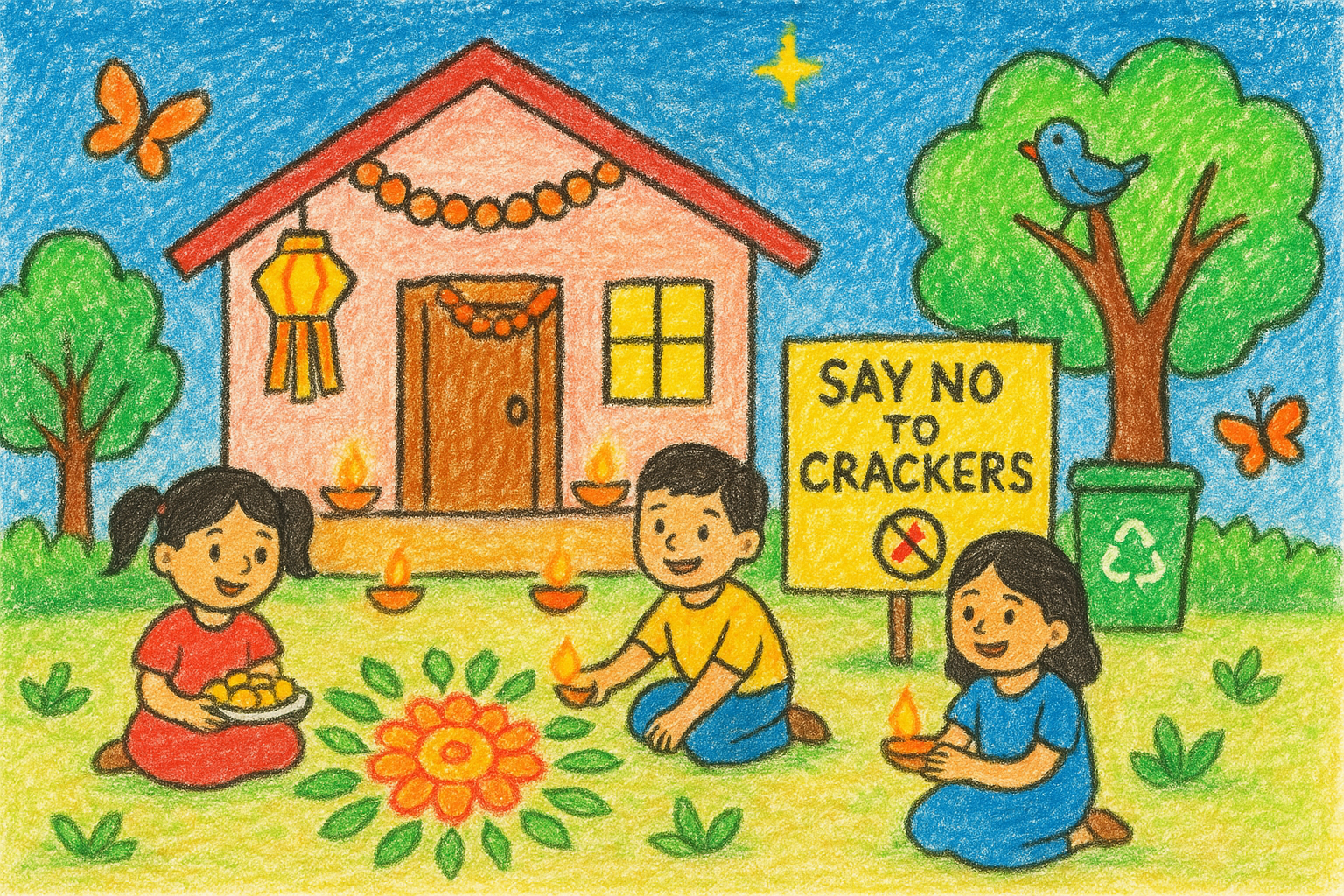
    How to Draw Diwali Scene for Class 1 Eco Friendly

    Best Diwali Drawing with Oil Lamps (Diyas)

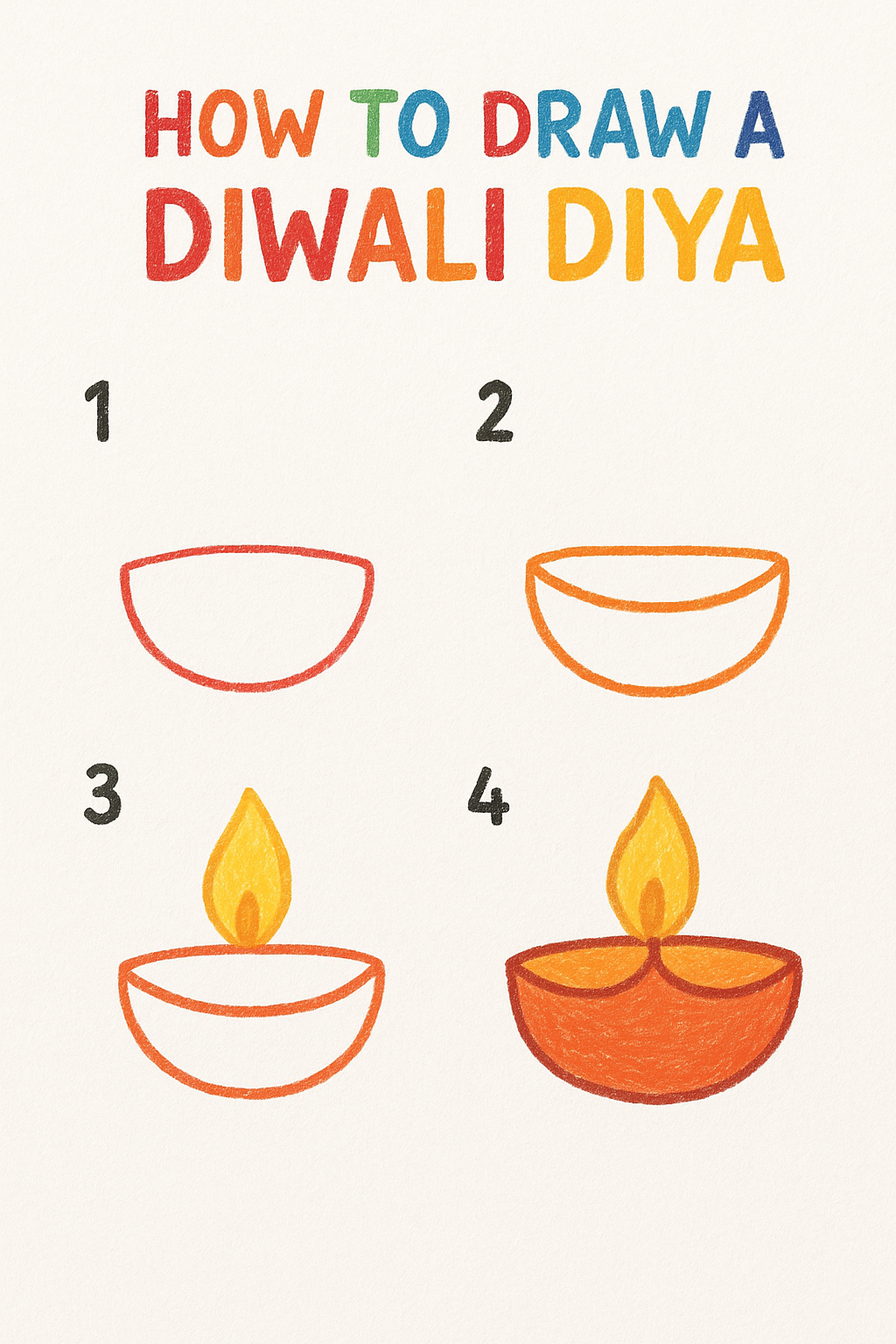
    How to Draw Diwali Diya for Small Kids

    10 lines on Diwali in English for Class 1

    1. My name is Aarav and I love celebrating Diwali.
    2. Diwali is my favorite festival of lights.
    3. I help my parents during diwali festival and decorate our home.
    4. We light many diyas and make our house bright.
    5. I wear new clothes and feel very happy.
    6. My mother makes sweet laddoos and kheer for us.
    7. I draw a small rangoli with colorful powders.
    8. I watch beautiful fireworks at night in the sky.
    9. I exchange candies and compliments with friends and neighbors.
    10. I like Diwali as it leaves everyone happy and full of light.
  • Toughest and Easiest Chapters in CBSE Class 12 Biology

    Toughest and Easiest Chapters in CBSE Class 12 Biology

    Class 12 Biology is one of the most important subjects for students preparing for CBSE board exams and competitive exams like NEET. It not only decides your final score but also builds the base for future studies in medicine, pharmacy, biotechnology, and other life science fields. With 16 chapters in the syllabus, Biology Class 12 covers a wide range of topics—from human reproduction to genetics, evolution, biotechnology, and ecology. While some chapters are easy to understand and scoring, others are considered lengthy, confusing, or tough because they involve complex processes and detailed concepts.

    The toughest chapter in biology class 12 is often reported to be Molecular Basis of Inheritance, because it is lengthy and filled with complex terms like replication, transcription, and translation. Similarly, chapters on Genetics, Human Reproduction, and Evolution are also marked as the most difficult chapters in biology class 12 because they require both memorization and deep understanding. These chapters are also very important for NEET, making them a double challenge for students.

    On the other hand, chapters like Reproductive Health, Human Health and Disease, Ecosystem, and Environmental Issues are usually considered the easiest chapters in class 12 biology. These chapters are short, simple to learn, and often scoring. They also include practical examples that students can easily relate to daily life, making them less stressful. By focusing on these class 12 biology easy chapters, students can secure quick marks and balance the overall preparation.

    Knowing both the toughest chapters in class 12 biology and the easiest chapters in biology class 12 helps students plan their study schedule better. Instead of spending equal time on every chapter, you can spend more time on the most difficult chapters in biology class 12 while revising the easy chapters of class 12 biology for accuracy. This smart strategy makes preparation more efficient and ensures better performance in exams.

    Importance of Class 12 Biology

    Biology Class 12 has 16 chapters divided into 5 units:

    1. Reproduction
    2. Genetics and Evolution
    3. Biology in Human Welfare
    4. Biotechnology
    5. Ecology

    Toughest Chapters in Biology Class 12

    Not all chapters are equally tough, but based on feedback from students and exam trends, here are the most difficult chapters in biology class 12:

    1. Molecular Basis of Inheritance

    • It is very lengthy and full of concepts like DNA replication, transcription, translation, and regulation of gene expression.
    • Students find it hard because of the complex processes and scientific terms.
    • However, it is also the most important chapter of biology class 12 for NEET.

    2. Genetics (Principles of Inheritance and Variation)

    • Includes Mendel’s laws, dihybrid crosses, incomplete dominance, and human genetics.
    • Numerical questions are common, which many students find confusing.

    3. Evolution

    • Students struggle with Darwin’s theory, Hardy-Weinberg principle, and evidence of evolution.

    4. Human Reproduction

    • Fertilization, implantation, and hormonal control add complexity.

    5. Biotechnology: Principles and Processes

    • Topics like recombinant DNA technology, PCR, and cloning need extra attention.

    Hardest Chapters in Class 12 Biology

    Chapter Name Why It Is Tough
    Molecular Basis of Inheritance Long, complex processes, difficult terminology
    Principles of Inheritance and Variation Genetic crosses, calculations, abstract rules
    Evolution Abstract concepts, theories, Hardy-Weinberg principle
    Human Reproduction Detailed anatomy, hormones, reproductive events
    Biotechnology: Principles & Processes Technical terms, experiments, biotechnology processes

    Easiest Chapters in Biology Class 12

    Some chapters are short, simple, and easy to remember. These are the easy chapters in biology class 12 that help boost marks quickly.

    1. Reproductive Health

    • Very short and easy to understand.
    • Covers simple topics like contraception, STDs, and population control.

    2. Human Health and Disease

    • Simple topics like common diseases, immunity, and vaccines.
    • Students can easily score full marks here.

    3. Biotechnology and Its Applications

    • Topics like genetically modified organisms, gene therapy, and applications are straightforward.

    4. Ecosystem

    • Simple flow of energy, pyramids, and nutrient cycles make it student-friendly.

    5. Environmental Issues

    • A very short and scoring chapter.
    • Falls under easy chapters of class 12 biology, with topics like pollution, waste management, and ozone depletion.

    Easy Chapters in Class 12 Biology

    Chapter Name Why It Is Easy
    Reproductive Health Short, simple topics, easy to memorize
    Human Health and Disease Common diseases, straightforward immunity concepts
    Biotechnology & Its Applications Simple applications, easy examples
    Ecosystem Flow of energy, food chains, pyramids are easy
    Environmental Issues Small chapter, scoring, simple environmental terms

    Most Important Chapters of Biology Class 12

    Apart from the hardest and easiest chapters of class 12 biology, some chapters are very important for board exams and NEET. These include:

    • Molecular Basis of Inheritance
    • Principles of Inheritance and Variation
    • Human Reproduction
    • Biotechnology: Principles and Processes
    • Human Health and Disease

    Strategy to Tackle Toughest and Easiest Chapters

    1. For the Toughest Chapters:
      • Break them into small parts.
      • Make flowcharts for processes.
      • Practice diagrams.
    2. For the Easiest Chapters:
      • Revise quickly before exams.
      • Write short notes for last-minute revision.
      • Use them to balance your marks.
  • Easy to Most Difficult Subjects in CBSE Class 7

    Class 7 is the foundation for higher studies, and it is important to know which subjects need more focus. Building strong concepts at this stage will help students improve reasoning and calculation skills from the beginning. This logical approach not only supports learning in higher classes but also proves useful in competitive exams.

    Therefore, understanding the subjects from easiest to most challenging in CBSE Class 7 becomes essential. In this blog, we will discuss the easy to most challenging subjects along with some good tips to score better marks in the CBSE board Class 7 exams

    CBSE Class 7 Subjects and Difficulty Level Guide

    Level Subject(s) Description
    Easy to Moderate Social Science Includes History, Geography, and Civics. The narrative style, maps, and real-life examples make it relatively easier for students to understand.
    Easy English Focuses on grammar, literature, and comprehension. Since students have been learning English from earlier grades, it becomes easier to manage.
    Moderate Hindi Similar to English but with more complex grammar, writing formats, and literature. Some students may find vocabulary a bit challenging.
    Difficult Mathematics Covers algebra, geometry, and fractions. Requires logical thinking and regular practice to grasp problem-solving techniques.
    Moderate Science Divided into Physics, Chemistry, and Biology. Involves experiments, diagrams, and numerical applications, which need clear conceptual understanding.
    Most Difficult Sanskrit Considered toughest due to difficult grammar rules, sentence formation, and extensive memorization of shlokas and vocabulary. Consistent revision is needed.

    CBSE Class 7 Subjects List for Students

    In CBSE Class 7, students usually study around 6 main subjects

    • English
    • Hindi
    • Mathematics
    • Science
    • Social Science (History, Civics, Geography)
    • Third language (like Sanskrit or regional language).

    Along with these, there are also subjects like Computer, Art, and Physical Education which add to overall learning. It is important for students to understand the topics of easiest to most difficult subjects. For example, some students may find English and Social Science subject easier as they involve stories and facts, while Maths and Science can feel more difficult because they need practice and logical thinking. Realizing what topic is not hard and what requires extra work, students will be able to organize their time more effectively, have certain confidence, and balance their preparation. In this manner, the process of learning is less emphasizing and more fun.

    Also Read: CBSE Class 7 English Grammar Narration

    Don’t Miss: NCERT Solutions for Class 7 All Subjects (2025-26)

    S.No. Subject
    1 NCERT Solutions for Class 7 Maths
    2 NCERT Solutions for Class 7 Science
    3 NCERT Solutions for Class 7 Social Science
    4 NCERT Solutions for Class 7 English
    5 NCERT Solutions for Class 7 Hindi
    5 NCERT Solutions for Class 7 Sanskrit

    Easy to Most Difficult Subjects in CBSE Class 7

    CBSE Class 7 English (Easiest) Subject

    • In Class 7, English includes grammar, comprehension, writing skills, prose, and poetry.
    • English subject is considered easy because it include stories and poems that are interesting and simple to read.
    • Grammar rules improve language skills and help in other subjects too.
    • It feels more like fun learning than memorizing facts.
    • That’s why English is the easiest subject to study.

    CBSE Class 7 Hindi Subject

    • Hindi covers vyakaran (grammar), gadya, padya, and different writing sections.
    • Hindi is close to our daily language and culture.
    • Stories and poems in Hindi are inspiring and enjoyable.
    • Sometimes grammar rules need focus, but with practice, they are manageable.
    • So Hindi is also among the moderate subjects.

    CBSE Class 7 Social Science Subject

    • Social Science includes history, civics, and geography in Class 7.
    • Students find history stories quite interesting to read but remembering all dates and events can be a little tough.
    • Civics teaches about democracy, rights, and responsibilities in society.
    • Geography is fun because students learn about earth, maps, and resources.
    • It feels moderate not too easy, not too difficult.

    Also Read: Top 10 Must Know Diagrams for Class 7 Science

    CBSE Class 7 Computer Science Subject

    • Computer Science includes basics of computers, MS Office, internet, and simple programming.
    • Students like this subject because it is practical and connected with modern life.
    • Using computers and learning about the internet feels useful for the future.
    • Sometimes programming or technical words are confusing.
    • Overall, it is an enjoyable subject but needs attention.

    CBSE Class 7 Science Subject

    • Science in Class 7 has physics, chemistry, and biology topics.
    • Students find difficult in doing experiments and remembering definitions and diagrams can be hard.
    • Physics topics like light and motion need clear understanding.
    • Chemistry has reactions that are sometimes confusing.
    • That’s why Science is a bit difficult, but very exciting.

    Also Read: Water Cycle Diagram for Class 7​

    CBSE Class 7 Mathematics (Moderate) Subject

    • Mathematics includes integers, algebra, fractions, decimals, geometry, and equations.
    • Many Students find Maths subject the most difficult because it needs daily practice.
    • But if one become master in doing calculations then getting full marks in Maths becomes easy
    • But sometimes one small mistake in calculation can make the answer wrong.
    • It also has many formulas that students must remember.
    • Still, solving sums correctly gives a lot of confidence.
    • So overall this subject is Difficult for students

    Also Read: Essay Topics Ideas for Class 7

    CBSE Class 7 Sanskrit (Toughest) Subject

    • Sanskrit has grammar, shlokas, translation, and literature chapters.
    • Students find it the toughest subject because it is not used in daily life.
    • The grammar rules are complex and need a lot of memorization.
    • Learning shlokas with proper pronunciation takes extra effort.
    • Though tough, it helps to understand the roots of many Indian languages.

    How to Score Good Marks in Class 7?

    Scoring good marks in Class 7 is not about spending hours with books but about smart strategies. Here’s how students, approach it:

    • Study in Small Blocks – Instead of long hours, students usually study in 30–40 minute slots that keeps them fresh and focused.
    • Make Your Own Notes – Writing key points in your own words helps to remember better during exams.
    • Solve Previous Exercises – Don’t wait for exams; keep practicing NCERT questions and extra exercises regularly.
    • Discuss with Friends – Group study helps to clear doubts and also makes boring topics more fun.
    • Revise Before Sleep – A quick 10-minute revision at night fixes topics in memory one can try this.

    These small steps feel more powerful than just reading the textbook again and again.

    Also Check: 

    S. No. CBSE Class 7 Syllabus 2025-26
    1 CBSE Class 7 Maths Syllabus
    2 CBSE Class 7 English Syllabus
    3 CBSE Class 7 Hindi Syllabus
    4 CBSE Class 7 Science Syllabus
    5 CBSE Class 7 Social Science Syllabus

    Tips to Master Tough Subjects in CBSE Class 7

    Some subjects like Maths, Science, and Sanskrit feel tricky in Class 7. To make it easy for students we have shared some tips to handle these subjects wisely:

    • Mathematics: Don’t try to memorize formulas blindly. Instead, solve real-life problems like measuring, shopping bills, or shapes around you. This makes Maths practical and easier.
    • Science: In Science, draw colorful diagrams and make flowcharts. Experiments in the lab are like stories, and once you connect them, you will never forget.
    • Sanskrit: Sanskrit is tough so its better to break big shlokas into smaller lines, practice speaking them aloud, and connect grammar rules with Hindi to understand better.
  • CBSE Class 7 English Grammar Narration

    English Grammar is very important for building strong communication skills. One of the key topics we learn is Narration, which helps us change a sentence from direct speech to indirect speech and vice versa. It is very useful because narration improves the way we express ideas in writing as well as in speaking. Practicing CBSE Class 7 English Grammar Narration exercises makes it easier to write answers correctly, avoid grammatical mistakes, and score better marks in exams.

    Narration means telling a story, usually in order. When you create a spooky ghost story and share it by a campfire, that’s narration. It’s like explaining or telling something, often about storytelling.

    English Grammar Class 7 Narration Introduction

    Learn about Narration in Class 7 English Grammar, Narration is about changing direct speech to indirect speech and vice versa. It’s important for CBSE Class 7 English Grammar Narration helps you share messages and stories in different ways. We’ll explain the rules and make it easy for you to use in your writing and speaking. Start this journey to become skilled at using Narration in Class 7 English Grammar!

    Narration is an essential part of English grammar, especially for Class 7 students. It involves the art of reporting what someone has said. Let’s dive into the details of Narration for Class 7.

    What is Narration?

    Reported speech is also referred to as narration, which involves the act of presenting the words of some other person. It can be done in two ways: direct speech and indirect speech. Direct speech is used to reproduce the exact words of the speaker such as; she said, I am happy. A slight variation of the words is observed in indirect speech and quotation marks are not provided as in the case of “She said she was happy.

    Also Read: Easy to Most Difficult Subjects in CBSE Class 7

    Parts of a Narration Sentence

    A narration sentence consists of two main components: the reporting verb and the reported speech.

    Reporting Verb: This verb indicates what the speaker said. Common reporting verbs include ‘said,’ ‘told,’ and ‘asked.’ For instance, in the sentence “He said he was going to the market,” ‘said’ is the reporting verb.
    Reported Speech: This part of the sentence recounts the speaker’s actual words, which can be a statement, a question, or a command. For example, in “She said she was happy,” ‘she was happy’ is the reported speech.

    Reporting Verb

    Reporting verb is essential since it is what defines the type of the reported speech whether the speaker was asking a question, giving a command, or making a statement.

    Example

    He asked if I was coming.” (question)
    “She ordered him to leave.” (command)
    “They said they were tired.” (statement)

    Also Check: Online course for CBSE Class 7

    Reporting Speech

    When converting direct speech to indirect speech, adjustments are made to the reported speech. Common changes include:

    Tense Changes: If the reporting verb is in the past tense, the tense of the reported speech is usually changed. For example, “She said, ‘I am happy’” becomes “She said she was happy.”
    Pronoun Changes: Pronouns may need adjustment to fit the context. For example, “He said, ‘I am going’” becomes “He said he was going.”
    Time and Place Changes: Words indicating time and place may require modification. For instance, “She said, ‘I will go tomorrow’” becomes “She said she would go the next day.

    Types of Narration

    Direct Speech

    Direct speech is when we use the exact words spoken by someone, enclosed in quotation marks. It gives the feel of the speaker’s original words being repeated exactly as they were said.

    Rules of Direct Speech

    • Quotation Marks: Use quotation marks to enclose the exact words of the speaker.
    • Comma: Place a comma before the quotation marks if the reporting verb comes before the direct speech.
    • Capitalization: The first letter of the direct speech should be capitalized.
    • Punctuation: The punctuation mark at the end of the direct speech should be inside the quotation marks.

    Example: She said, “I am going to the market.”

    Indirect Speech

    Indirect speech, also known as reported speech, is when we report what someone said without using their exact words. We make some changes to the sentence structure and verb tenses.

    Rules of Indirect Speech

    • No Quotation Marks: Do not use quotation marks for indirect speech.
    • Tense Changes: Change the tense of the verbs in the reported speech to match the tense of the reporting verb.
    • Pronoun Changes: Change the pronouns in the reported speech to match the point of view of the reporter.
    • Time and Place Changes: Adjust words referring to time and place to match the context of the reporting.

    Example: She said she was going to the market.

    Rules of Changing Narration (Direct Speech to Indirect Speech)

    In the direct speech to the indirect speech, there is a set of rules that must be adhered to when transitioning to the indirect speech, particularly the use of pronouns, tenses and time and place.

    In Terms of Pronouns

    First Person Pronouns: Change based on the subject of the reporting verb. For instance, “She said, ‘I am tired’” becomes “She said she was tired.”
    Second Person Pronouns: Change based on the object of the reporting verb. For instance, “He said to me, ‘You are late’” becomes “He told me that I was late.”
    Third Person Pronouns: Generally remain the same. For instance, “They said, ‘She is smart’” becomes “They said she was smart.”

    In Terms of Tenses

    Present Simple to Past Simple: “She says, ‘I eat apples’” becomes “She says she eats apples.”
    Present Continuous to Past Continuous: “He says, ‘I am walking’” becomes “He says he is walking.”
    Present Perfect to Past Perfect: “She says, ‘I have finished’” becomes “She says she has finished.”
    Will to Would: “They say, ‘We will go’” becomes “They say they will go.”

    Note: The tense of the reported speech remains unchanged if the reporting verb is in the present tense or if the reported speech conveys a universal truth or habitual action.

    In Terms of Time and Places

    Now to Then: “She says, ‘I will do it now’” becomes “She says she will do it then.”
    Today to That Day: “He says, ‘I saw her today’” becomes “He says he saw her that day.”
    Tomorrow to The Next Day: “They say, ‘We will meet tomorrow’” becomes “They say they will meet the next day.”
    Here to There: “She says, ‘Come here’” becomes “She says to come there.”

    Direct and Indirect Speech Exercises with Answers

    Direct Speech Exercise with Answer

    1. He said, “I am reading a storybook.”
    2. She said, “I will call you in the evening.”
    3. The teacher said, “Water boils at 100 degrees Celsius.”
    4. They said, “We are playing in the garden.”
    5. He asked, “Do you like ice cream?”

    Answers:

    1. He said that he was reading a storybook.
    2. She said that she would call me in the evening.
    3. The teacher said that water boils at 100 degrees Celsius.
    4. They said that they were playing in the garden.
    5. He asked if I liked ice cream.

    Indirect Speech Exercise 2 (Indirect → Direct)

    Convert the following sentences from indirect to direct speech:

    1. She said that she had lost her pen.
    2. He told me that he was watching a movie.
    3. The doctor said that the patient would recover soon.
    4. They mentioned that they had seen the new teacher.
    5. She asked if I could help her with the homework.

    Answers:

    1. She said, “I have lost my pen.”
    2. He told me, “I am watching a movie.”
    3. The doctor said, “The patient will recover soon.”
    4. They mentioned, “We have seen the new teacher.”
    5. She asked, “Can you help me with the homework?”

    What is the Difference between Direct Speech and Indirect Speech?

    Direct Speech Indirect Speech
    Repeats the exact words spoken Conveys the meaning of the original speech without quoting the exact words
    Enclosed in quotation marks Not enclosed in quotation marks
    Uses the speaker’s exact words Uses reporting verbs and may involve changes in pronouns, tenses, etc.
    Example: She said, “I am happy” Example: She said she was happy

    Other Study Materials for Class 7 English

    Benefits of Learning Narration for Class 7

    Learning narration in English grammar can benefit Class 7 students in several ways:

    • Better Communication Skills: Learning about narration also makes students be able to communicate better through assessing the words of other people well, as well as, through being able to get a point across.
    • Improved Writing Style: Knowing how to write the direct speech indirect speech and vice versa, will enhance their writing skills, and thus their written communication will become more accurate and interesting.
    • Grammar Proficiency: The study of narration makes students understand grammar rules (use of tenses, pronouns and sentence structure) as well as their general knowledge about the grammar of the English language.
    • Improved Understanding: The analysis of direct and indirect speech improves the comprehension level as it helps students analyze and interpret written and oral texts better.
    • Literary Appreciation: Learning various types of narration in literature that include dialogues and reported speech makes students appreciate literature and methods of narrating their stories.
    • Higher Classes Preparation: Narration is the initial strong preparation of the higher classes, where the more complicated grammar principles and literary criticism are involved.
  • CBSE Class 10 Sample Papers 2025-26 Released

    The Central Board of Secondary Education (CBSE) has released the official Sample Question Papers (SQPs) for the Class 10 Board Exams scheduled for 2026. For students preparing for the CBSE board exams, these sample papers are the most crucial resource for understanding the latest question paper format, marking scheme, and the types of questions to expect.

    This article provides direct links to download the CBSE Class 10 Sample Papers 2026 and their official Marking Schemes for all major subjects in PDF format.

    CBSE Class 10 Sample Papers 2025-26: Highlights

    Exam Conducting Body Central Board of Secondary Education (CBSE)
    Class 10
    Academic Year 2025-26
    Exam Year 2026
    Resource Type Sample Question Papers (SQP) & Marking Scheme
    Subjects Available All (Mathematics, Science, Social Science, English, Hindi, etc.)
    File Format PDF

    How to Download the CBSE Class 10 Sample Papers and Marking Scheme

    Follow these simple steps to download the subject-wise papers directly from our page:

    1. Scroll down to the table below.
    2. Find the subject you wish to download the sample paper for.
    3. Click on the “Download PDF” link in the ‘Sample Paper’ column.
    4. Click on the “Download PDF” link in the ‘Marking Scheme’ column to get the official solutions and marking criteria.

    Do Check – Toughest and Easiest Chapters in CBSE Class 10 Science

    Subject-Wise CBSE Class 10 Sample Papers PDF Download 2026

    Here are the direct links to download the subject-wise Sample Question Papers (SQP) and their Marking Schemes (MS) for the CBSE Class 10 Board Exam 2026.

    Download Subject-Wise CBSE Class 10 Sample Papers
    Download CBSE Class 10 Maths Sample Paper
    Download CBSE Class 10 Science Sample Paper
    Download CBSE Class 10 Social Science Sample Paper
    Download CBSE Class 10 English (Lang. & Lit.) Sample Paper
    Download CBSE Class 10 Hindi Sample Paper

    Why Solving CBSE Class 10 Sample Papers is Essential

    Integrating sample papers into your study routine can significantly boost your score. Here’s why they are so important:

    • Understand the Exam Pattern: Get a clear idea of the paper’s structure, section-wise marks distribution, and the number of questions.
    • Know Important Topics: Sample papers often highlight the key concepts and chapters from which questions are most likely to be asked.
    • Improve Time Management: Practicing within the 3-hour time limit helps you strategize on how much time to allocate to each section, improving your speed and accuracy.
    • Assess Your Preparation: Solving these papers acts as a self-assessment tool, helping you identify your strengths and pinpoint weak areas that need more attention.
    • Master the Marking Scheme: The marking scheme provides insight into how answers are graded, including step-wise marking. This helps you write precise, high-scoring answers.

    Do Check – CBSE Class 10 Sample Papers 2025-26 Released

    CBSE Class 10 Exam Pattern 2025-26:

    CBSE has introduced major changes in the Class 10 Board Exam Pattern 2026, focusing more on competency-based learning and flexible assessment.

    Component Details
    Competency-Based Questions 40% weightage (MCQs, case study-based, source-based)
    Objective-Type Questions 20% weightage (short, fact-based)
    Short & Long Answer Questions 40% weightage (descriptive/analytical)
    Theory Exam 80 marks
    Internal Assessment 20 marks (tests, assignments, projects, practicals)
    Two Board Exams Conducted in one academic year (from 2025-26)
    Grading System 9-point grading system introduced

    Do Check – CBSE Class 10 Blueprint 2026

    Marking Scheme for Class 10 CBSE 2025-26 Examination (All Major Subjects)

    Sections Total Number of Questions Marks Per Question Total Marks
    Sec: A 22 (MCQs) 2 (Assertion-Reason) 24 × 1 24
    Sec: B 6 (Very Short Answer Questions) 6 × 2 12
    Sec: C 4 (Short Answer Questions) 4 × 3 12
    Sec: D 4 (Competency-Based Long Answer) 4 × 4 16
    Sec: E 4 (Case Study-Based Questions) 4 × 4 16
    Total 42 Questions 80 Marks


  • Poster Making Class 11

    Poster making is a scoring and creative part of Class 11 CBSE curriculum. Whether it’s for an assignment or an exam, our guide helps you nail the format, choose trending topics, and draw inspiration from real examples. Poster creation serves as an effective method for announcements, appeals, notices, and advertisements, while also raising awareness on public issues. A well-crafted poster must be eye-catching and easy to read from afar.

    This medium is widely utilized by NGOs, political groups, government bodies, and others for various purposes. In a Class 11 setting, students learn the importance of visual appeal and clarity, making poster-making a valuable skill for communicating important messages and information.

    Poster Making Class 11

    In the Class 11 CBSE exams, students encounter poster writing in Section B as a short answer question worth 3 marks. They must keep their responses within a maximum word limit of 50 words. Students can choose between two poster creation topics, allowing them to select and attempt one.

    Poster Making for Class 11 is a fun and creative activity that helps students improve their artistic skills and communication. Students get to express their ideas visually using colors, images, and different fonts. They learn how to arrange these elements to make their message clear and attractive. This activity boosts creativity and teaches critical thinking and problem-solving. By making posters, students also raise awareness about important social, environmental, and educational topics. This makes poster making a well-rounded and valuable learning experience.

    Poster Making Format for Class 11

    Understanding the correct format is crucial for creating an effective poster. Here’s a step-by-step guide to the CBSE format for poster making:

    1. Title/Header: This is the main focus of your poster. It should be bold, catchy, and relevant to the theme.

    2. Tagline/Sub-heading: A brief and impactful statement that supports the title.

    3. Content: The main body should include:

    • Message: Clear and concise information about the topic.
    • Details: Essential details like date, time, venue (for events), or any other necessary information.
    • Visuals: Use images, drawings, or illustrations to make your poster visually appealing.

    4. Contact Information: Provide contact details if the poster is for an event or announcement.

    5. Border and Layout: Ensure your poster has a neat border and an organized layout. Avoid clutter and maintain a balance between text and visuals.

    Poster Making Samples

    Topic: Save Our Oceans

    Sample Question: Create a poster to raise awareness about ocean pollution. Your poster should:

    1. Include a catchy slogan that encourages people to take action to protect the oceans.
    2. Feature an eye-catching illustration or graphic related to ocean conservation (e.g., sea animals, marine debris, etc.).
    3. Add a brief, informative message explaining why ocean pollution is a serious issue and how individuals can help.
    4. Include at least one action step that people can take to make a difference (e.g., reducing plastic use, participating in beach clean-ups, etc.).
    5. Use clear and persuasive language to motivate viewers to get involved.
    6. Title: Protect Our Oceans – Act Now!

      Illustration: [Image of a clean ocean with marine life and a contrasting polluted ocean with plastic waste]

      Message: “Our oceans are in danger! Plastic waste and pollution are harming marine life and ecosystems. You can make a difference by reducing plastic use, recycling, and supporting ocean conservation efforts.”

      Action Step: “Join a local beach clean-up or switch to reusable products to reduce ocean pollution.”

      Poster Making Class 11 Topics

      • Impact of Renewable Energy on the Environment
      • Promoting Mental Health Awareness in Schools
      • The Benefits of Sustainable Living Practices
      • Exploring the Wonders of Space Exploration
      • The Importance of Preserving Marine Ecosystems
      • Advocating for Fair Trade and Ethical Consumerism
      • Understanding Climate Change: Causes and Solutions
      • Celebrating Diversity: The Power of Cultural Exchange
      • The Role of Technology in Modern Education

      Also Check: Classified Advertisement for Class 11

      Sample Questions on Poster Writing Class 11 – Examples

      Q1. Design a poster that warns against the consumption of alcoholic beverages by showcasing the risks associated with alcohol use. Your design should align with the theme given to you.

      Q2 . As the Secretary of the Janshakti Legal Help Unit, create a poster for display outside the office to raise awareness about and invite community members to the upcoming legal awareness camp hosted by the unit. Be sure to include all relevant event details.

      Q3. The Tourism Department of the Government of Uttaranchal has introduced an exciting initiative to promote adventure sports and eco-tourism in the state. Design an engaging poster for display at key public locations or for publication in newspapers to highlight this new development.

      Q4. Create a poster emphasizing the significance of celebrating a cracker-free Diwali.

      5 Things to Avoid While Making a Poster Design for Class 11

      1. Overcrowding with Text and Images

      Why: A cluttered poster can be overwhelming and make key information hard to find.
      Unique Tip: Focus on a clean design by using space effectively and prioritizing essential content for clarity.

      2. Ignoring Readability and Font Choice

      Why: Difficult-to-read fonts can diminish the impact of your message.
      Unique Tip: Select fonts that are easy to read from a distance and maintain visual harmony with the overall design.

      3. Using Low-Resolution Graphics

      Why: Blurry images can give a poor impression and distract from your message.
      Unique Tip: Always use high-resolution images to ensure a sharp, professional appearance.

      4. Choosing Clashing Colors

      Why: Poor color choices can make text hard to read and disrupt the visual flow.
      Unique Tip: Opt for a color scheme that enhances readability and aligns with the poster’s theme and purpose.

      5. Neglecting the Target Audience

      Why: A design that doesn’t cater to the audience’s preferences will be less effective.
      Unique Tip: Design with the audience’s interests and needs in mind to create a more engaging and relevant poster.

  • Classified Advertisement Class 11 Format

    In Class 11 English, one important writing skill students need to learn is advertisement writing. The classified advertisement Class 11 topic is a scoring part of the syllabus and helps students improve their writing skills. A classified advertisement is a short ad that gives clear and brief information. It is printed in newspapers and magazines in specific columns. These advertisements are grouped under categories like jobs, property, lost and found, matrimonial, education, and more. That is why students also need to know the different types of advertisement Class 11.

    The advertisement Class 11 CBSE English syllabus teaches students how to write these short and useful ads. Whether someone is looking for a job, wants to sell something, or has lost something important, classified ads are very helpful. Students are taught the proper format of these ads and how to present all important details in just 50 words. This skill is not only useful for exams but also in real life.

    The best part about learning advertisement writing Class 11 is that it is simple and interesting. It helps students learn how to communicate clearly and effectively. They learn how to use short phrases, avoid unnecessary words, and still share the message correctly. This is why writing a classified advertisement Class 11 is a good practice for improving writing skills.

    There are different types of advertisement Class 11, and each one has its own purpose and format. For example, a “situation vacant” ad is written by a company to hire someone, while a “situation wanted” ad is written by a person who is looking for a job. Similarly, there are ads for selling property, renting a house, finding a lost item, or seeking a marriage proposal. Understanding these different types of advertisement Class 11 helps students know what information to include and how to present it.

    In this article, we will explain everything students need to know about classified advertisement Class 11. We will share the correct format, give useful tips, and provide many sample ads for different situations. We will also discuss the types of advertisement Class 11 in detail. This guide will help students write better in their exams and understand the value of short and clear communication. So, let’s begin learning the art of advertisement writing Class 11 step by step.

    What is Classified Advertisement Writing?

    A classified advertisement is a small ad placed in a newspaper or magazine, typically used to buy or sell items, find or offer jobs, or rent out or seek a house. Matrimonial alliances are also commonly advertised through classifieds. These ads aim to communicate with a specific audience, encouraging them to take actions such as purchasing products, using services, or supporting causes. Classified advertisements are crafted to be engaging and persuasive, effectively marketing the product or service and motivating the audience to respond.

    Types of Advertisement Class 11

    Advertisements come in various types, each serving a specific purpose to address different needs. Whether it’s connecting job seekers with employers, selling goods and property, or finding suitable tenants and accommodations, advertisements are a crucial tool for communication. Below are brief descriptions of common types of advertisements:

    Type of Advertisement Purpose
    Situation Vacant Written by an employer seeking to hire someone for a position in their organization.
    Situation Wanted Written by a job-seeker looking for employment opportunities.
    For Sale Written to sell property, assets, office goods, and other items.
    To Let Written by a property owner looking for tenants.
    Accommodation Wanted Written by individuals seeking a place to live.
    Matrimonials Written to find prospective marriage partners.
    Missing Written to provide details about lost items, persons, or pets.

    Also Check: Diary Entry

    Importance of Classified Advertisement in Class 11

    The topic classified advertisement Class 11 is important because:

    • It improves your formal writing skills.
    • It helps you learn to write concisely.
    • It is frequently asked in CBSE Class 11 exams.
    • Students must understand the advertisement Class 11 structure and purpose well to score good marks.

    Format For Classified Advertisement

    The classified advertisement Class 11 format is simple and follows some basic rules:

    Element Details
    Heading Write the category name in CAPITAL letters
    Content Give all important information in short and clear sentences
    Word Limit Around 50 words
    Contact Details Include phone number, address, or email
    Box Always write inside a box in exams

    Note: Don’t use full sentences. Use phrases. Avoid unnecessary words.

    Classified Advertisement Class 11 Extra Question and Answers

    Q1. You are Meera/Manoj. Draft a classified advertisement in not more than 50 words to be published in The National Herald for renting out your 2-bedroom apartment in Bangalore. Include essential details and your contact number: 9876563210.

    Apartment for Rent
    Available: 2-bedroom apartment in Koramangala, Bangalore. Fully furnished, close to major amenities, with parking space and 24/7 security. Rent: ₹25,000 per month. Contact Meera/Manoj at 9876563210 for further details or to schedule a viewing.

    Q2. You are Rakesh/Rita. Write a classified advertisement in about 50 words for a local newspaper to sell your old laptop. Provide necessary details and your contact number: 9876563211.

    Laptop for Sale
    Selling: HP Pavilion laptop, 8GB RAM, 1TB HDD, Intel i5 processor, 15.6″ screen. Lightly used, in excellent condition, includes original charger and bag. Price: ₹25,000 (negotiable). Contact Rakesh/Rita at 9876563211 for inquiries or purchase.

    Q3. You are Seema/Suresh, and you want to advertise your tuition classes for Class 11 students in Pune. Write a 50-word classified advertisement for the local newspaper. Include details of subjects, timings, and contact information.

    Tuition Classes
    Offering: Tuition for Class 11 students in Physics, Chemistry, and Mathematics. Experienced tutor, small batches, personalized attention. Classes from 5 PM to 7 PM, Monday to Friday. Location: Shivaji Nagar, Pune. Contact Seema/Suresh at 9876543212 for enrollment and details.

    Q4. You are Anjali/Arjun, and you have a fully equipped bakery for sale in Jaipur. Write a classified advertisement in not more than 50 words for a business magazine. Provide key details and contact information.

    Bakery for Sale
    For Sale: Fully equipped bakery in Jaipur. Prime location, established clientele, includes all machinery and inventory. Profitable business with a loyal customer base. Serious buyers, contact Anjali/Arjun at 9876543213 for more information and pricing.

    Situation Vacant Advertisement Class 11 Questions

    Q1. You are the placement coordinator of your school. Draft a ‘Situation Vacant’ advertisement on behalf of a reputed IT company looking for interns. Include essential details such as qualifications required, job responsibilities, and how interested candidates should apply.

    Situation Vacant
    Reputed IT Company Looking for Interns

    A leading IT firm is seeking enthusiastic interns to join our dynamic team. Candidates must be Class 11 students with a strong interest in technology and excellent problem-solving skills. Responsibilities include assisting in software testing, data analysis, and basic coding tasks. This internship offers valuable industry experience and mentorship opportunities. Interested candidates should email their resumes to hr@itcompany.com by [deadline]. Don’t miss this chance to kickstart your career in IT.

    Q2. Imagine you are starting a new tutoring service for Class 11 students. Write a ‘Situation Vacant’ advertisement to attract qualified tutors. Specify the subjects they will teach, required qualifications, and how interested candidates can apply.

    Situation Vacant
    New Tutoring Service Seeks Qualified Tutors

    A newly established tutoring service is looking for dedicated tutors to join our team. We are particularly seeking tutors for Class 11 students in subjects such as Mathematics, Physics, Chemistry, and English. Ideal candidates should possess a minimum of a Bachelor’s degree in their respective subjects and have prior tutoring experience. Responsibilities include conducting personalized sessions, tracking student progress, and providing constructive feedback. If you are passionate about education and committed to student success, please submit your CV along with a cover letter to info@tutoringservice.com by [deadline].

    Classified Advertisement Class 11 Examples English Writing skills

    Q1. The Principal of Sunrise Global School in Agra is looking for a qualified receptionist. Write a 50-word advertisement for the classified section of a national newspaper. Include essential details about the required qualifications and experience.

    Receptionist Wanted
    Sunrise Global School, Agra, seeks a qualified receptionist. Candidates should have a high school diploma, excellent communication skills, and a minimum of 2 years of experience in a similar role. Proficiency in MS Office and multitasking abilities are essential. Interested applicants, please send your resume to principal@sunriseglobalschool.edu.in.

    Q2. You are Ram/Rajani. Create a 50-word classified advertisement for India Times to sell a used motor car. Provide all necessary details and include your contact number: 12345679.

    For Sale: Used Motor Car
    Available: Well-maintained used motor car in excellent condition. Make: Maruti Suzuki Swift, Year: 2015, Mileage: 45,000 km, Color: White. Single owner, regularly serviced. Price: ₹3,50,000 (negotiable). Contact Ram/Rajani at 12345679 for more details or to schedule a test drive.

    Q3. You are the principal of Green Valley High School, Delhi, and you need to hire a librarian. Draft a classified advertisement in about 50 words for a national newspaper. Include details of the qualifications and experience required.

    Librarian Required
    Green Valley High School, Delhi, seeks a qualified librarian. Applicants must have a Bachelor’s in Library Science, at least 3 years of experience, and strong organizational skills. Proficiency in digital cataloging is preferred. Interested candidates, please email your resume to principal@gvhsdelhi.edu.in by July 30th.

    5 Easy Tips for Writing a Classified Advertisement in Class 11 English Writing Skills

    Here are five simple and easy-to-read pointers for writing a classified advertisement for Class 11 English Writing Skills paper:

    • Clear Headline: Begin with a clear and catchy headline that summarizes the purpose of your advertisement, like “Job Opportunity: Receptionist Needed” or “Car for Sale: Maruti Swift 2015”.
    • Key Details: Include essential information such as what you are offering (job, product, service), important features (location, price, qualifications), and contact details (phone number or email).
    • Concise Language: Use simple and direct language to convey your message within the word limit (typically around 50 words). Avoid unnecessary details and jargon.
    • Organized Format: Structure your advertisement with clear sections for title, details, and contact information. This helps readers quickly find the information they need.
    • Call to Action: End with a strong call to action, encouraging readers to take the next step, such as “Apply now!” or “Contact for more information.

    Common Mistakes to Avoid in Advertisement Writing Class 11

    When writing advertisement Class 11, avoid these errors:

    1. Writing long sentences
    2. Including unnecessary personal details
    3. Using informal language
    4. Forgetting to draw a box
    5. Ignoring the word limit

    Conclusion

    The classified advertisement Class 11 topic is easy but needs practice. Focus on the correct format, short phrases, and clear information. Knowing all types of advertisement Class 11 and using them correctly in writing will help you score full marks. Whether you are writing a situation vacant, lost and found, or matrimonial ad, follow the correct structure and stay within the word limit. Practicing more will make your advertisement writing Class 11 skills strong and exam-ready.